"Jeff Withey shouldn't have called him Peter Dinklage, is all I'm saying."
Upon Further Review: The FAQ
Basics for people who don't know what the hell I'm talking about, buddy, when I do UFRs. Endeavoring to have this heavily linked in them for future usefulness.
What's a "technique"? What's a one-tech, three-tech? What the hell are you talking about, buddy?
"Techniques" refer to where defensive linemen line up relative to the offensive line. As with all good indexing systems, it starts with zero, which is head-up over the center, and increases the farther you get away from the center. Helpful diagram:
In Michigan's current 4-3 under there are 1 and 3 technique defensive tackles on opposite sides of the center, and then Michigan aligns its DEs differently based on the formation of the opponent.
Basically: 1-tech = 4-3 nose tackle, 3-tech = 4-3 defensive tackle, 0-tech = 3-4 style 350 pound space eater nose tackle.
What's the difference between strongside, weakside, playside, and backside?
Strongside and weakside are pretty self-explanatory: if there's a tight end (or two) in the game or an offset H-back/fullback, the side with more players on it is the strongside and the other side is the weakside.
Here, the strongside is to the top of the screen as that's where Kevin Koger is aligned. Some formations don't have a strong or weak side.
Playside is basically the direction the play is run in, and is important on stretch plays mostly. If the offense is running to the right, the right is the playside and the left is the backside. These terms usually get mentioned in the following ways:
- The "backside" defensive end is the player who doesn't get blocked by the defense and is instead read by the quarterback.
- I'll often refer to a good block by an interior lineman, usually the center, as sealing a guy "lined up playside of him". What this means is that the defender lined up outside of the OL—closer to the area where the running back will attempt to cut the ball up—and still sealed him away.
- Other blocks will be described as an OL "getting playside" or failing to do the same, which basically means the OL gets between the DL and his attempt to flow down the line of scrimmage and tackle as the back cuts up.
What is cover one, two, three, zero?
Cover X describes how many players are playing in a deep zone. Here's a look at a conservative cover three out of the 3-3-5 stack:
And here's a cover two out of a 4-3:
Higher X means a more conservative pass defense and more holes open underneath as more defenders are dedicated to the deep area of the field. Note that cover two usually has two deep safeties on the hashes and cover 1 or 3 usually makes do with one, using the other safety in a shorter zone or as a run defender or blitzer.
There's also a variation of cover three called "quarter-quarter-halves" where there are three deep defenders but one is tasked with half the field and the other two split the other half. This is usually a response to formations with lots of receivers on one side of the field.
What's this route you named?
- Flare: running back originally lined up in the backfield runs mostly parallel to the LOS and receives a pass behind said LOS.
- Flat: usually a slot receiver or TE but can also be a fullback or RB. Basically a really short out route that attempts to exploit cover three, which usually doesn't have defenders out there. Example.
- Out: player runs some distance downfield and then takes a hard 90 degree cut to the sideline.
- In: player runs some distance downfield and takes a hard 90 degree cut to the middle of the field.
- Drag: TE or slot receiver drags across the field maybe a yard to three downfield. Usually a checkdown that comes open late if it does at all.
- Slant: Outside WR runs diagonally up the field into an area that should be good against either man or zone coverage. Usually a short route good for 6-8 yards.
- Fly: also "go": receiver runs as fast as he can straight down the field.
- Seam: basically a fly route run by an interior receiver. Called a seam because usually there are deep middle safeties and the quarterback has to find the seam in the zone between the linebackers and said safeties.
- Post: variant of fly where after 10-20 yards, depending on the coverage, the receiver breaks his go route to the inside at a 30-45 degree angle.
- Corner: A post that breaks to the outside, usually run by slots or tight ends.
- Circle: route with an inside feint on which the receiver comes to a stop and then breaks to an out. This usually results in something of a circular path. Michigan won the Notre Dame game with one. Example.
- Wheel. Running back hauls ass out of the backfield, running what looks at first like a flare route before turning it up as he nears the sideline to attack areas a wide receiver has already dragged through to clear out a zone. Example.
- Bubble screen. Slot receiver runs parallel to the line of scrimmage in an effort to get behind the block of the outside receiver and spring downfield for 6-10 yards.
Comment or email for expansions.
I felt that circle routes were the routes mostly run by running backs/full backs in which he heads out diagonally towards the side he's lined up on and then snaps back and heads the other way, making a kinda oval shape to the route.
Matthews, to me, ran an out route but sold it with a jab step inside as if he were running an in route. Since the DB on him had inside position, the jab step made him commit to jumping that route, leaving the out route wide open. I think that the wheel route is a little more "smoother" - without the sudden cut that Matthews' did.
I could be wrong.
Jokenjin
I came to the comments to make the same point. No, I am almost certain you are right. A "circle" route is generally run by someone in the backfield where they circle around to the middle of the field in space that was occupied by a linebacker and sort of sit down there.
As for the Matthews play, I actually think it was a slant-and-out. When a guy (especially on the goal line) is playing you for the slant/you think/the coaches think he is doing so, you take a step or two up, two or three steps on a hard slant route, stop, pivot, and open your hips toward the quarterback (depending on the offense- some coaches teach to open your hips the other way b/c you can get outside faster that way, but aren't immediately ready to catch the ball, as in, the qb probably has to wait for you to make your cut to throw it) and head out. This is a variant of what we called a "7 route" when I was playing, which was a slant for a few steps, followed by a hard cut, and a change of direction to the outside and at an angle away from the quarterback. The interior angle on the "slant and out" that I believe Matthews was running, if you drew it on a piece of paper and measure the angle between the pre-pivot part of the route (the "slant") and the post-pivot part of the route (the "out"), would be approximately 45 degrees, whereas the "7 route" is more of a 90 degree angle. Both are very effective against man coverage, usually when you've completed some slants already. Further, the "7 route" against man with 2 deep safeties or cover 2 with two deep safeties can be good if you have a guy running a seam down the middle, as it forces the safety on that side to pick either the middle seam route or the "7 route" because it's very difficult to cover both. And if it's run against man with one safety over the top, it's very effective because it's a very difficult route for the corner to cover man-to-man, if the qb has time, and assuming the wr isn't being given a 10 yard cusion so he can break the cb's cushion by the time he has either made his hard cut to the outside or a step or so afterward.
I are not as dumb anymore!
"Fear. Columbus is rank with it. Let us ease their pain."
I'm going to start sounding really smart watching these games now.
Brian, how dare you release this information to the general public? The inner-workings of football are secret! Or so it would seem, you'd think color analysts, especially former players, might bring some of their football knowledge to the broadcast instead of pointing out things that even the casual observer can see.
Seriously. I don't know how someone who is not a former player or coach even learns this stuff. At least I didn't before Mgoblog.
Got a quarter?
You either have to have played, coached, or play a shitload of NCAA video games and/or Madden. Or read books.
Fantastic post! For those of us that never actually played, for whatever reason, this really helps us know what to look for.
"This is the EMU game, not the emo game."
I feel like I know a lot about football, especially its history. But, man, it seems like every week I learn a new football term between your UFRs, Smart Football and other wonky writers.
This will be helpful to most of us here.
Help My Friend Allison Fight ALS
MSU/IU at the JCB
another note re: strong side/weak side. you will hear the weakside linebacker (w for weakside) referred to as Will, the strong side linebacker (S for strong) referred to as Sam, and the middle linebacker (M for middle) referred to as Mike.
also, on WR routes, a fade is a route about 45 degrees to the line of scrimmage, toward the sideline (often the back of the endzone) in which the QB attempts to loft the ball over the CB's head and between the WR and the sideline, often resulting in an over the shoulder catch. see Floyd, Michael.
For clarification's sake, wheel routes are not exclusive to running backs. Inside receivers (slots, tight ends, whoever) can run them as well.
Given our weak corner basically sucks, and Warren is the man, why not run cover 2 man with Warren and then roll coverage to the 1/2 side of the weak corner, and then blitz the free safety when we want or play him back?
Thanks to this post, I now understand what that question means!
GERG likes him some single deep safety packages. but also, you need adept safeties to play cover 2 and Kovacs is not it. neither, i'd guess, is Williams. otherwise they'd be in coverage more.
...the Canadians make up for it with their emotion and classic ice-dancing skill.
.....you've created a cover 3 (if I'm "hearing" you correctly). In cover 3, BOTH corners have deep 1/3s.....and that's exactly what we don't want with our w.s. corner.
If you want to leave Warren in man-to-man, and zone the other side, fine. But the strong side "under" routes and flats are gonna be wide open............I think.
"the Spirit of Michigan...is based on a deathless loyalty to Michigan and all her ways....and a conviction that nowhere is there a better university, in any way, than this Michigan of ours" - Fielding Yost
Wow nice, Thanks alot Brian. Can you post this under the "Useful Stuff" tab for our future reference? I'm nowhere near the stage where I can remember all this stuff and recognize it in-game.
That tab's a good place for this. Though I've picked a lot of this stuff up here over the years (years?!) that I didn't know before, sometimes I was just guessing based on context ("backside" for example, was uncertain despite "playside" being obvious, I thought it was the opposite of some other, yet-to-be-discovered side). Congregating it all like this is wonderful for reference or first timers. Great post.
The worst guest-picker in the history of the Michigan Daily.
most do not use the straight numbering system like you describe. wing-t, and double wing schools do a lot, but most use the ole 50 front tech lingo...
"shade" is shaded nose... or a 1 tech, but i never use the term 1
2i is inside of guard, 2 head up, 3 outside
4i inside of tackle, 4 head up, 5 outside
7 inside of the te 6 head up 9 outside
also, just so you knwo where the terms come from,
post, vertical 10 12, then cut off, aiming for the near goal post (think the old two post goal posts) not to cross midfield..
Flag route is the opposite of a post (aiming point is the deepest pylon) it is a cut which means the reciever is getting the ball over his outside shoulder (different then fade routes to the back pylon)
and Drag route (or square in) consists of post broken off to a deep drag, great compliment to a post...
the fade route, is a go route ran by the outside recievers, to the outside, looking over their inside shoulder....
also strong side weak side... the progression of strong side ususally goes like this...
1. te, if there is a te in the game, he is the strong side, regardless of how many other recievers are there.. (you can still shade coverage to most recievers while still decalring the strength to the te)
2. most receivers, if no te, or even te's, the most receivers beomes the strong side
3. backs, if te's are even, recievers are even, then you go to the backfield for near or far offsets, etc.
4. wide side of the field...
i think i have an older post Brian, where i diagram a lot of this stuff. espically the routes, i think it was one of my first posts over at three and out... if i left it up there..
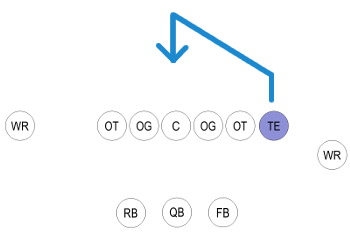
What's this route called?

I'm guessing that's a "curl" as shown in the Cover 3 image? So then this route:
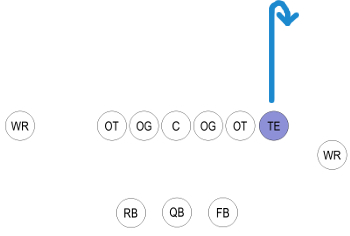
is a "hook"?
(Blogger alias: "Misopogon") This team is under construction. We thank you for your patience.
see images or vids at school, but a curl route is a longer developing route, which looks like a deep route, with the reciever curling to the insdie, then working back down field....
a hook on the other hand is a short, quick cut back to the ball, 3 step or quick pass set...
The first route is a Post route that is cut short because the backside safety "sat" on the route. It's a read by the QB and TE. Probably every coach has his own terminology and passing tree, but that's what we call it.
The second route (in our system) is a Stake. Stake is a 2-line stop-route with the WR turning OUTSIDE. A Dig is a similar 2-line route but the WR turns INSIDE.
By 2-line, I mean the WR runs to the second line on the field in front of him. If the first line is less than 2 steps from where he lines up in the formation, it is disregarded, and the next two lines are only considered.
Also, my OCD overwhelms me to note that the technique chart is wrong. EVEN numbers are HEAD UP (0 over the C, 2 over the G, 4 over T,....etc).
In our system (and I know it varies from coach to coach):
1 is inside shoulder of G/3 is outside shoulder
4i is inside shoulder of T/5 is outside
7 is inside shoulder of TE/ 9 is outside shoulder---that's Bear Bryant's numbering system.
"the Spirit of Michigan...is based on a deathless loyalty to Michigan and all her ways....and a conviction that nowhere is there a better university, in any way, than this Michigan of ours" - Fielding Yost
Showing the difference between 4-3, under, and over might be a good addition.
weakside reduction vs strong side reduction, i have some stuff up on that as well, if i remember correct...
This is hugely informative, especially with the video examples. I'm not great at visualizing, but the video examples make it incredibly clear.
I think you mislabeled a flag route as a corner. I think a corner route is a bit different from what you've described.
So drag = shallow cross?
Also, since flag and post are named after the objects you're kinda running at after going vertical (goalpost or flag at the goal line-sideline border) could a corner route be another name for the fade?
Also, I've heard of tunnel screens a few times lately and don't know what that variety means.
The worst guest-picker in the history of the Michigan Daily.
i learned more about formations reading this ufr than i did playing 7th grade football. although, i was mostly in it to wear my jersey to school on gamedays and scam on girls.
some are scared of being misfits; I'm afraid of fitting in
i could kick a lot of your asses in Madden or NCAA based on what I am reading here.
and yes, there are such things as stupid questions. I actually did play football in high school, but for the life of me I can't remember the defensive set ups.
I get the 4-3 (I think). Four lineman on the LOS and three linebackers. I assume then that that the corners and safety will have their own defense called in?
What I don't get is the 3-3-5. Looking at the diagram you posted, you've got 3 lineman on the LOS, 5 men in the middle and 3 in the back (so I do get the #'s part of it, just not the order of #'s). What is the reason it's called a 3-3-5 instead of a 3-5-3?
I'll hang up and listen.
because there are 3DL, 3Lbs and 5DBs in the game. I think his diagram shows a 3-3-5 stack, but you can move those guys around, but the 3-3-5 comes from the personel you have on the field. When the defense is set to a 4-3, the alignment of the DL is usually part of the defensive call, but their is only one defense called and everyone has their won job to do in that playcall. There is not one defense called for the front 7 and another for the secondary.
The play call usually has a couple terms in it that tells each unit what they are doing. Like if I called out a "Whiskey Smoke Robber" to the defense, that tells my lineman what to do, the linebackers know what to play and the DBs, no they are going man to man with the FS(robber) in a short zone where the LB just vacated because I blitzed him(Smoke). That is just one example, but you can see that if the LB gets the call and commits to the blitz and the FS doesn't get down into the robber zone, then there is a hole where the LB usually would be.
Make sense?
It CAN be a 3-5-3, but more often then not, it it a 3-3-5 as listed because usually there are 3 Defensive linemen, 3 Linebackers, and 5 Defensivebacks (2 corners, a safety, and two hybrid safety/LBs- think stevie brown '09)
Those DB's may play closer to the LBs or even blitz from close to the LOS, but they are DB's none the less.

Plus it'll be more official with the MA stat included.
It is strange to see how so many of you are blown away by this info because you never played before. Now I know why so many people think that jacking some guy in the throat is "dirty" and the player should be suspended a la Mouton. When you play high school football, you learn both the things in this post and how to beat the ever loving shit out of somebody all at once, it's glorious!
i don't know you but i agree with your general point
great and omniscient Grand Poobah of the WLA
I believe there is the occasional reference to a "dig" route.
On an unrelated note, the wheel route is the most awesome thing in football when it works.
redefining epic fail, one comment at a time
"The "backside" defensive end is the player who doesn't get blocked by the defense and is instead read by the quarterback. "
Should read "...who doesn't get blocked by the offense", right?
Anyways, thanks a million for the knowledgable explanations, Brian. I love this site.
Not so fast my friend!
...Ok, so maybe that fast.
Regardless of where they line up, it's three def. linemen, three linebackers and five DBs. It's a permanent nickel.
I didn't see a description of a cover-1, but in that formation, the strong safety is essentially an outside linebacker. In cover-2, ideally, you'd have two free safeties.
Someone asked about a pattern with a TE running across the middle and cutting in...I'd call that a hitch.
And if anyone is interested in this stuff, look at your local library or used book store. There are shelves filled with books on basics of football coaching that cover all of this (and much more). Ron Jaworski's show on ESPN2 (don't know if it's still on the air) where they go through coach's film and break down the plays is a great place to learn too.
Wheel routes are basically double-moves. Your receiver goes out to the sideline and then cuts up. The QB will pump to him and get the defender to bite or hesitate and then hit him as he makes the break upfield. If the defense is in a zone, you can "lose" a receiver that way too. The linebacker will think the TE or back is one place and the corner or safety will go ahead and commit to a guy already moving up the field. Suddenly, you've got a guy in space and the QB is the only one who knows he's there.
I think it depends on your terminology. I've also heard what Brian refers to as a "Circle" as a "Gear" route where you fake inside and go out as Matthews did. Usually an arrow and out or a fake slant and out are run a little different. Where Matthews plants and runs back outside essentially flat classifices this a Gear or Circle route in my mind. I have also seen circle used to describe a back coming out of the backfield that runs a looping route outside of the EMOL on the backside of a play and vacates a spot that a linebacker might have opened with either a zone drop or a play-action fake.


for posting this........this helps a great deal!