Fourth Down Decisions: Never Punt With Tebow
[Ed: This week's Mathlete column expands on fourth down decision-making. I haven't seen a graph anywhere near as clear as those included below about how shifting the parameters of the offenses and defenses in question makes major impact on what a correct decision is. This is not a situation where you can just read the decision off a chart. Feel and personal preference will always play a role. It's a complex decision.]
Last week I wrote on the value of special teams but a very interesting side topic arose: fourth down decision making. It started with this chart:

About which I remarked:
The going for it actually peaks between 30 and 35 as more coaches don’t really know what to do so they just go for it.
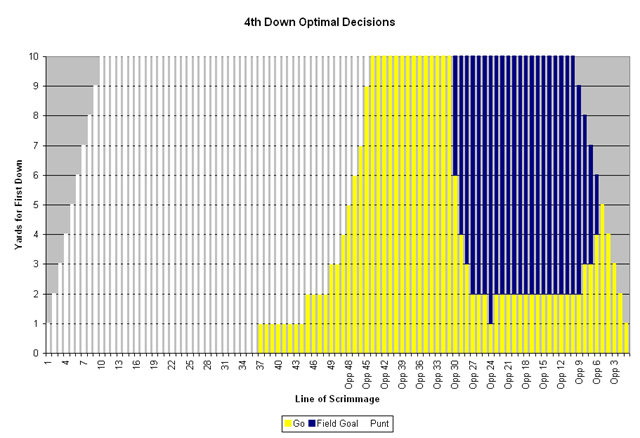
So I decided to look and see what the decision chart should look like on an expected points basis.

Anything close to two different colors is a virtual toss-up. Any gains near a color transition are negligible and not worth noting, but there are very real gains to be made in the heart of the yellow section, where coaches are taking their offenses off of the field far too quickly.
A couple of quick rules of thumb:
- Don’t punt on the opponent’s side of the field.
- Really consider going for it on 4th down after crossing your own 40.
- Field goals only make sense if there are more than 5 yards to go and you are between the 10 and 30 yard lines. If you’re in opponent territory and these two criteria aren’t true, you should be going for it.
I know this is not the first time a topic like this has been presented, David Romer was mostly criticized for his paper on the topic a couple years back (thanks for the reminder Colin). [Ed: Not around here.] Of course there was the great Patriot debate last season when the Patriots elected to go for it on 4th and 2 with the lead in their own territory. Even though the majority of the arguments against this work amount to "people like David Romer and The Mathlete don’t know anything about football and just live in their parent’s basement" I did want to look at the main objections and see if they had any validity.
Objection 1: Does not account for “quick change” momentum
Below you’ll see a chart of the expected points on a drive based on field position, and how teams have actually fared. I also included drives obtained by turnover as comparison to the other “quick change” drive source.

There could be a case that drives started on a short field due to a 4th down stop generate more points than normal drives, but the small sample size reduces how strongly that argument can be made. From 2007-2009, the total points accounted for on drives obtained by 4th down stops (2523) is less than the projected points would be for any drives starting at the same field position (2580). This difference is meaningless statistically, something very damaging to the idea "momentum" helps the opposing offense after their defense gets a fourth down stop.
Adding in the turnovers does nothing to build a case for momentum after big defensive stops or turnovers. The turnover-started drive line tightly hugs the average line. As a whole, the turnover expected points line is slightly higher than the average line, but only by enough to generate an extra touchdown every 50 drives. That's about one every two years or so.
Although it can often feel like there is a big momentum swing after a big stop or turnover, there is scant evidence that it is more than our memories selecting the most traumatic or exhilarating scenes to hold onto. [Ed: for an example of this human tendency to ascribe meaning to unusual events where there is none, see any of the zillion "hot hand" studies.]
Objection 2: It assumes all offenses and defenses are average
To get a gauge on what “good” can mean in comparison to average, I plotted the best offense and best defense of the last three years against the average team’s expected points per drive.

As a rough approximation, the best offense is about a 1 point per drive better than average and the best defense makes offenses about a point worse per drive.
Scenario 1: Good offense

If your offense is as good as Florida, you should never punt against an average defense. Maybe if you are deep in your own territory, but only in the most extreme situations. This assumes that a new first down gives the Florida offense an extra point over an average team in expected value and a 10 percentage point increase in the likelihood that they convert.
A punt is conceding any chance of scoring and an offense this good should not give up that right so easily. This is the basic philosophy behind the vaunted no punting HS coach in Arkansas. His team isn’t necessary good because he doesn’t punt. He doesn’t punt because his offense is good. Why waste another scoring opportunity?
Scenario 2: Going against a good defense
Playing against a good defense changes the dynamic extensively but it does not mean forgoing the fourth down attempt altogether. With a reduced likelihood of success on 4th down and a reduced payout if the conversion is successful, the 4th down attempt still is an optimal strategy more than is currently utilized. Even against a top national defense, you should still not punt in opponent territory. The field goal becomes a more viable option against the stronger defense and punting becomes a much better idea all the way out to midfield.
[Ed: I think this is moving towards correct strategy since it takes a caveman or a seriously long-yardage situation for someone to punt from inside the opponent's 40 these days. That range from midfield to the opponent 40 is a spot we might see move towards fourth-down aggression in the next few years.
Also note that coventional current strategy gets way less wrong once you ramp up the ability of the defense. If we jacked it up even farther, it might get to the point where punting from the 36 (or even on third down) is a good idea. The flaws in strategy here are leftovers from an era when punting was actually the best option. Thinking has not kept pace with scoring since.]
Scenarios 3/4: Good defense or opponent good offense
The conventional wisdom is that if you trust your defense, you don’t go for it on fourth down. [Ed: In my experience the conventional wisdom is remarkably malleable on this point. If you have a good D and the announcer agrees with the call, the good D will be cited as a reason why.] In reality, the strength of your own defense (or the strength of the opposing offense) is largely irrelevant to the decision. Fourth down decisions are all about offensive opportunity. A 4th down decision to punt is the decision to take the ball out of your offense’s hand, leaving the relative impacts on your defense to negate each other. A 4th down failure puts your defense in a worse situation, but it doesn’t guarantee points for the other team; a good defense is still a major asset in stopping or limiting the other team with good field position. A punt doesn’t guarantee that the other team is going to be stopped, but a good defense makes it more likely. In the end, it’s still all about the offense.
Objection 3: Does not account for game specific situations
This objection does ring true, but its application is much narrower than most people believe. The main flaw with the expected points model is that for most of the game all points are largely equal but at the end of the game, a field goal or even time can become crucially important. If a field goal can tie a game, take the lead, or move said lead from one possession to two (or vice-versa), the decision-making process suggested above can shift radically. This could mean punting near midfield to prevent a short field goal drive for the other team or taking a field goal instead going for it on fourth in field goal range.
These situations are rare, however, and only come into effect in the fourth quarter. When there are likely to be even 2-3 additional possessions, the expected points model still holds up.
Another potential game situation not accounted for above is the presence of a high quality field goal kicker. A very accurate field goal kicker will move the blue field goal “bubble” in the above charts down, making fields more practical in short yardage situations. An above average kicker from long range will move the bubble left. Even a great kicker won’t make kicking inside the 5 practical in very many situations.
Conclusion: In Which Romer Is Re-Iterated
Teams need to be using kickers and punters less and their offenses more. Especially teams with good offenses. If you have a good offense, bringing out the punter should only be done in long distance situations or when deep in your own territory. Scoring touchdowns is the valuable thing in football and giving away a quarter of your plays to kick on fourth down greatly reduces your ability to score them, the gain in field position from a punt is worth less than it is currently perceived to be and the idea that momentum is obtained from a quick change of possession is to be slight at best and most likely non-existent.
One final thought I haven’t been able to quantify yet: if you switch to a fourth down mindset, what opportunities does it open up in play calling during the first three downs of a series. Planning on four plays for a first down instead of three would surely have some value for an offense to adjust and re-optimize their play calling, and the total offensive value could become even greater.
Note: apparently Brian Burke at Advanced NFL Stats and I have been having some of the same offseason thoughts as he just put up another piece on 4th down decision making, and this after we both introduced similar defensive player evaluation metrics within a month of each other.
Hmm, I did think that there was more of an advantage to going for it more often, but I did not know that it was this much of an advantage. Mail this to Coach Rod stat!
...great stuff, but please don't alert Zoltan Mesko to any of this. He's been on such a high lately.
I think I remember reading about this in freakonomics. Football coaches don't go for it more often on fourth down for the same reason that basketball players don't shoot free throws granny style: Even though it would work better and help your team win more games, it makes you look foolish.
is coaches are ingrained with traditional approach with always punting or kicking for a FG on 4th down even if it's 4th and short. The job security aren't as great as it used to be in the past so coaches are more conservative with this type of approach. If they failed, they would get criticized for being stupid and should go with the traditional approach.
I've been waiting for a coach who has a lot of knowledge of stats and use them to his advantage. I know that Belichieck is one of them(thanks to the infamous Indy-Pats 4th down call that led Peyton to a game winning drive).
When knowledge is less prevalent, support for unconventional decisions tends to be low, so coaches tend to make conventional decisions in case their performance is measured solely by results rather than by a combination of results and decision-making.
What seems to change convention is the success of unconventional methods over time. People look at successful coaches and copy what they do. If successful coaches begin going for it more often on 4th down, other coaches may do the same.
It does help a bit, I think, when the knowledge behind the process begins to spread among "outsiders". Of course it can spread much faster there because we only need to know the ideas behind the choices; we don't have to implement them ourselves, nor are we graded on our choices. Steadily, as people show that in the long run, valuing possession more leads to more points, we begin to support those decisions more. Eventually, coaches begin to make them more often, and we're happy that coaches have caught up.
Until those turning points, though, it does seem to take a coach with no thought to job security (two extremes: someone like Belichick who simply won't get fired or someone like Billy Gillispie who has no idea he might get fired) to be one of the first to implement a different strategy.
Great diary post. You always provide such great analysis of things.
This post touched on something kind of interesting that is never really looked at: momentum. If you don't have ideas for your next post and you want to do something, you could take a look at momentum and how much various things affect the team (e.g. an interception affecting the QB, fumble affecting the corresponding RB, just a turnover affecting offense as a whole, a defense giving up a big play affecting their next series, or whatever).
Additionally, and you may have answered this sometime before, but where do you find all of your data?
This definitely validates my NCAA Football coaching style. 4th and 2? No problem. FB Dive for 7 yards!
No lie...This is probably my favorite diary of yours.
Very interesting, as always, mathlete. Thank you for the diligence.
I agree with the general conclusion about kicking less, but there will still be that difficult element of knowing, at any point in a season proactively, if you are average, a +1 offense, a +1 defense etc. and assessing your opponent in that regard. One benefit that you have is that you can digest all of the numbers after the fact. Maybe once a team nears the final 1/4 of their season they can factor in their on-field performance statistics more effectively? But then, you have those incidental items like injuries to key players, weather/wind etc. that may change the situational decision, too?
I don't recall if you have done this, but have you looked at the impact of penalty yards on the effect of drives? Not directly related, but it popped into my head.
Great stuff!
Can we get you a job with Football Outsiders already? As long as you throw throw mgoblog a bone once and a while that is.
Very interesting. I am an under-educated stat head that eats this stuff up. A few things.
1, if everyone followed these models, how do you think they would change? Obviously at this point, a small percentage of coaches are going for it on fourth and 4 from the opponent's 48, even though they probably should be. So the situations where they are going for it might be different than what it would be if everyone was doing it. I don't know if that makes any sense... think of it this way. Maybe right now, the majority of people that go for it on fourth and four from the opponent's 48 are behind in the waning moments of a game and are going against a prevent defense. Does that change things?
2, as another idea to throw out there for you... how do expected points change based on the preceding drive? This kind of goes along with the "quick-change" aspect of it. If your defense forces a three and out, does that increase your chances of scoring when you get the ball back? I was thinking of a plot that shows the difference between expected points between the "average" and say a preceding drive of 3, 5, 7, or 10 plays. I'm not sure I'm expressing this clearly, but it makes sense in my head.
EDIT: Re #2. The basis of my point is that people point to TOP and "tired" defenses being factors. This could prove this one way or the other. If you're a lot more likely to score after your defense gets a three and out (the opposing d got a small rest) then that would lend some credence to the "tired" defense thing.
How do expected point values hold up when distance to make a first down is considered? Obviously, expected point values go down, but I wouldn't be surprised if it becomes more advantageous to punt or kick field goals relatively quickly as distance to go increases.
How many teams and how many years of data is this stuff based on? Great work!
All games between 2 FBS teams from 2007-2009.
As usual. Too bad not as many people seem to read the diary section.
Mathlete, again, bravo.
1. Charts 2 and 6: Wings!!!
2. Sampling bias on your disproof of momentum swings from 4th down stops (unless you accounted for this and I missed it): a lot of those 4th down decisions are made by losing teams late in games. You can pretty easily spot the kneel-down drives resulting from 4th down stops at the very end of the 4th quarter, but I think a lot more late-game stops on 4th down are followed by run-out-the-clock drives. I'm thinking of teams down by two touchdowns late in the 3rd quarter, etc. The team taking over, then, may not be in a position to take advantage of any "reversal effect" because their coach's conservative playcalling artificially keeps scoring down for those drives.
That's not to say that I believe in momentum swings -- just that your data is pretty inconclusive in disproving the theory.
Keep up the great work!
if you believe in it - Vince Lombardi
Failure to note on my part. The data is only first 3 quarters and games within 2 TDs.
effect is really a "game over, demoralized" effect.
When do you go for it on 4th down in your own territory? At the end of the game when a change of possessions means you lose.
Also, I love chart three. To look it it from the other perspective,
net benefit of punting (roughly)
= P(not making it) * change in opponents expected points per drive due to punt
- P(making it) * own expected points per drive at current field position
Going left, the slope of the expected points per drive starts to decrease in magnitude around midfield.
You fail to correlate 4th down decisions with your NEXT starting field position. Your logic makes sense if you only consider a single drive, but you need to look at the entire game.
If you go for it on the 50 and fail, your next drive will likely be on your own 10. If you punt, your next drive will likely be around the 50.
That is an excellent point, but if you have the +1 offense like he brings up, unless you are playing a -1 defense, you will probably still score from there.
The data is tough to argue against in the context in which it's typically presented. Usually the analysis revolves around an average offense against an average defense but this is frequently not the case. Kudos for tying the analysis back to real world examples. But, its still a very here-and-now analysis and does not take a long view. In fairness, it's very difficult to incorporate the many possible future outcomes.
Refreshing downs doesn't guarantee a score of any kind and doesn't preclude a turnover. This is a very real consideration and particularly applicable to Michigan's offense last year where we had a ridiculous level of red zone turnovers. Michigan lost 28 turnovers in 12 games last year; that's about 1 turnover every 5 drives! Excuse me while I barf. Factor that in and going with the bird in hand starts making a lot more sense.
that you have it backward: the analysis is taking the long view (by describing things in terms of expected points), but the decisions are typically evaluated based on their short-term success. In other words, the first time RR goes for it on 4th down in 2010, if he fails, people see it as a bad idea, even if over time it turns out to give Michigan more points.
I think the analysis by its nature has to be based on an average offense against an average defense. There simply aren't enough data points when you start looking at offenses and defenses toward the same end of the curve. Even if the data came from, say, 30 or 40 years of games, you could then question whether it was valid to combine all that data due to the differences in football between then and now.
Even if there were more data, though, as indicated in the editor's note, this is best used as a guide rather than a set of rules (not that it was intended any other way). Even data gathered from Michigan's fourth-down attempts under RR doesn't necessarily suggest whether a particular attempt is more or less likely to be successful, and that's really what coaches want to guess. That can even lead back to the small sample in the first place: it doesn't help the coaches much to know that after 50 trials expected points will be higher with a more aggressive approach if they only encounter 5-10 per year and may not last long enough to see out the 50 trials.
This data assumes that all drives are independent trials; they are not (except for kickoff or free kicks). In a given game each drive is linked to the outcome of the preceeding drive. So the optimum decision should consider, at the very least, what you likely outcome is if you decide to go for it or kick and what their likely outcome is if you punt. If you think that you can pin them inside the 15, and stop them, then it might make sense to punt it, even if EV says to go for it because the net sum of the current drive and the subsequent drive may higher than if you considered them independent trials. So, the long view I was referring to was with respect to a given game which is what the original comment I responded to assumed; not with respect to eternity. The battle over field position is a battle worth fighting; this type of analysis does not consider that.
On the point about averages, take an extreme case: the Detroit Lions. There's no way they should be considered an average offense at any point in the last 6 years. Analysing their decisions based on what the average offense is capable of is inappropriate. Continueing, what Michigan's offense should be expected to acheive against EMU is different than what they should be expected to acheive against Ohio State. And so on. These adjustments can and should be considered.
A coach most definately knows how their offense/defense compares to the average. If the offense averages 6.7 yards per play (Florida 2009) versus and average of 5.3 yards per play (NCAA 2005-2009), it can be safely assumed that the offense is well above average and decision aggressiveness can be turned up. The same thing can be done for oppentent's defense and then a compensated EV line (and subsequent charts) can be generated based on the specific matchup at hand. One season consitutes 720+ different matchups. After 3 years (what this study is based on) there's anough data to make reasonable adjustments for a specific matchup. This data are guidelines but will be aggressive/conservative for matchups deviating from average vs. average.
So, while I agree that the analysis must be tied to averages, each specific decision must be tied to the specific case at hand. In the famous Belichic example of last year, the fact that the Colts were virtually unstoppable had a lot to do with the appropriateness of the decision to go for it. Manning probably would have scored no matter what.
on most of our points and differ just a bit on the rest.
One place I think we definitely agree is in how the final decision should be made. Even if you could compile enough data about a single team under a single coach and coordinator to make a general assumption about a game situation, the individual data points that make up the data set are significant in and of themselves, and the best decision would consider both the average case for the team and the specific case facing the team.
Ultimately, though, I disagree that field position itself justifies a conservative decision. In situations where the clock is not a factor and the score is still reasonably close, punting the ball is simply removing your ability to score on that drive (barring an extremely unusual play), and benefiting from good field position requires that you score on an ensuing possession. I think it's reasonable to ask why it is that a coach does not believe his team can score on this possession but expects it to be able to score on the next one. (Some coaches may also believe that field position will lead to a score on a possession farther in the future, but if that coach is expecting two or more possessions with no points, that may suggest an alternate strategy even more conservative than the current "book" strategy.)
I don't think that's an issue because the study is based on the expected value of success, of failure, of the chance of making it, and of the expected value of punting/FG. EV should take that into account because they just assign a number to a spot on the field based on who is more likely to score.
I love this analysis and I have been fascinated with this discussion since the Romer article first came to light. I was wondering if you could figure a way to add this question to your analysis. I will call it Lloyd vs Spurrier.
If I am to believe your analysis I could reasonably assume that a power team like Florida would expect to outscore their opponents by an even greater margin over the course of the year than they already do, but intuitively I think that to adopt this philosophy would add a greater variance to the scoring. For example, I could see them score 100pts in a game over an overmatched opponent if things were clicking. On the flip side a couple of missed 4th down plays on your own 20 could lead to a disaster. Over the course of several years these swings would even out to make your point differential greater than under the more conservative philosophy, but that is not the goal in college football. The goal in college football is to win all your games or at the worst lose 1 so you could qualify for the Championship game.
So my question to the Mathlete or anybody else so inclined. Could adopting this philosophy, while allowing you to score more points open you up for more upsets than under the more conservative approach making the likelihood of a championship season less likely?
PS One bonus factor I think is the choke factor of going for it deep in your own end, when it is so against accepted game management practices. This could be overcome but I think you need to really explain to the kids the value in what you're doing.
Very good analysis! Is there anyway to develop mathematical relationship between having a kicker that can make a high percentage of field goals from 40-50 yards, and going for it on fourth down under the circumstances stated above?
It is always beneficial on 4th and 2 to have the ability to run Mike Hart behind Jake Long for 3 yards. As a coach, that would make it a no brainer. Go Blue!
My one comment would be that this is all based on averages so it doesn't represent the risk involved in a single decision and it's ramifications on the game. This is different than "Objection 3". What I'm saying is: while the numbers show it may be in your best interest of going for it on 4th and 2 from your own 30 this is really only true when averaged out across many occurences.
If you just went by the numbers, then over a season you very well might optimize your expected points, but due to variance you may lose a couple close games that you otherwise wouldn't have. Now of course you can flip that around and say you would win a couple you otherwise wouldn't have, but then you're basically getting into a Gladwell variance arguement.
Those maize and blue graphs are sexy. Well done.
I'm trying to think of a similar decision in other sports, and best I can think of is whether to bunt a runner over in baseball. Absent the pitcher in the NL, "new school" managers bunt less (equivalent of punting less), with the realization that you get a finite number of outs each game, and you should not forfeit one of those outs to move a runner up a base.
although somewhat different in nature, would be deciding when to bring in your best reliever. As it stands, the vast majority of managers bring in their best reliever in the ninth inning if it is a save situation, regardless of how the game has played out to that point. Three-run lead going into the ninth: bring in the closer. Tie game in the seventh with the bases loaded and two out: do not bring in the closer.
That is to say, managers in this situation tend to make decisions that are likely to cost them games in the long run, because "the book" overvalues certain late-game situations and undervalues situations earlier in the game. "Traditional" statistics back this up by awarding more credit to that ninth-inning effort than to the seventh-inning rally killer: the closer expects to get saves, so the manager feels more pressure to keep the closer back until a save situation occurs, even if that means events transpire that prevent the save situation from occurring.
Of course using a "closer" in the seventh or eighth doesn't ensure that you'll get the outcome you desire, and you will occasionally find yourself in a save situation without your closer available, but over time, using your best reliever in situations most important to the outcome of the game will help you win more games.
Talking to coaching who run the flexbone (triple option, aka, Georgia Tech) offense, I have noted that your point about how this changes your play calling in the first three downs is correct.
If you have the attitude that a 4th and 1 or 2 yards to go is an opportunity to "go for it," it gives you the opportunity to run a FB zone, or option play on a 3rd and 7 play. Contrarywise, if you know you will punt, it's pretty much draw or pass on 3rd and 7. That changes things for the entire defense, making DE's unable to "pin their ears back (although, seriously, who does THAT?)" and rush the QB, forces Cornerbacks to keep an eye on the Runningbacks (which in turn may give a WR the opportunity to blow past a corner who was attempting to watch out for an option play on third down.
Mathlete,
I love your blogs and was wondering if you could do one on the ranking, by team, in the Big 10, comparing, recruiting class ranking and youth/age of the team.
I think UofM is one of the youngest in the B10, but I have nothing to base that on other than our large recent classes.
That would be a very interesting piece to see.
Thanks.
But for some reason I was thinking "Go" should be colored blue. Not sure why...
I've only completed one reading, so I can't yet formulate any questions or comments.
But I can't say thank you enough for taking your great analysis from the Special Teams post and doing the next step of analyzing what decisions the Head Coach should be making.
Well, I will say that I want to look over this again to argue the hypothesis that "the best defense is a strong offense" and find reasons to disprove the other huge pile of analysis that is proving the case that "Defense Wins Championships"
As much as I loved watching Michigan under Bo, I think the 1988 Miami game stands out as the game that proved to me, "Offense (i.e. scoring) wins games". I state that as a gut feeling subjective decision, and damn it I was trying to make this a short comment, but now I just googled that game to confirm the date and found this great blog post on that game,
http://motownsportsrevival.blogspot.com/2005/07/anatomy-of-michigan-los…
Despite being one of the premier college football programs in D-1 football, Michigan has given fans countless ulcers and heartbreaks. It seems like Michigan invents a new way of losing each year. Things go wrong at the most inopportune time providing some of the more memorable losses in sports history. I'm going to break down every Michigan loss since 1988 to see if there's some kind of a trend or method to Michigan defeats. At the very least, going over these losses again will hopefully be therapeutic.
"
and damn, but doesn't that sound like some of the recent posts about RichRod?
anyway, the point I'm clumsily making is that I was raised on Bo's Michigan Football, and I share completely the perspecive of that blog post, especially in Bo's later years, it was just painful to watch him call safe offense plays with the intention of running the clock and punting and putting the game on the shoulders of a quickly tiring Defense.
so I'll close with some awesome Wolverine Historian and will direct you to the Bo comment at the 3:10 mark where Bo comments on his legacy head coach pick Gary Moeller's win over the Irish in 1991 and specifically a certain 4th down call to "go for it"
<object width="445" height="364"><param name="movie" value="http://www.youtube.com/v/D_LBB4RDMN8&hl=en_US&fs=1&color1=0x2b405b&colo…"></param><param name="allowFullScreen" value="true"></param><param name="allowscriptaccess" value="always"></param><embed src="http://www.youtube.com/v/D_LBB4RDMN8&hl=en_US&fs=1&color1=0x2b405b&colo…" type="application/x-shockwave-flash" allowscriptaccess="always" allowfullscreen="true" width="445" height="364"></embed></object>
I think those Championship Defenses look so good and have such good stats because they hand it off to a strong offense that scores after a stop.
Yes, your defense has to stop the other team from scoring more than you, but don't you increase those chances by scoring on every offensive opportunity?
so wouldn't that mean "offense wins championships?"
I mean unless you have Charles Woodson and all your points come from the Defense scoring and Special Teams, don't you need the offense to score?
Are you listenting Demar of the soft hands and the near Dilithium like speed?
Oh crap, how did this end up so long, I need to get back to work.
Curse you Mathlete for you way too interesting use of statistics!!!
What is considered "average" in this data? Are games against non-BCS or DI-AA teams excluded? If not, I would consider redoing the first graph and only include games that excluded lopsided matchups.
Interesting point Brian brought up at the end - that I think is essentially correct - about strategy being behind statistics. I think this is very true, and I always hated when Lloyd punted from the opponent's 38.
This is a great column because it shows how far behind that thinking is. Despite RR's first few years being....less than stellar....I am encouraged at his risk taking usually and I think he will be much more willing to not punt on the opponent's side of the field.
Couple of things about that though that I think go a long way in explaining the behavior - not excusing of course, but expaining- first, old habits die hard, and back when Lloyd started with Bo, 4th and 7 was a lot different then it is now. (Actually, I would love to see this chart from a prime Bo year, like 1972 or something, and see what the decision chart looked like then. I bet back then anything over 4th and 5 anywhere had really low returns. Then we could see what years current coaches are trapped in!) Anyway, when Carr had Henne and Braylon that 4th and 4 short pass was a very effective play, back in the day it was much less reliable. One of my principal complaints with Carr was that even though we obviously used Braylon to great effect, we could have used him even more on those stupid 4th and 3's at the Notre Dame 39 instead of punting. In fact, given Carr's willingness to use short passing much more than Bo I'm surprised he didn't go for that more often. In that way I totally agree with the column that the decion making is way behind what offenses can actually do now.
But I think what explains that in part is what one might call a strategic decision verus what you might call a tactical one - Carr in general wanted to play a low-variance game. He wanted a game with no surprises more than he wanted to maximize one possession. This was usually a good thing for Michigan - against Indiana there was NEVER a reason to take chances no matter what. There was no reason to maximize one possession because, all things being equal, it was only a matter of time. And it's important to keep in mind that Carr was good at that part. What I think a lot of us would liked to have seen is more risk taking (and not even that big of a risk...) in close games where one possession had much more importance.
This is kind of a related question, but due to all the data you had I wondered if you thought it suggested anything along these lines - is there any percentage at all in keeping the game within a score? Let's say we are down 10-0. Does that make a field goal make more sense statistically than if we are down 14-0? I know that kinda falls under game specifics, but I only wonder because I think a lot of coaches make decisions to keep the game within a score, and I was wondering whether there was anything to that or just a preference not to take chances?
which is very important in a high-profile job, given the current methods of evaluating coaches. Even if Carr had an EV chart that showed that in the long run, he'd be better off going for it in all situations like X, doing so wouldn't necessarily improve each individual situation. If he went for it twice in ND territory, failed both times, and lost the game, the criticism wouldn't be about the general performance of the offense or even about the results themselves as much as the decision to do something unexpected and the failure to succeed when doing so.
As a side note, I think the idea here is that Indiana is precisely the sort of team against which you should take chances. Because the difference in talent is so great, you should be maximizing that difference by coaching more aggressively ... given enough possessions per game, you are less likely to end up in a close game by being aggressive than by being conservative, assuming the difference in talent is significant. (That's what the "Florida" graph says.)
I believe that when time is not an issue, there is no percentage in simply putting points on the board. You maximize the return on your possessions in the long run by making decisions with the greatest EV ... the theory being that while a field goal cuts a 10-0 deficit to a single score, a touchdown does that and makes the game closer, and if going for it has a higher EV you should choose that path. (Naturally, a below-average offense may have a higher EV when kicking in many more situations than an above-average offense, so outside the context of Michigan football, there are probably a lot of occasions where the numbers point to kicking.)
I think you are absolutely correct in pointing out general coaching behavior: coaches do coach to the scoreboard rather than the game situation, mostly to avoid the appearance of significant failure. For example, if they feel there is a perceived difference between a 21-0 loss and a 21-3 loss, they will kick even when the game situation suggests going for it is a better play. Coaching with EV in mind is not certain to be profitable in the short term, and you can't exactly demonstrate long-term success if you get fired before the success shows itself.
Sorry to spam the topic, I am just fascinated with this sort of analysis. Having seen it in baseball for so long (I've got Bill James abstracts from '85 and '88, the two years following Tigers playoff appearances in his era), I love watching the same process hit both college and pro football now, not because traditional coaching patterns are necessarily wrong but because there are most likely a number of ways in which traditional coaches could benefit from additional information, and it's great to see some schools and teams embracing that philosophy in different ways.
We need the one that shows what coaches should do as compared to what they actually do. We have the actual one (the second chart in this diary), though it is inverted and reversed (FGs on the bottom and goal on the left). It's also truncated (opponent's territory only), but that's no biggie.
The chart which can be directly compared to that one is missing. What we have is a decision matrix based on down, distance and field position, but we need to see how often each situation occurs in order to understand how conservative coaches tend to be.
For example, if the distance of 4th down from the opponent's 35 yard line is 5 downs or more less than 20% of the time, then the average coach is too conservative. If it occurs more frequently, then he's actually too aggressive.
Any chance we can get the first chart re-cast with optimal decisions? I'd do it myself, but I gots no data.
The final frontier might be adjusting offensive quality not on mean points-per-drive, but on mean yards-per-play and the standard deviation.
Theoretically, a Carr or Tressel offense should get two yards anytime it wants it, which means the 'Go' window should be very wide. But it shouldn't be tall: 4th-and-8 is asking too much, even deep in opponent territory.
Conversely, a Spurrier offense's 'Go' window should be quite tall. If the play is successful, it'll get ten yards, so scribble maize from floor to ceiling. But, you have a higher risk of failure, so the 'white' window should creep farther towards midfield . . .
Peace
Ty
So you're saying if you have a good offense, you should go for it on 4th and 7 from your on own 10 yard line. That's pretty crazy. Good luck getting coaches to take your word for that.
Comments