the just released schedules were a flat-out statement that the B10 doesn't believe SOS will matter in playoff selection
4-3 under
Mailbag: Run Denard, Don't Run Denard, Carbon Dating, Funchess and Black Moves, Fakez
runnnnnnnnn
JUST RUN THE BALL
Dear Brian,
I know you've touched on this before, but why isn't Denard scrambling on at least 25 percent of our called pass plays? I mean, can't Borges just tell him, "If your first and second reads aren't immediately open, run"? It seems like a win-win situation. If guys are wide open, great. If not, the holes are likely to be bigger than on our usual designed QB keepers. I know Denard seems to have problems with this, but has Borges ever actually said this is a problem that they're actively working to remedy? I don't get it.
Thanks.
Markham
Nobody knows why, but it's just never happening. I'm sure they've attempted to remedy this in multiple ways, like:
- screaming RUNNNNN at him in practice when he should scramble
- screaming RUNNNNNN at him in games when he should scramble
- calling him at 3 AM and screaming RUNNNNNN at him
- popping out of oversized birthday cakes screaming RUNNNNNN [note: works on children]
- plopping down with despair and saying "I give up and welcome the sweet oblivion soon to follow"
- RUNNNNNNN
Ain't happening. E-fact.
Student section celebration thing: can we carbon date this?
Brian,
Regarding the whole rushing the field debate I have a question about the reverse: when the team runs over to party with the student section. You gave a list of when people rushed the field, but when was the first time the players ran over to the student section? I was in the band at the turn of the century (Boom. Old-timed.) and I don't remember that ever occurring. The first time I remember it happening was the Manningham TD against Penn State. Was that the first? When else can you remember it happening?
Thanks,
Eddie
I do not actually know. 2005 Penn State sounds pretty good as a plausible start for that but I have this feeling it was more something that started in the RR era. I throw it open to readers: when did Michigan going over to the student section after home wins become a thing?
Funchess at WR?
Hey Brian,
My cousin brought up a scenario during the MSU game that I haven't seen discussed much: could Funchess move to WR next year if no one proves to be an adequate replacement for Gardner? He has proven that he has great hands, leaping and size. Along with this, if the idea is to give matchup issues for the defense, I see no bigger matchup problem than a 5'10" CB covering him. If he has blocking trouble, I don't see the sense in Ricardo Miller-ing him, but obviously I'm no coach. What say you?Thanks,
Josh Q
For a guy like Funchess that's kind of a distinction without a difference. He's already lining up at WR in a lot of sets, and I imagine he'll continue to do so throughout his career. He is a flex tight end.
But Michigan shouldn't and almost certainly won't try to keep pounds off of him so that he's more of a downfield threat/WR guy instead of a tight end. He's already too big to be a guy who threatens CBs and safeties over the top, and he'll still be too fast for linebacker sorts to reliably cover. Bulking him up to NFL flex TE size—250, 260—makes him a more credible blocker and gets him more open when he does go out to catch passes.
Besides, Michigan's got a slightly smaller Funchess coming in. His name is Jaron Dukes. If there's a role for that on the outside he or Jehu Chesson can fill it.
[AFTER THE JUMP! MORE THINGS! ABOUT STUFF! /bradyhokeinjuryreport'd]
Michigan Museday If the Dudes Get Dinged: D-Line
- 2012
- 4-3 under
- brennen beyer
- chris wormley
- craig roh
- defensive line
- frank clark
- i has a graph
- injuries
- jibreel black
- keith heitzman
- ken wilkins
- mario ojemudia
- matt godin
- mike martin is the hulk
- museday
- nathan brink
- quinton washington
- richard ash
- tom strobel
- will campbell
- will campbell is thor
- willie henry
Heiko|MGoBlog
♪ Well a whole season played with the first string guy is usually quite lucky.
And a squad who plays with the second team out can be anything but fussy.
But a team whose seen an important guy down—head concussed, knee on the ground!
If they ain't got depth around, then all goes to poopie.
To poopie, to poopie, to poopie, but depth is hard to get!
To poopie, to poopie, to poopie, but we can get there yet! /♫
--------------------------------------
This is a continuation from last week when I went through the expected offensive depth chart and tried to predict what would happen—what's the dropoff? how do we react?—if each starter is injured for an extended time. Now, I'm not here trying to roll into town and stir up trouble, see? I'm a purveyor of portents and hedger of predictions only. What I seek to do is prepare us for any one of these dings, so that if one occurs we can say something intelligent like "it hurts to lose Roh but Black is probably the less replaceable!"
Why not all defense? Things slow down from here because the defense has a lot of intermeshing parts, and because there actually is depth in places to speak of. Mattison's er Michigan's defense has been characterized by interchangeable positions but really each spot is more of a sliding scale from NT to field corner where each one overlaps the things on either side of it. The listed spring/recruiting weights play this out (click e-bigitates):
Quickly again. Photos are all by Upchurch unless otherwise noted. Ratings are given in Saturn-punting Zoltans. Think of them like stars except more heavenly. Five is an all-conference-type player (Denard to Kovacs); four is a guy you'd call "solid" (RVB to Demens); three is an average B1G player (Morgan to Hawthorne); two is a guy with a big hole in his game (freshman Kovacs); one is trouble with a capital T, and that rhymes with P, and that stands for Poole.
Nose Tackle (Avengers)


Geeks / O. Ryan Hussain|TheWolverine / 247 Sports
Backups: Ondre Pipkins ![]()
![]()
???, Richard Ash ![]()
.5 ???
In case of emergency: I'll be honest; this one is impossible to call straight. The 4-3 under is like the 3-4 in that it leans on the nose to suck up double teams and create mismatches elsewhere. The ideal is a superhero, and for the last few years we've had one of the best (by Ghost of Bo).
Hulk is gone but the franchise must go on, and for now that means we are 100% committed to making Thor work.
If the old 5-star takes up the hammer he's the pivot point of a great defense. If he doesn't then one of two mystery men could be anything from serviceable to disasters, and most things in between.
The upside on all three of Michigan's nose tackles is mighty. Weirdly, we think we know more about the true freshman, Ondre Pipkins, than the redshirt sophomore. Pipkins was a 4 or 5 star whose huge, squat, Tongan frame and jovial, Hoke-impersonating character made him and Michigan's need for nose tackle a cosmic destiny. If he's got the goods we'll see Pipkins early in spells of Campbell. True freshmen (Martin, Gabe Watson) of his caliber have fared well enough in rotational duty. The later this season goes, the more comfortable you can feel about Pipkins when he's called upon. Caveat: until he's called upon you have no idea if he can hack it, and for every huge dude you can name who could play right away (Marcus Thomas, Suh, Ngata, [sigh] Johnathan Hankins, DeQuinta Jones) there's 30 who need to spend a year as Ben Grimm before being The Thing. /metaphor used up.
In case of dire emergency: …break glass on Richard Ash. Nobody knows on this guy, who was recruited by Rodriguez as the last Pahokeeian project for Barwis to tear down and rebuild. The tear-down went unnoticed through 2010 and '11 and we caught a glimpse of possible rebuild when, 20 lbs. svelter, he made a few plays nice in the backfield. Ash could be anything from ahead of Pipkins to Adam Patterson. If that's where we are I could see Quinton Washington sliding down.
Rush Tackle (3-Tech)


Right: Dell Callihan|UMGoBlog
Backups: Quinton Washington ![]()
.5, Ken Wilkins
, Matt Godin ???, Willie Henry ???, plus nose tackles
In case of emergency: The coaches have made it clear that Jibreel Black can play, and moving him two slots down the size/speed slide chart of defensive positions means they want him on the field, and that they want 5-tech-ish skills at the 3-tech. This being a swing position means the backups could be different things.
Quinton Washington is a big dude who was an offensive guard until he and Will Campbell were swapped for each other in that experiment. He still looks like a guard, and has yet show much at tackle besides easily dismissible coach hokum right after the move in 2010 so it wouldn't look like Rodriguez was throwing substances at surfaces to see what sticks.
Q stuck although the OL he left is now about as leaky as the DL he came to save. That the coaches moved Roh and Black down the line tells you something about their faith that Washington is ready, and going into his redshirt junior year that might mean he'll never be. He's seen time on goal line situations and is likely to again. Early in the year I wouldn't be surprised if he or Ash—whichever wins—is backing up both interior line spots, and that later on we see some Pipkins and Campbell together time.
In case of dire emergency: Ken Wilkins has been absent enough from chatter that people email me asking if he's still on team. Yes he is on the damn team, and he's still just a RS sophomore, but yeah, there's room for true freshmen on the three deep. Those two seem to be Godin and Henry, the lesser heralded of the heralded class, both of whom would benefit from redshirts. Henry is the larger. Chris Wormley, whom I rate at 5-tech, seems a more likely backup.
Strongside End (5-Tech)


Backups: Nate Brink ![]()
![]()
, Keith Heitzman ![]()
![]()
, Chris Wormley ???, Tom Strobel ???, plus 3-techs.
In case of emergency: Craig Roh has to be the hardest four-year starter to project in history, thanks to many different careers as too-small WDE in a 4-3, a miscast OLB in the 3-3-5, then as the edge rushing WDE in Mattison's 4-3 under. Now he moves to RVB's old spot.
The backup here is almost assuredly Nate Brink, whom the coaches love but the fans hardly know because he's been hurt (he missed Spring because of it). When the coaches talk about the one-time walk-on they make sure to hit all of the Ecksteinian points: "coachable", "hard worker", "toughness", "great technique", "great motor." To that I might add he's 6'5 and 263, which is normal for the position. He's not Heininger (who as a sophomore backed up Brandon Graham), except in that he's some of the things you wrongly thought about Heininger. Then again I remember Brady Hoke making all sorts of guys into effect tech linemen.
If you'd rather see stars, Keith Heitzman is your guy. The beneficiary of the spring time Brink missed, the redshirt fresham was rated higher at tight end out of high school yet apparently good enough at SDE that the coaches moved Jordan Paskorz instead of him. Either this was a promise made at the time of his last-minute recruitment—likely since Tim reacted strongly when I say him and the TE depth chart together—or an endorsement by Hoke that he can play, or both. Best guess is it's both.
In case of dire emergency: Any of the freshmen linemen but Pipkins and Ojemudia are ready built for 5-tech. Of these Chris Wormley was a longtime high school star, which tells me he is probably physically ahead of the other guys right now. Tom Strobel is the other proto-RVB here. One day I expect we'll see the two of them playing next to each other at 3- and 5- respectively.
Weakside End
Starter: Brennan Beyer ![]()
![]()
.5, or Frank Clark ![]()
![]()
.5
Backups: Mario Ojemudia ???, plus 5-techs
In case of emergency: Well if one goes down the other starts. Following a trend, both Clark and Beyer were OLBs last season, while this spot was rotated between Black and Roh. Though technically a unit change, the job they did last year—outside rusher—and what they'll be called on to do this year are not all that dissimilar. It speaks well to both that they played as true freshmen ahead of once-touted Cam Gordon. Read less into that, since Gordon was hurt to give them the opening and their skillsets are different from his.
They're also different from each other. Beyer was the more highly regarded and will get called "solid" more often because he's less eventful than Clark. Clark has the greater athleticism (see: interception in Sugar Bowl) though has been convicted of multiple accounts of giving up the edge, a freshman mistake repeated in spring. The rest of the D-line by design is meant to free these guys up for sacks, thus I see both rotating. If one goes down we lose the rotation.
The only other designated WDE is freshman Ojemudia, who is about 200 lbs. right now and would be 2009 Craig Roh'ed by most of the OTs and TEs on our schedule. Far more likely, in the event we lose one of the sophomores, we'll see one of the 5-techs or SLBs move in before the shirt is lifted from Mario. Craig Roh has played WDE more than any other spot, and Brink has the coaches' trust to fill in at 5-tech.
In case of dire emergency: Packaging still covers but there's Ojemudia if you need him. Packaging means in pass situations you just put Jake Ryan here and have Cam Gordon or Brandin Hawthorne or a nickel corner come in; otherwise go "big" (for a certain definition of such) with Roh back to wide and whichever backup DT/SDE in the game instead.
Mailbag: Schedule Motivation, Money Edge, 3-4 vs 4-3 Again
a place Michigan won't be going
Scheduling motivation.
Brian,
Do you think the recent schedule announcements that have us playing more quality non conference opponents are in anticipation of the selection committee favoring teams with a quality strength of schedule?Scott
To me it seems more like an economic thing than an attempt to gain a competitive advantage. One of the benefits of being squeezed hard—or at least having a subsection of the fanbase that is now dumping millions of dollars into club seats and suites—is those fans are now expecting more for their money. As the price you're asked to pay for tickets approaches its value to you, improvements in the product matter. Eight years ago it didn't matter who Michigan scheduled as long as it was a home game. That's no longer the case, or at least it's close enough that the AD doesn't want to take chances.
Combine that with rising rates for tomato cans and the importance of television and college football's economics are moving back towards having more real games.
That said, I do think a schedule like the 2015 slate is a good one if you're good enough to be in the playoff discussion. If that's the case you should be beating the two Pac-12 teams you've signed up, and that may give you the edge over a team from another conference that played East Nowhere. Brandon is due credit for the way he's set up the next few years of nonconference games. Hopefully he secures a home and home worth interrupting the Notre Dame series for in the near future.
Money gap == performance?
Brian,
I’ve seen several of your entries over the months talk about the growing financial disparity between the B1G and the rest of the BCS conferences. By all accounts the BTN has been a success and helped put the B1G on very sound financial footing, and has kept the other BCS conferences scrambling to find a way to match revenue (realignment, renegotiated TV contracts, etc.)
I don’t have any numbers, but I’m guessing that the B1G is about to enter a brief period where their revenues will outshine everyone in the BCS conferences and that gap will grow. Do you think this financial advantage will ever lead to a competitive advantage in football? Could more revenues, funneled down to the league members, create some national championships?
FWIW, I spoke with my brother (U-M grad and fan) about this and his opinion is that this might show up more in the middle and bottom of the league than at the top. Basically he says that seedy coaches, even seedier alumni boosters, regional talent bases and an obsessive focus on football can trump the money advantage.
What’s your take?
Pete
If we're talking about the will to power here, don't you think we would have already seen some of that impact? Minnesota and Illinois aren't reaching deep into their pockets to hire a Mahlzahn or similar, they're making the same hires they always have when they're not hiring patently unqualified nutcases: guys who've done well in the MAC. Northwestern's married to Fitzgerald for a long time, Iowa's going with Ferentz, Bill O'Brien was not exactly a power move by Penn State (though he is recruiting well out of the gate in trying circumstances)… the easiest and most legal way to flex your dollars is by hiring big time coaches, and the middle and bottom of the Big Ten aren't doing that.
It's actually at the top where we're seeing that money spent in buckets. Michigan hired a did-well-at-lower-level type coach but paid him handsomely, and now they're giving both coordinators SEC-type money. Ohio State paid Urban Meyer a ton of money to rescue them from tatgate. The only middle-of-the-road program that is using money to its benefit is Michigan State, which is managing to hold onto its DC for another year or two by paying him mad money. And even the Spartans have seen big chunks of their coaching staff leave—it's one reason MSU hasn't been able to get a high profile instate guy without huge grade question marks since Hoke arrived.
Part of this is just the attractiveness of the job. Is Sexy Coach X confident he can make waves at Minnesota? Probably not. He's worried that his front teeth will start growing… and that he'll end up like Glen Mason in the best case scenario. There's only so much dollars can buy you when the alternative is almost as many dollars and a better shot at long term-dollars (and success).
I don't think the Big Ten's lead in money is going to make for a noticeable competitive advantage. The margins aren't that high. The SEC dumped $18.3 million on its member schools last year, the Big Ten $22.6. That gap narrows once third-tier rights—which Big Ten schools have signed over to the BTN and SEC schools do get some money out of—are considered, and narrows even further when you spread that bounty over two dozen sports that are all clamoring for something. The money advantage is washed away by having more local talent and more dudes willing to ply that local talent with other local talent.
My long term Big Ten dominance hope: global warming.
But seriously folks, the Big Ten is going to be better in the future. Penn State no longer has the Paterno millstone around their neck, OSU isn't going anywhere, and Michigan will in short order be This Is Michigan again. A large part of the conference's reduced standing in recent years has been because the big powers weren't pulling their weight, and it looks like that's coming to a close. Add in Nebraska and more equal footing is coming. Perfectly equal? Probably not.
Yes, I'm going to keep answering this until people stop asking me about it.
I was wondering if you could explain the advantages to using the 4-3 over the 3-4 this year. Although I understand the theory behind the different systems, it seems like Michigan's depth and more proven talent is at linebacker. Instead of having two unproven guys up the middle in Black/Washington and Campbell/Ash/Pipkins, why not line up with the best space-filler of the DT's, and then have Morgan, Demens, Bolden/Hawthorne/Gordon (the best of the three), and Ryan all lining up at LB. This would give us an option with fewer question marks and would allow Mattison to have some more fun with his blitz packages, which can generally be far more varied in 3-4 systems than in 4-3.
Bill
There are three main reasons Michigan's going with the 4-3 under this year.
ONE: IT IS GREG MATTISON'S DEAL, MAN. When I checked out Mattison's presentation at a Glazier Clinic earlier this year, he briefly paused at one point and said something along the lines of "if you think you can defend with three linemen, God bless you, but at Michigan we're using four. We'll be here for hours if you want to debate with me." Mattison's a 4-3 guy, especially on the college level. Asking him to run a 3-4 is not playing to his strengths. See: GERG 3-3-5.
TWO: IT IS THE SAME THING AS LAST YEAR. The last time Michigan went into a season with the same defensive coordinator running the same defense he ran the year before was 2007. That was forever ago, and we have felt the pain since. With most of the defense returning it makes sense to tell them to do the same things they were doing last year. Remember how much better Jake Ryan got at not screwing up as the year progressed? You're tossing some of that away by changing defenses.
THREE: IT DOESN'T ACTUALLY SOLVE ANY PERSONNEL PROBLEMS. The most obvious difference between the two systems is in what they ask the linemen to do. Michigan's one-gap 4-3 under generally asks defensive linemen to pick one spot between two linemen and attack it. Traditional 3-4s want all three defensive linemen to control the blocker opposite them and be able to come off on either side of the guy when the ballcarrier gets to them.
If that latter task sounds like it requires a big strong guy, yeah. The best example is Alabama's Jesse Williams, the Australian swamp beast who is moving to nose this year. This guy played DE for Alabama:
That is the kind of guy who occupies all three line slots in a 3-4.
Craig Roh is not a swamp beast. Nor is Jibreel Black. In a 3-4, those guys are either moving to outside linebacker or wandering Europe like a stateless refugee in WWII. They don't really have a role. Meanwhile, the WDEs all get drafted at OLB, leaving you with three spots to fill with tanks instead of one and a half.
The 3-4 is kind of an all or nothing setup, with 300+ pound guys who can squat dump trucks on the DL, Lamarr Woodley sorts at OLB, and traditional ILBs. In contrast the 4-3 under has a smooth size gradation from nose to three-tech to SDE to WDE to SLB to MLB to WLB. In a year when Michigan's not even sure if they've got one nose tackle, a 3-4 essentially asks them to have three.
Clinic Items: Greg Mattison
So I hit up a Glazier Clinic last week. I'm not sure what the etiquette is about actually talking about this stuff since the atmosphere in the room was not at all similar to press conferences in which carefully evaluated non-statements are provided. For instance, at one point Greg Mattison said that "I've never seen such awful technique" than that of the defensive line upon his arrival.
Mattison didn't say anything offensive, but he was very blunt. If he knew someone would be posting about it on the internet he might not have spoken like that, which means I probably shouldn't be in the room. But being in the room was exceedingly useful for me as I try to figure out what people are supposed to be doing on the field. So here's a mostly paraphrased recap that I don't think anyone could possibly get mad at.
I also listened to an hour of Funk after Mattison was done; having missed two hours of table-setting and lingo I had a hard time grabbing anything that I could relate to you. FWIW, Funk's presentation was three hours of inside zone minutiae—I don't think we're dumping zone any time soon. Craig Ross took in the whole thing and provided a few notes that I'll post Friday.
Philosophy
Mattison. Very personable, obviously a veteran of the clinic circuit. At points reminded me of a folk singer in one and only one very specific way: after explaining this formation or this coverage or this defense, he would fire off some zingers, get everyone to laugh, and then continue with business. I can see why he's regarded as a great recruiter.
His interest in teaching was also clear. Occasionally it felt like it was a college class as Mattison asked the room what player X would be doing in a particular situation. That lent a lot of credence to his assertion that one of two primary reasons he came back to college was a desire to "influence young men—that's what we do." (Brady Hoke was the other.)
On message. Mattison kicked the session off with about 30 minutes describing Michigan's philosophy, goals, and motivational techniques before getting into Xs and Os. He started by talking about Hoke; that "the one thing Brady did was bring back what made Michigan what it is." Michigan hasn't been "one of those teams loaded with unbelievable stars" but plays fundamentally sound, tough defense with maximum effort. Etc.
There were then the usual bits about Hoke's "Years: 133, Championships: 42" call-and-response and a statement that the Sugar Bowl was "fine" but he would trade 100 of them for a Big Ten Championship. The rooms say "THE TEAM THE TEAM THE TEAM," of course. The program is on message.
Position switches. As I wrestled with how to handle this various coaches in the room told every-damn-body that Mattison said Brennen Beyer was moving to WDE and Craig Roh to SDE. This was explicitly stated. Adjust the wiki pages.
Helmets to the ball. A major theme: "loafs" are not tolerated and Mattison wants to see the jersey of 10 guys at the end of every play. When he catches a defensive lineman getting passed by another one he asks the kid how fast he is, and when they say "4.7" he says "well that guy must be a 4.3 then."
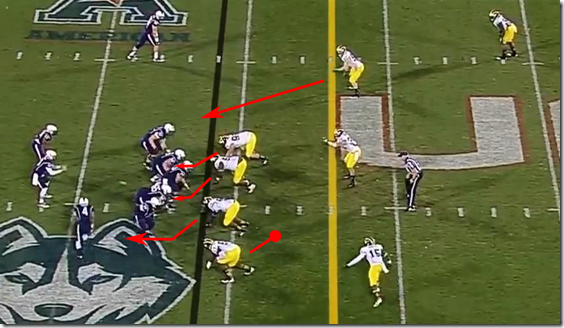
At the end of the session Mattison was discussing a corner blitz they didn't run much because the corners didn't come hard enough. One of the cut-ups was from the end of the third quarter against OSU. This play:
The coaches' film is a wider shot and emphasized the huge distance Floyd had to make up to catch Miller before the touchdown. Mattison took the opportunity to point out that this was an example of the corners not coming hard enough and gush over Floyd ("I love this kid") in general and specifically as an exemplar of the Michigan philosophy. Floyd's effort led to this:
And that led to a field goal.
Bonus: For those looking for a reason other than blind luck that Michigan recovered 80% of opponent fumbles this year, in practice all incompletions are live balls. Mattison credited this practice for getting players moving towards the ball at all times and being in position to scoop up live balls in actual play.
Technique a priority. This was a feature of both the general philosophical section and the chalk talk. Mattison did not select the cutups himself—that was delegated to a video coordinator—and didn't know exactly what would come up. This made for an interesting dynamic as he evaluated each play live. He repeatedly digressed from his main topic to note the footwork of his linemen: Van Bergen is getting distance with his first step. All of these guys have identical footwork. There was also a long discussion about why your rush end needs to start with his outside foot back when he gets a tight end to him*. Etc.
In the philosophical section he noted that Michigan was probably the only team in the country with a head coach who coaches a position, that nose guard. It was at this point he told the story about Hoke coming to him fuming, saying he "wasn't going to be one of those head coaches who just walk around" and demanding a position group. He took the nose. Zinger: "now… I question why he coached the best player on the team."
Here he also noted that everyone hits the sled every day and that this was not something the previous coaching staff did frequently, if ever. This is where the bit about "I've never seen such awful technique" came in. Pretty much the only thing negative Mattison said was about the state of the team he was handed. Everyone who's surprised raise their hand. That's no one.
The final bit on this: "don't go be a scheme coach, focus on technique."
*[The reason is the biggest threat to the rush end in this situation is getting reached and if the tight end flares out to do so that first step needs to be one that gains him distance, something you can't do while remaining square if your outside foot is to the LOS. Disagreement with this appeared to be a pet peeve of Mattison's.]
Big plays. Obviously a priority just from the play on the field. Section on this concentrated on the secondary, declared the biggest problem with big plays. Hates it when safeties "look like blitzing linebackers" when there is a pile. He wants a cup around the pile and safeties to make tackles at least six yards downfield.
Now, that doesn't mean Jordan Kovacs needs to make a tackle six yards downfield. In this context a safety is a player in a deep zone. This is most often the corners and Gordon/Woolfolk.
Rotation. This is a Hoke thing Mattison was skeptical about: Michigan rotates the entire defense on every play of practice. Run on—snap—run off. This is "not pretty" when your 21st and 22nd best defensive players are going up against the first team offense but builds conditioning and depth and was credited for "saving the team" in the Sugar Bowl when injuries whittled down available defensive linemen to dust. Think Martin and Van Bergen in the third quarter.
Situational
Goal line philosophy. To Mattison it's simple: one zone "you run perfectly" and an all-out pressure.
When they're backed up. Mattison asked the crowd to think of what they are thinking when they've got the other team backed up, and then said "how many of you are thinking 'don't give up a big play'?" Mattison's been there and tries to fight that. Now if you're backed up, "if we have a great run pressure, we're coming after your ass."
This goes here.
Not exactly a run pressure but Michigan is sending all five guys on the line there. "When you have a chance, when they're backed up, go after their ass."
Third down. "For us, we're gonna pressure." Mattison on the end of the Akron State game:
You saw the Ohio game, you probably thought 'this guy is the dumbest sonofabitch in the world' He turned a wide receiver loose against Ohio a couple minutes left in the game.
But we intercepted it on the next play. Did we win? Yes. So we were aggressive and we won. [laughter]
So they'll be aggressive come hell or high water, that's clear.
Scheme
4-3 versus 3-4: THE FINAL WORD. "We'd be here for hours" if someone tried to argue him away from playing the 4-3 under. Said something along the lines of "if you've got that 330 pound nose tackle and your ends and your linebackers, okay, God bless you." I thought of Pipkins—what is Mattison going to do with a 330 pound nose?
Anyway, Greg Mattison will never run a 3-4. End of story.
4-3 under assertions from the man himself. These aren't too different than the things you'll hear about the under when you read up on it on the internet but just to confirm, the basis of the defense:
- Rush end: "The whole thing is predicated on the rush." Must be a great player, and athlete who can spill power (ie, get into a pulling guard and stop him in his tracks), drop into coverage, and win one-on-one battles with the tight end. All that and he's got to be a ferocious pass rusher. More similar to the SAM linebacker than the SAM is to the ILBs.
- SAM linebacker. Must not be outflanked either in the run or the pass game. Hugely important not to give himself up one for one on the edge. [Editor's aside: that's something we were talking about a ton early in the year. It got a lot better as the season progressed.]
- Inside linebackers. The usual: the mike has to be a little bigger, a little stronger, and the will has to be able to adjust to coverage outside of the box. An important difference between the two is the WLB has to be able to run vertically down the seam whereas the MLB can pass his guy off; IIRC this year the guy running down the seam was Demens, not Morgan. Adjustment based on Demens's surprising ability to stick with guys downfield?
- Nose tackle. Also hugely important. "You cannot win with a weak nose." We should start calling our incoming five star "No Pressure Pipkins" right now.
- Corners. "Corners are corners" but the field corner (Countess) is not involved with "heavy work" and usually just has to clean up plays that have been strung out. The boundary corner (Floyd) has to be a bigger guy better in run support. It's a seven man front; if you go eight you'd "better have a war daddy" at field corner because he's got to cover an outside receiver with little additional help.
Michigan does not align to strength but rather aligns to field—ie, if you're on the left hash the SAM will be to the wide side of the field and if you're on the right hash the SAM will be to the wide side of the field. You can flip your tight ends all around and Michigan won't flip in response. I assume the flipping from earlier in the year was a necessary evil as Michigan tried to get everyone up on the new system.
The most important thing. One of the line shifts Michigan runs is called "pirate technique."
Player Notes
Kyle Kalis. Mattison saw one of the St. Ed's guys and mentioned that Michigan had recruited a "real man" out that school, one that "may just maul some of our guys."
Brennen Beyer. Beyer was talked up like a future star. Reportedly up to 250 pounds and will be given an opportunity to win the WDE job in the spring.
Jake Ryan. Mattison said Michigan was "blessed" at SAM linebacker—probably including Beyer in that assessment—and that Ryan was a major player. A major player they probably wished they didn't have to run out as a freshman, but a major player.
Mattison referenced a particular play against Nebraska on which he lined up on the wrong side of the field. I remember that but I don't think it was against Nebraska; there's no mention of it in the UFR. "Still a lot of coaching to do" with him but it's clear they think he has vast potential.
JT Floyd. As mentioned, Mattison seemed enamored with him. "Love that kid."
Desmond Morgan. Came up on a couple of clips where he ended up clubbing offensive linemen. Mattison said something along the lines of "think he'll hit you?" And "is that good or what? For a little freshman?" It is unknown whether he has ever said "freshman" without preceding it with "little."
Morgan tipped one of the blitzes they run; Mattison mentioned that he told Morgan he'd play three technique if he kept it up. This is a common threat, as…
Kenny Demens. …they literally did this with Demens, playing him at nose so they could have Martin run the blitzes he wasn't coming hard enough on. In contrast, the SAM (Ryan) was called out as a guy who does come hard.
Some secondhand reports that the implication was Demens's job is under threat have filtered out to premium message boards; I did not get that vibe.
Jordan Kovacs. Michigan's "down safety" or "close safety"—I'll stick with strong, FWIW—was "tremendous."
Departing DL. Heininger "really became a football player." Seems like they think they'll miss him. Van Bergen "really, really played" for M and Martin was of course the best player on the team.
More On Next Year's Front
no pressure, Ondre
As part of the run up to the Super Bowl, Smart Football posted a Grantland article detailing the Patriots' defense. It's not much good at football, that defense, but it is pretty interesting from the Michigan perspective for two reasons.
Reason one: it provides an excuse for Chris Brown to talk about techniques in an easy to understand way.
"Gap" refers to the area between offensive linemen. A 1-gap technique is just what it sounds like: The defensive lineman lines up in front of the gap he is responsible for and his job is to attack and control it. If nothing else, a defender must not allow a runner to go through his gap. While defensive linemen attack their gaps, the linebackers behind them are responsible for their own gaps. These are the defense's "run fits," meaning how they fit into an offense's blocking scheme to take away running space.
Courtesy of Chris BrownThe 2-gap technique, by contrast, sounds physically impossible. How can one player occupy two separate gaps? He does it by controlling the blocker. At the snap of the football, a two-gapping defensive lineman does what Wilfork did to Birk. He leads with his hands, gets leverage on the offensive lineman, and takes control of the blocker. From there, the advanced techniques kick in. On run plays, the defender reacts to where the blocker tries to take him. If he is double-teamed, he'll try to split the blockers and either shoot into the backfield or occupy the blockers, thus freeing up his teammates to make tackles.
In short, while a 1-gap player attacks gaps, a 2-gap player attacks people. Football's conventional wisdom states that an effective 2-gap lineman, particularly one who lines up in the middle of the defense like Wilfork does, must be enormous. Coaches refer to them as "war daddies." But size is actually less important than athleticism and smarts. The line between touchdowns and stops in the NFL is exceedingly thin, and it's footwork and feel that are the difference. It is the most violent, most complicated, and most beautiful ballet I can think of.
Count the war daddies on the Michigan defensive line. You come back with a true freshman and an inconsistent former five star who can't play consistently without standing up straight. The other guy who would be two-gapping in a 3-4 is… Nate Brink? Jibreel Black? A true freshman? Not happening.
This matters much more than a surfeit of linebackers when you're trying to pick a defense to run, especially when moving to a two-gap system does not get more of them on the field. The 3-4 is not coming to Michigan.
At least not in total. We might see bits and pieces, though…
Reason two is an interesting adjustment the Patriots have made to adapt to their personnel. Wilfork is a monster they would like to use to the maximum extent possible, which means two-gapping him. Asking him to be Mike Martin is a lot like asking Ondre Pipkins to run a bunch of goofy pass-rush stunts like he did in the AA game. But because of deficiencies elsewhere Bill Belichick (mainly a 3-4 guy) feels compelled to run a 4-3, which generally means one-gapping.
What to do?
The Patriots run a 3-4 to one side of the field and a 4-3 to the other, all on the same play. The key to all this is Wilfork. He lines up over the center and assumes his traditional spot of run-stuffing, blocker consuming, two-gapping war daddy. Belichick fills out the rest of the pieces based on the strengths and weaknesses of his other defenders.
Create a hybrid. This is the Patriots' under front, one similar to what Michigan ran this year except with one planetoid defensive tackle and one strong-and-good strongside defensive two-gapping. This might be something we see from Michigan next year. Getting maximum production out of Pipkins basically demands something similar.
The problem here is still the same one we have when we theorize about moving to a 3-4, though: there is no SDE on the roster with a prayer of being able to two-gap anything. If you try to get clever by flipping Campbell out there you're asking for it when that tight end goes in motion to the other side of the line and you're either rearranging the entire DL on the fly or running this:
Your weakside DE is not a pass rush threat at all. So don't expect this next year.
HOWEVA, even if you shouldn't go around calling the defense "basically Belichick's" yet, we should expect Pipkins' deployment to be radically different than Martin's. That should mean fewer blocks getting to the linebackers and more plays from that unit. If the ILBs find a surge in productivity it will be because of Pipkins—not because he is a better player than Martin, but because he's a different one.
You'll be able to tell if this is happening by Pipkins's alignment. Martin played a "shade"—he aligned in the gap between the center and guard. If Michigan wants Pipkins to be Wilfork they'll put him nose to nose with the center and say "sic 'em."
-------------------------------
This is where disclaimers go. Even with New England doing this a major theme of the first half in the Super Bowl was that one-gap backside tackle getting doubled (often on zone runs) and blown up. It is never as simple as "this guy gets one on one blocking." All you can do is change the equation so that doing that exposes someone else to a tough assignment. You can't entirely cover up for a sucky player.
Pipkins may be talented but there's more to playing nose tackle than talent. You can dominate your guy, push him into the backfield, and still screw up if you lose control of one of your gaps. Usually this happens when the DT gets pushed too far in the direction he wants to go and opens up a cutback lane behind him. When one of these players is Gabe Watson and the other is Pat Massey, pain results. It's not too hard to envision that happening what with Will Campbell still a rotation player you're a little afraid of. At least he's not 6'8"*.
It may make more sense to start Pipkins off with the easier assignment (always one-gap) and hope to make him impactful in two gaps later in his career. That'll be one of the interesting tactical decisions we unveil against… oh, Christ. Alabama. Yay!
*[Who in the hell looked at a 6'8", 260 pound player and put him on defense? That is either a tackle or a tight end or a man who should be playing basketball.]
Mailbag: 3-4 Switch (Again), Kenpom, Basketball Leaders, The More You Know
Brian,
What is the possibility of switching to a 3-4 defense next year? With a lack of a proven option at DT, and a seeming plethora of linebackers coming in that look ready to start from Day 1, it seems like it would be a wise move. Mattison ran it at Baltimore so we wouldn't need to worry about running a system our DC doesn't understand. Or is that asking for trouble with Will 'high pads' Campbell trying to absorb double teams?
This comes up over and over. Look:
Brian - Any chance Mattison takes a stab at running a 3-4 next year with Will Campbell as the space eater in the middle and Cam Gordon/Jake Ryan the speedy LBs? I image he prefers that base defense because of the variety of blitzing looks it can bring to confuse a 20 year old QB but has he discussed it at all in press conferences. Also, the LBs coming in are upgrading the athleticism to potentially smooth the transition in coming years.
-Jim Dudnick BBA '01
I think I've already dispelled it multiple times, but here it goes again: Michigan will not switch to a 3-4. If it looks like they're recruiting to a 3-4, well, that's because the 4-3 under is halfway between a traditional 4-3 and a 3-4.
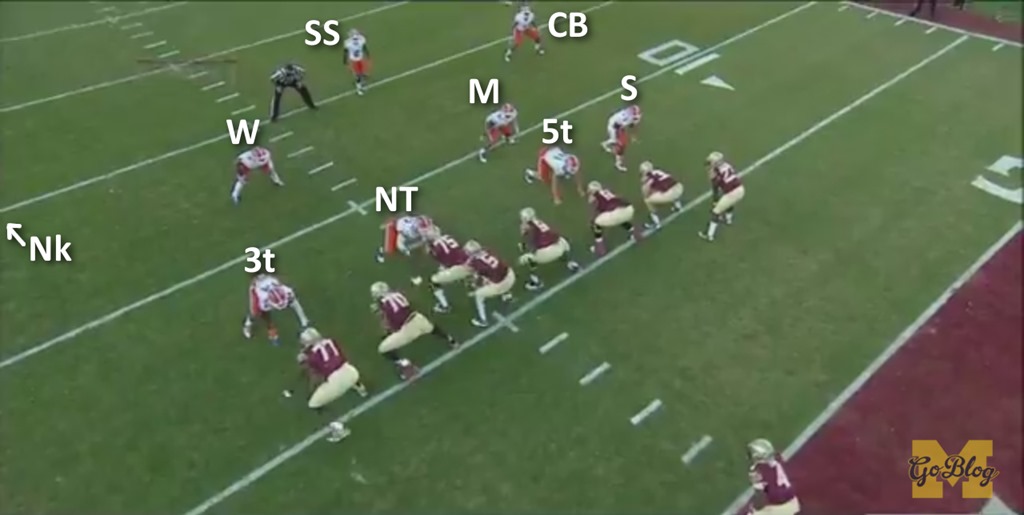
Consider the effect of shifting the line against the strength of the formation:
- The SDE moves inside the tight end and becomes vulnerable to double teams
- The NT hovers near the center
- the DT is lined up just outside the guard
- the WDE gets outside the tackle and is hard to double team
What personnel do you want for that? You want a big bulky DE on the strongside and a penetrating, athletic whip on the weakside. Your nose tackle needs to be able to take on and beat double teams either by splitting them or forcing both players to stay in to block him; the three-tech also must hold up on the interior. That's not that different from what you want from your three down linemen and weakside OLB in the 3-4; add in the SLB hovering around the line and the two MLB types hanging out off the LOS and the under is probably closer to the 3-4 than a 4-3 in terms of personnel.
What the under gives you that the 3-4 doesn't is flexibility in your playmakers. This year Mike Martin one-gapped the hell out of opponents, darting into the backfield and destroying play after play. Next year Ondre Pipkins or maybe Campbell (but probably Pipkins) may be able to shove opponents five yards backwards but he's not going to be as explosive. This should be okay since he will free up Demens. In the 3-4 Martin is not a viable nose (or at least not as good of one) because he has to two-gap—hold his ground and be able to pop off either side. Theoretically, anyway. These days fronts are multiple.
Moving to the 3-4 does not fix any hypothetical issues on the line; Roh and the various WDEs become OLBs* and you're still replacing the three interior players. Instead of allowing those new guys to take one gap and hit it hard you're asking them to play both sides of a player, which means they have to be immensely strong and able to anchor; quickness is much less of a consideration. The 3-4 would exacerbate potential issues with young and/or light players (like Brink). It is the opposite of a panacea.
*[Remember that Michigan's one-year dalliance with the 3-4 saw Lamarr Woodley play OLB.]
35th in Kenpom seems low for a team that beat their number 3 and 6 teams. This seems to be a big game team, they play well against good teams and then sleep walk through Iowa and Alabama A&M Tech State. What would our ranking be if we removed every team over 50th (arbitrary cutoff)?
I don't know but I agree that Kenpom seems to have a weakness in that sloppy games against poor competition seem to have a greater impact on the rankings than they do expectations from Vegas. This can make the rankings and predictions look odd.
But that's tough to weed out. If I understand his methodology correctly, Pomeroy tests out changes to his rankings and only implements them if they improve the overall accuracy of his prediction engine. The '06 Gonzaga team is one that Pomeroy thinks his system underrated because they did not play with much effort defensively unless they had to and thus didn't rack up the huge margins of victory that see teams like OSU, MSU, and Wisconsin near the top of his ratings this year.
In Wisconsin's case you can make an argument that their defensive style is dominant against weak competition but fails for whatever reason against better competition… but then how do you explain the Badgers' considerable success over the past half-decade? If you can't find some correlation to go with your model that's as useless as a correlation without a model.
Michigan beat Western Illinois by four and a few other weak teams by ten or thirteen and thus hover lower in the rankings than they maybe should. (Iowa is another matter. That's not screwing around after getting a big lead, it's getting blown out by a bad team.) Could Pomeroy find a way to downplay games between badly mismatched teams? Maybe. If and only if it made the prediction engine stronger, though. Evidently he hasn't.
DISCLAIMER: I know I rely on Kenpom's tempo-free stats extensively but they are just numbers and they do have flaws even Pomeroy admits; that doesn't make them bad or useless. It's a reminder to keep them in perspective.
Brian,
What are the options for captains on the men's basketball team next year? With Novak and Douglass around it's something we haven't had to think much about much lately, but what scenarios do you foresee playing out? I figure you're looking at a group of players (provided no unexpected attrition) from Vogrich (Sr), Morgan (Jr), Smotrycz (Jr), Hardaway (Jr), and Burke (So). Being that Vogrich seems to have a dab of the gritty mcgrit that Novak and Douglass feature along with being the only senior, I can see him being one of them. But from there do you hope THJ matures with the imaginary 'C' on his jersey? Do you go back to the sophomore route that worked with Novak and give a nod to Burke? Do you tap into the floppy hair of McLimans? So many options...
That is tough, and gives me the heebie-jeebies as I think about Michigan's inexplicable collapse in 2009-2010 after the departures of CJ Lee and David Merritt. That decline is the most powerful argument in favor of gritty leadership I've ever run across, and Michigan is going to have huge shoes to fill in that department next year. Getting that right is going to be captial-I Important.
Honestly… doesn't Burke seem like the guy despite his youth? He spent the offseason before his arrival documenting his insane workrate on the internet and has immediately become the headiest player on the team, non-Novak division. Hardaway has the passion but often fails to control it; Morgan is a quiet guy who has to be goaded into emotion by Bacari Alexander, Vogrich doesn't seem to have the on-court impact to be a candidate, and Smotrycz… I don't know. Smotrycz just doesn't give off the vibe. I'd guess Burke and Hardaway, as odd as that might seem.
The more you know, part one.
If Wikipedia is correct, Denard Robinson has the chance to be the first player in Michigan history to be a three-time team MVP. There have been 6 two-timers:
Ralph Heikkinen
Tom Harmon
Ron Johnson
Mike Hart
Brandon Graham
Denard RobinsonNobody has been a two-time B1G MVP
This may be something to keep in mind when debates about Robinson's place in Michigan history (like, is he patch-worthy) come up. Unless Robinson makes that argument moot.
The more you know, part two.
A commenter dug down to find the last Michigan players who graduated with a winning record against MSU:
It was Louis Bullock (1995-99), unless we're not counting the vacated games. If we're not counting any of them (we vacated the 1992-93 season and everything from 1995-99), I believe we have to go back to the seniors on the 1989-90 team (Terry Mills, Rumeal Robinson, Mike Griffin and I think someone else [ed: Loy Vaught]).
Bullock does not count. Bullock can go to hell. Vacated games do not count generally. So it's been over 20 years. That's what's at stake for Zack Novak and Stu Douglass in Breslin.
Side note: I hear tell Michigan is going to PSL-up the lower bowl in Crisler next year, with one section opposite the students at midcourt designated for high rollers with a 1k+ PSL attached. Part of this revamp will be the addition of a club analogous to the one at Michigan Stadium for said high rollers.
It sure would be nice to somehow name it after a guy who's given his all for the program like Novak…
…instead of a rich guy whose contributions we certainly appreciate but do not viscerally feel, no offense rich guys.