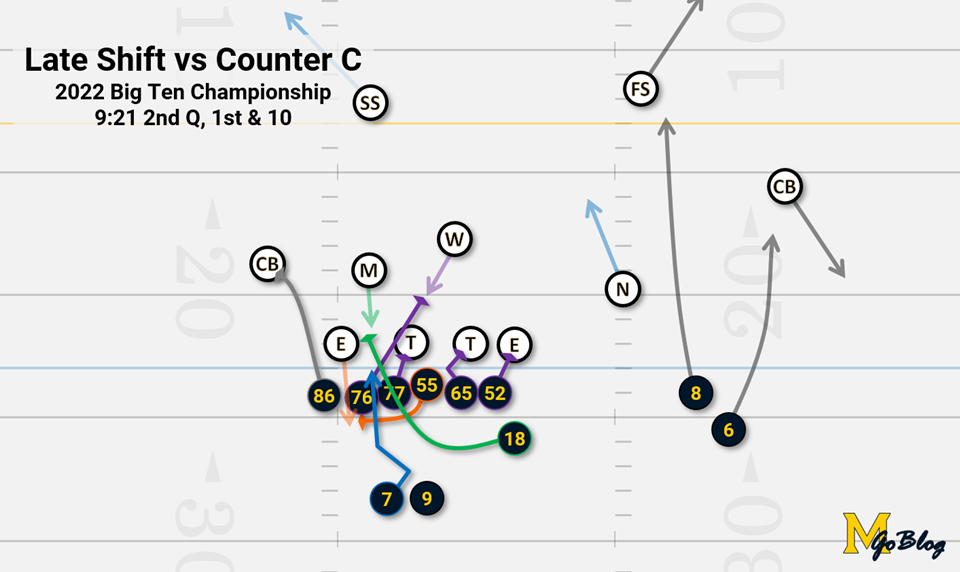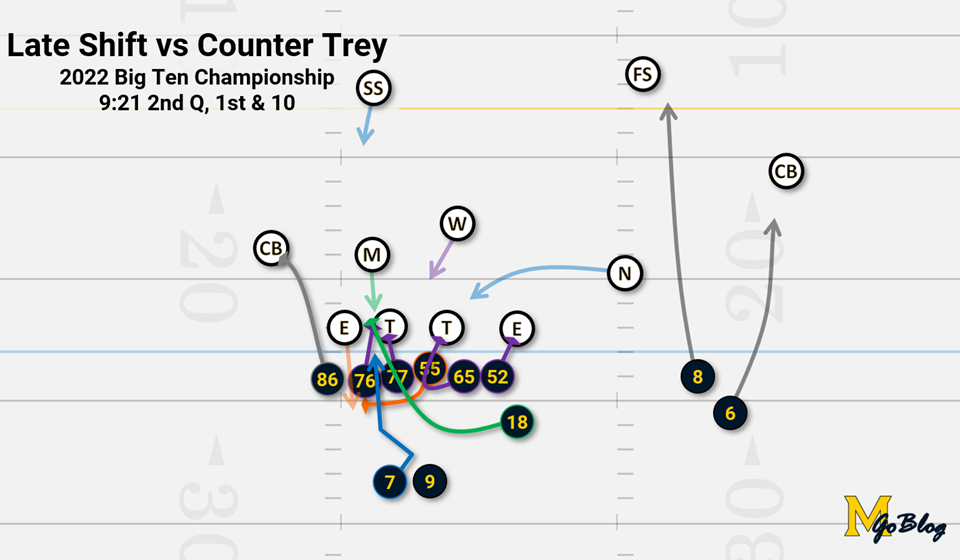
yes plz
power off tackle
Mailbag: Allowing Threes, Height == Rebounding?, Why Pulling Is Hard
Brian,
As you've referenced with KenPom's research several times, it would appear that the best way to defend the 3 point shot is to keep your opponent from shooting them at all. Unfortunately, according to an ESPN insider article, Michigan is allowing its opponents to shoot them on 36.9% of their possessions, which ranks 295th in the nation. Does this concern you? I think we would all hate to see Michigan beaten in the tournament by a less talented opponent with a hot hand from deep because they can't prevent teams from getting off 3 pointers.
Thanks.
Somewhat. The nice thing about Michigan's defense is how few shots at the rim they give up. Michigan's forcing more two-point jumpers than any team in the league except Nebraska:
Team Defensive Summary
|
Shot Type |
% of shots |
FG% |
% of Shots Blocked |
Unblocked FG% |
|---|---|---|---|---|
|
At Rim |
25% |
62% |
10% |
69% |
|
2pt Jumpers |
39% |
35% |
5% |
37% |
|
3pt Shots |
36% |
32% |
1% |
32% |
The conference:
| Team | Rim | 2PT | 3PT |
|---|---|---|---|
| Nebraska | 24 | 46 | 30 |
| Michigan | 25 | 39 | 36 |
| Indiana | 26 | 37 | 36 |
| Iowa | 27 | 38 | 34 |
| OSU | 28 | 38 | 34 |
| Minnesota | 29 | 39 | 32 |
| Penn State | 31 | 30 | 40 |
| Purdue | 33 | 41 | 26 |
| Wisconsin | 33 | 42 | 26 |
| Illinois | 34 | 31 | 35 |
| MSU | 35 | 34 | 31 |
| Northwestern | 39 | 30 | 31 |
Insofar as shots are migrating to three-pointers, they're shots at the rim. So… that's okay. Ideally you'd like to see that Nebraska shot configuration, but to do that the Huskers give up on the idea of offensive rebounding and steals.
I'm not sure what Michigan can do to improve their defense at this point. Forcing a lot of jumpers plus their defensive rebounding and lack of fouls has propped their defense up, and that's about all they can do. They don't have a shotblocker—at least right now, maybe Horford can provide some of that later in the season—or an elite perimeter defender. They rotate out on pick and rolls to prevent guys getting to the basket, and then you have to start rotating away from the corners. Threes inevitably result… if you're not Wisconsin.
As for the tourney, it will be tough for any major underdog to keep up with Michigan's offense, but a second or third round matchup against a good defensive team that takes and hits a lot of threes would be worrisome.
Brian,
Whenever Michigan gets a 3-star recruit earlier in the process, there tends to be widespread complaining about taking up scholarships that could be filled by more highly rated players. The general response to that is, "I trust the coaches to evaluate players." This got me to thinking that most major programs essentially have their pick of just about any three star player that they want.
My question is, do three star and lower players who go to major programs perform better on average than the total population of three star players?
I understand it would be hard to distinguish between a three star player taken for depth/filling out a roster purposes compared to a three star player who the coaches think are better than their ranking, but I thought it might be an interesting topic to explore.
I'd guess it's actually worse since there's more competition and recruiting sites give recruits at the bottom end of the scale a courtesy bump to three stars 90% of the time a nobody commits to a power program.
At Purdue, everyone is a three-star player and someone has to be relied upon; sometimes you get Kawann Short. At Michigan—at least at Michigan in the near future—the three star is going to have to climb over some other guys to get on the field.
I do think that there is a big difference between a recruitment like Reon Dawson—who Michigan clearly grabbed to fill a previously designated spot that was vacated—or Da'Mario Jones—seemingly offered once Treadwell flitted off—and Channing Stribling, who Michigan liked at camp and then had a very nice senior year. To put in in Gruden terms, did Michigan want THIS GUY or just A GUY?
Brian,
In your post, "Aging in a Loop", you mentioned how the solid defensive rebounding performance in Columbus proves that we are for real on the boards this year. I agree completely, but it got me wondering how much of that has to do with our sudden ability to actually have three to four non-midgets (relative use of the term, I get it) on the floor at once. I can't remember too many Michigan teams having anything resembling a luxury of length in quite some time.
Have ever looked for or found any statistical correlation between average height and rebounding prowess? Even the least astute observer must realize it will benefit the numbers, but I guess what I'm after is just how much it actually does?
- chewieblue
[Note: since this email came in Minnesota did pound Michigan on the offensive boards.]
While much-improved, Michigan still isn't a very big team. Replacing Novak and Douglass with a couple of 6'6" guys and adding McGary into the mix has pushed them to a hair above average on Kenpom's "effective height,"* but that's in the context of 347 D-I teams. There are entire conferences where the 6'10" guy is a tourist attraction. They remain a lot shorter than Kentucky, Arizona, USC, Miami, Gonzaga, Eastern Michigan, and others. Effectively four inches shorter, in fact.
Michigan's moved up in the world in that stat—they've generally hovered around 250th in effective height since Beilein arrived—but I don't think that's the reason they've been so good at rebounding this year. I crammed together the data available on Kenpom to eyeball an ugly scatter plot, and here it is:
Libre Office makes sinfully ugly graphs yo.
That round ball with a dense central cluster is typical of things that are not correlated. You'd find something similar if you graphed hair color versus desire to eat bananas.
There is no correlation between effective height and defensive rebounding. If you insert a trend line into this—something I don't like to do in low-correlation graphs like because it implies that there actually is a trend—it actually goes down as your height goes up, at a surprisingly steep slope. Some people would try to apply some crazy mechanism to make that make sense here; I'm just going to tell you there is no meaning. There does seem to be some correlation between EH and offensive rebounding, but not much of one.
Anecdotally, that enormous Eastern Michigan team Michigan played earlier this year is below average at both facets of rebounding despite having played only a few games against decent competition. They're hideous on the defensive glass.
In general this is good news for Michigan, a team that trades some rebounding muscle for increased offensive effectiveness. But why are they so much better this year than last? Well:
- Luck, always luck.
- Effective height does not capture the difference between Mitch McGary and Evan Smotrycz very well.
- Michigan has not trudged through their Big Ten schedule yet; IIRC they entered conference play last year in the top ten and ended up 9th in conference, dropping to 99th overall.
- Tim Hardaway is serious, man.
- Some teams are abandoning the offensive boards in an effort to choke Michigan's transition game off.
If you asked me to put weights on these things I would give them nearly all equal weight, which means they can expect some regression as #1 and #3 betray them but should realize a significant gain from last year's 9th-place conference finish.
SIDE NOTE: You'll notice that GRIII > Novak is not on that list. While it's true that GRIII is much better on the offensive boards than Novak was, their defensive rebounding is essentially identical, lending credence to the idea that getting on the defensive glass is a matter of effort and positioning while offensive rebounding is more about being a skyscraper-bounding genetic freak. Holla at yo' Petway.
*[IE, if you have a seven-footer who plays 10 minutes and a 6'8" guy who plays 30, the 6'8" guy counts three times more than the seven-footer.]
Pulling: hard?
Brian, Quite often the site discusses the ability of an offensive lineman to pull. Why is this difficult? My understanding is that pulling requires the lineman to:
(0) (set up:) ignore the guys across from him before the snap, because the lineman is about to pull,
(1) after the snap, back up a step or two,
(2) run sideways behind other blockers, and then
(3) find a guy to block.
So what is hard? I'm not saying there isn't anything, I just don't know what it is. Is finding the right guy to block hard? Or backing up and running?
Also, have you thought about doing a basketball version of HTTV?
Best, PR
One of the major takeaways from the clinic swing I did last spring was that everything is hard on the offensive line. I missed most of a three-hour presentation by Darryl Funk on inside zone because I was at Mattison's thing, and when I came in I was too far gone to understand much. I also sat in with a wizened consultant who scribbled various v-shaped diagrams on an ancient projector and demonstrated how if you stepped like so your world would end, and if you stepped like so demons would pour into the world from outside known space, but if you stepped like so there was a slight chance of you living to see dinner.
All of these steps looked identical to me. Offensive line is hard.
So. Consider the pull. You are 300 pounds, and you are lined up across from men who would like to run you over, and you are trying to get to a hole past other 300 pound men before a 200 pound man lined up a gap closer to this hole can get there. On the way you may encounter bulges in the line you have to route around. When you arrive you have to instantly identify the guy to block, reroute your momentum, and get drive on a guy.
This is a tall order. Michigan particularly had difficulty with step 2 the last couple years. Here's a canonical example from the uniformz MSU game. Watch Omameh (second from the bottom):
"Run sideways" goes all wrong there as Omameh arcs slowly and Denard ends up hitting the hole before he does; Denard has to bounce as a result when a block on Bullough is promising as the left side of the line caves in MSU.
To get to the place you are supposed to be you have to execute a series of steps as carefully choreographed as anything on dancing reality TV and be able to adapt on the fly, and you have to be able to redirect your momentum quickly enough to go in three different directions in a short space of time, with enough bulk to be, you know, an offensive lineman. Getting there in time is harder than anything the tailback has to do.
How does this impact Michigan's search for run-game competence in 2013? I hope it doesn't since I'd rather have Schofield back at right tackle than moving back inside.
Picture Pages: Short Yardage Slant
wsg Slanty, the football-playing, jean-vested gecko who is inexplicably the first hit in Google images for "line slant football", or at least was a year ago.
One of my main concerns going into the season was what would happen to the short-yardage defense that Michigan was so good in a year ago without Mike Martin and RVB. Turning a third and short into a punt is 50% of a turnover, and Michigan could paper over a lot of deficiencies last year by telling Mike Martin to destroy some guys on third and one, thus allowing other guys to tackle.
Illinois disclaimers are in full effect—they can't do anything against anyone—but the Illini could do even less of anything against Michigan Saturday, and getting bombed on short yardage was a major part of that.
Michigan blew up Illinois short yardage with slants. Multiple times we saw this pattern:
- Michigan slants away from a power run.
- The playside end gets inside and upfield of the tackle or end trying to block down on him.
- The pulling guard bangs into the playside end.
- Linebackers profit.
Actually, Michigan doesn't so much "slant away" as show one defense and run another. When Michigan isn't running their base 4-3 under call they are inverting it by blitzing Ryan and moving everyone else over a gap.
Let's see it in action. /fishduck'd
It's fourth and one on the second and final Illini drive to make it past midfield, just before the half. Michigan has just stoned a power run by Riley O'Toole for a half yard to set up this opportunity. Illinois comes out in one of their standard sets, a pistol with two tight ends to one side of the line and twinned WRs.
Michigan is in an over this time since the strength is to the boundary, but Illinois will move a tight end over and not have an unbalanced strength on the line on the snap anyway so whatever.
This is what Michigan does:
They're essentially moving everyone over a a gap and dropping Ojemudia into a short zone. On run plays he "folds" which consists of backing off, keep an eye out for cutbacks, and allowing the linebackers to run to the frontside. If you're watching a replay and are wondering if Michigan's doing this gap-shift thing, the WDE backing off the LOS is a sure tip. If you watch for it, you will find it—Michigan runs this on upwards of 20% of downs.
On the snap, Ojemudia backs off and the line shoots down. Gordon, who is right behind Ojemudia in the above frame, has followed the TE across the field and now takes contain responsibility to the playside.
You can see the slant better from this angle:
Campbell is now attacking outside the left tackle, like he's a WDE. Roh and Ryan both shoot gaps to the inside. They get penetration, giving up an outside crease to do so.
Ryan gets under fast. He's essentially through clean, so the pulling G has no choice but to pick him off. Demens is already a yard off the LOS and charging as the handoff is made.
Now it's all about tackling.
Check.
Demens went inside out here as the back tried to go north and south on fourth and inches. That allows him to use the pile as help, and look at Desmond Morgan popping up to say hi/clean up any messes.
If you take a second look at this frame:
Note how Morgan is also clean and has stepped playside as the slant develops. He's still trying to check for any potential cutbacks and find the gap he's going to fill; he is available if the back makes Demens miss or threatens to power to the line.
Video
[After THE JUMP: play it sort of again, Sam.]
Picture Pages: Toussaint's Sad Day
[Special Toussaint Mini-UFR is what this is but it didn't seem like a good title.]
The single downer from the Purdue game was Fitzgerald Toussaint's anemic output: 17 carries, 19 yards, and at least one kicked cat in the Toussaint household after his return from West Lafayette. What happened? Should Thomas Rawls be inserted as a replacement? Let's look at pictures and try to find out.
First, let's set aside three short-yardage carries. One was a third and one power that just made it; two were goal line attempts that got in. (There was a third goal line attempt that did not wiped out by penalty.) Now we've got… 15 carries for 22 16 yards, one of which went for two yards but was wiped out by an irrelevant chop block. Dios mio, man.
How much of this is on Toussaint, how much the OL, and how much the line? Let's find out. Toussaint's non-goalline carries ordered by play type.
| Line | Dn | Ds | OForm | RB | TE | WR | DForm | Type | Play | Yards | |||||||||
|---|---|---|---|---|---|---|---|---|---|---|---|---|---|---|---|---|---|---|---|
| M27 | 1 | 10 | Shotgun 3-wide | 1 | 1 | 3 | Nickel even | Run | Inside zone | 2 | |||||||||
| Poor damn Toussaint. Again he's eating an unblocked guy in the backfield. The end shuffled down and then collapsed on the handoff; give or not is a push for Denard because the corner was blitzing. Play was dead on the snap. RPS -1. | |||||||||||||||||||
Barnum gets blown into the backfield here by a Short slant that can happen because of a corner blitz:
Toussaint is forced to cut behind that and then the end shuffling down behind makes the play.
VERDICT: 75% RPS, 25% blocking.
| Line | Dn | Ds | OForm | RB | TE | WR | DForm | Type | Play | Yards | |||||||||
|---|---|---|---|---|---|---|---|---|---|---|---|---|---|---|---|---|---|---|---|
| O22 | 2 | 7 | ,Shotgun 2TE twins | 1 | 2 | 2 | Base 3-4 | Run | Inside zone | 6 | |||||||||
| OLB comes off slot; Kwiatkowski blocks him out. Purdue slides its line playside and has a linebacker behind who's unblocked thanks to the blitz. He's staying outside, so handoff. The slant gets the Purdue OL past the M OL but the M OL gets good push on a couple guys. Mealer(-1) lets Short by him in frightening fashion; Lewan(+1) gets his guy two yards downfield and makes him give up a lot of space. Toussaint(+1) cuts backside and avoids that linebacker, stumbling as he manages to power through the arm tackle. Short can now finish the job from behind. | |||||||||||||||||||
This worked well enough that we can dispense with the Verdict Of Blame.
| Line | Dn | Ds | OForm | RB | TE | WR | DForm | Type | Play | Yards | |||||||||
|---|---|---|---|---|---|---|---|---|---|---|---|---|---|---|---|---|---|---|---|
| O15 | 2 | 10 | Ace big | 1 | 3 | 1 | Base 3-4 | Run | Inside zone | 0 | |||||||||
| Michigan runs an inside zone away from the strength of the formation and into five guys against four blockers. This doesn't work, especially when the playside ILB bugs out to beat a block. Maybe this should have been a cutback. Yeah, maybe, but tough when Barnum(-1) has just caught a guy and is a yard in the backfield. Still, Toussaint -1. | |||||||||||||||||||
This was not set up well from the start:
Michigan's running to the left of the center, where there are four Boilermakers and three blockers. A cutback develops and I have a sneaking suspicion that this run is supposed to cutback just because it can't work if it's run directly at where the action goes.
VERDICT: 50% Toussaint, 25% RPS, 25% blocking.
[AFTER THE JUMP: BLAME! BLAME! BLAME!]
Picture Pages: Slanting Against Power
Picture Pages on a bye week? Sure. I generally take more snapshots than I can reasonably cram into one week of posting what with all the other whatnot that goes on in this space, so this is a perfect spot for some reheated leftovers.
Yesterday I tagged Whoever at WLB as one of the main trouble spots on the defense; last week I criticized the linebackers for a particular Edwin Baker run that popped big despite Michigan seemingly having it covered. I caught some criticism myself for not being harsh enough with Mike Martin on that particular play that I'm still not sure about.
In any case, I pick the individual plays after the game (or season) has developed enough for me to identify a trend, and I grabbed that specifically because of the WTF behavior of the linebackers. Here's a play from earlier in the season that got in my thought processes and may have compelled me to pull that baby out of the bathwater. Metaphors not guaranteed.
------------
It's late against Eastern. The starters are still mostly in; the Eagles have been driving a bit. It's first and ten. They'll run a power play to the strong side of their formation*. Michigan is in their usual under.
*[People have told me this is a "Down G", not a Power O, because the guard blocks down—I see what you did there—and it's actually a frontside tackle pulling, along with the center.]
USUAL UNDER IS USUAL
Ryan to bottom of screen, Frank Clark to top.
The key guy to watch is Hawthorne, who is the topmost of the MLBs.
On the snap everything happens!
By this I mean three things.
- the center pulls
- the frontside tackle pulls
- Michigan slants away from the play
You can see the entire line headed inside away from the playside. Brink, Ryan, Martin: all are oblivious to the idea of containment. This is fine.
SLANTING THE LINE AGAINST POWER
wsg Slanty, the football-playing, jean-vested gecko who is inexplicably the first hit in Google images for "line slant football."
Why do it? To get a free hitter. Your slant should make life difficult for anything run to its side. The downblocks are key in the power. They're the easy bit for the offense. If one gets beat your play is going to not work very well. In all likelihood your pullers are going to take defensive linemen in the backfield, leaving linebackers free to run up and smash face.
If the opponent runs away from your slant it should be okay because the linebackers know there's a slant on and can chase playside as soon as the offense gives any indication there is a playside. This gets the backside tackle/guard/whoever—the guy assigned to the WLB—blocking air. The WLB gets to scrape down the line to tackle.
This gets the backside tackle… guard… whoever…
…blocking air…
…awww, come on, Hawthorne.
In the wider view you can see huge numbers of players on the backside:
Cutback == doom. Hawthorne has no responsibility but to get down the line to the POA. Note the difference in the disposition of the linebackers. Demens is hauling for the frontside; Hawthorne is in full block-catching mode.
Now, Michigan's D can bottle this up without needing a WLB if Ryan gets a two for one on these pullers. He's the guy currently inside of #68. The other puller is running right by him. He's already given up the bounce because of the slant; if he gets into the other blocker Demens has a free run.
Ryan doesn't. He gets knocked to the inside and pancaked, which erases backside help. The other puller gets out on Demens:
Demens has maintained outside leverage, forcing it back to his help, which is three yards downfield and getting farther away.
First down on a basic power run.
VIDEO
ITEMS OF INTEREST
Hesitation is a killer here and it does not seem explicable. Hawthorne does not quite know what he's doing yet, especially earlier in the season. The hesitation gets a little more explicable when you look at the previous play, when one Brandin Hawthorne got burned on a counter:
Even so, with the line slanting in front of him he should know to take off playside at any hint of a pull or any hint of a guy releasing to block him. Slanting should make LB decision processes easy.
This play is one of the archetypical examples of why the WLB is hard to block and can get away with being a slight fast guy… so don't get blocked.
This is especially bad for a player like Hawthorne. Hawthorne looks like Leo Messi out there. He has a hard time getting off blocks and has basically no chance if he's not thundering at whoever is coming out to block him. At least in that situation his momentum can pop the guy back and he can come off to tackle. He's done if he pulls the [REDACTED] Memorial Block Catching Dance.
Ryan missed an opportunity to MAKE PLAYS. The other thing a slant like this can do is take the playside DE/LB and make two guys block him. You see Ryan dive inside the first puller. This means the RB is going to bounce, which means Ryan's basically done. Also done is Ryan's blocker.
Ryan has one way to impact the play left: try to pick off that other puller, leaving Demens unimpeded on the edge. Here he takes the block and appears to try to fight back outside, which ends with him in a heap. This isn't the worst thing in the world but great defenses that swarm these kinds of plays with two guys get both the 2-for-1 and the WLB in the hole.
This is one of the reasons I'm looking owlishly at the WLB whenever something goes wrong. Picture Pages are attempts to thematically summarize trends I see as I'm UFRing, so when I pull a play to illustrate something it is a complaint/credit I've seen quite a bit of. That may mean I focus on the linebackers on a particular play that may or may not be Mike Martin's fault for not shedding his guy and tackling for loss.
Google images can be weird sometimes.
Picture Pages: Fourth And Fun
Last time we saw Michael Schofield run by a blitzer coming up an interior gap. That combined with a panicked back-foot throw from Denard to result in an interception on a play that had otherwise opened one of two receivers up for an easy touchdown.
This time we're going to get an almost identical play from the offense, except instead of play action is it QB power. This is the fourth and one Michigan converted en route to the endzone.
The setup is the same: shotgun with twin TEs and twin WRs. Northwestern lines up in an even 4-3 with one of the linebackers over the slot and a safety rolled into the box. For fourth and one this is fairly conservative:
With Denard running the ball Michigan has a blocker for every opponent.
On the snap, Schofield pulls…
…and the SLB blitzes, hell-bent for the gap between the playside DE and DT, both of whom are doubled:
Faced with a similar situation on the last play, Schofield ran by the linebacker:
This time not so much.
With both linebackers gone—the other one ran into the line on the backside—and a double on the playside DE, once Smith kicks out the corner it's an easy conversion.
Video
Items of Interest
Being the pulling guard seems a lot more complicated than you'd think. A lot of power blocking is derp simple: block down on this guy. By contrast, everyone who runs a zone system talks up the need for their linemen to be intelligent because to run the zone you have to make a lot of split second decisions about who to block and when to release.
On these two plays we've seen what happens when a pulling guard gets challenged from a gap he doesn't expect to be threatened. He can miss it, at which point rivers of baby blood, or he can adjust, at which point your unsound defense has put the QB one on one with a safety for bonus bucks. He's got to have the vision and agility to pull that off. That's tough.
This seems like one of the major problems with the pulling scheme: the guards are crappier at it than the defenses are at defending it. Last year when they pulled out power blocking, defenses were trying to defend the zone and often got caught off guard. This year Michigan does not have that luxury. As a result we've seen a lot of plays on which the pulling guard gets caught up in some wash or just takes a bad angle to the hole.
"Adjustments." Is this an adjustment, or is it just telling the guard what he did wrong and not to do it again? In my view, an adjustment is changing your scheme to combat something the other team is doing—like throwing Ryan out on the slot to prevent argh bubble death. Telling your players how to stop screwing up is coaching, but it's not adjusting. What I was trying to say in the game column was that because of the nature of the offense they didn't have to do much adjusting, they just had to stop screwing up, at which point points fall from the sky.
This is not black and white. Borges did bring out some actual adjustments, like using Shaw to get the edge on theses aggressive linebackers, but I think the second-half turnaround was less figuring out what Northwestern was doing and stopping it than having a few specific players fix things the scheme is already telling them to do.
Short yardage numerical advantage. Not running Denard on short yardage is a goofy idea. Here you'd have to be nuts to not run the guy. He gives you the ability to double the playside DE and still block everyone except a safety rolled up. He has to be cautious because if he misses it's six points.
Handing it off, even on a zone read that should occupy some defenders, runs the risk of the defense selling out and Denard missing a read. Going under center takes away one of those doubles and turns the read into a call-and-hope situation.
I can see running conventional stuff in a low-leverage situation like first and goal from the one, sure. Keep the wear and tear down. When it really matters, this is the way to go.
Perfect mirror. This is a perfect mirror of the play that Denard got intercepted on, which is why the latter suckered Northwestern so badly and would have likely resulted in an easy TD if Denard can buy some time or Schofield makes the adjustment.
Mailbag: Zone/Power, Stretches, Trail Technique, Play Action, Linebackers
NOTE: I am looking to purchase a pair of tickets to Northwestern. If you've got a couple extras email me to discharge built-up beveled guilt.
Power vs zone read. A couple weeks ago I wondered if running a bunch of power had opened up the zone read again or if it was just an effect of playing Bob Diaco and Ron English. Frequent correspondent Tyler Sellhorn provides some insight:
WLBs are the bugaboo defender for the power play (double team frontside = WLB difficult to block/unblocked). They are coached to hit the window created by the inside OL stepping to the double. Playside combos of inside zone are difficult to distinguish from straight doubles.
The best defense vs. ZR is to exchange gaps between the DE and WLB (you already know this). Therefore, these two plays in concert screw with the WLB assignment-wise from a gameplan standpoint. Gap-exchange weakside means that the free defender versus power is no longer paying any attention to the RB running said power. Leaving the DE to defend the ZR by his lonesome, though, against DR...hell to pay.
Hope that enlightens.
God Bless,
Tyler Sellhorn
Since then we've seen San Diego State defend the zone read (and nothing else) ably and Minnesota defend nothing (and nothing else). A test of this theory will come against Northwestern, which may have given up 38 to Illinois but held the Illini rushing game to just 82 yards. Sacks factor in but even without those Scheelhaase and company managed just 3.1 YPC.
They also gave up 400 yards passing, so don't get too frightened.
Stretches versus outside zone. I've been using the two terms interchangeably, which Tyler suggests is mistaking rectangles for squares:
…the zone stretch, the various sweeps (including QB sweeps), pin/pull, and when the G tries to "log" the end/OLB on Down G, the Dash (frontside zone read) all try to accomplish the same thing: circle the defense and (usually) carry the ball between the numbers and the sideline.
What I am getting at is that you have made the statement that there have been zero stretches and it feels like you are implying that M is not trying to get outside when you make that statement. There are lots of ways to get the same thing as "stretch" conceptually, and Borges is trying to fit the concept into what he already has experience calling and know what to call when. For example, QB sweep was the first call against WMU.
So yeah, you keep harping on "zero stretches" when there have been plenty of attempts to get the ball outside, but M is using different blocking schemes to do the same thing. You just need to be clearer about what you are trying to say in regards to this: we should be running outside more or we should be using stretch to run outside. That is the distinction I am encouraging you to make.
Tyler Sellhorn
Right, then: I'd like to see more outside zone blocking from Michigan because they're pretty good at it and don't seem particularly good at getting outside with pin and pull stuff or toss sweeps.
Advanced not looking at the ball. Chris Brown of Smart Football had a couple of things to add in re: Michigan's NOBODY CARES WHEN WR LOOKS FOR BALL coverage technique:
Saw your picture pages on Michigan DBs playing the fade and having success playing the man versus the ball. Thought you might find this of interest from Saban.
Basically if you are even with the WR, you play the ball. If the receiver looks over his inside shoulder you look back that way; if the WR turns his outside shoulder back you turn into the WR (toward the sideline) to play the back shoulder fade.
But if you're out of phase with the guy, ie trailing him, you don't turn back to find the ball because you never will and they'll catch it; you play the man and his hands and eyes. (I get the impression that this wasn't the case last year.)
From the photos I saw on your site the Michigan DBs are doing a good job playing the man, but that's because they aren't "in-phase" with the WRs. If the throw was better they'd probably be completing the fades. But you're closer to this stuff than I am; mostly wanted to pass along the Saban points.
So Michigan's trail technique seems born of necessity. Since they don't have Charles Woodson or Leon Hall back there the best they can do is go for the PBU. We've seen Blake Countess look for the ball because he's in better position a few times.
If Countess proves to be the real deal and Michigan can get a second corner at that level we may see more DBs look back for the ball. As it is the current technique is at least an excellent stopgap.
A little outdated. This came in before the Minnesota game:
Brian,
Do you think Denard would be as effective a runner from the RB position as he is from the QB position? My gut says he would not be but can't explain why. I bring this up given his continued poor passing performance with some people clamoring for him to change positions.
Peter F
Denard wouldn't be as effective a runner because he excels in the space allowed by a spread formation. In a pro-style offense he would probably be too slight to be a tailback, at least full-time. He'd end up in the slot.
The main tactical innovation allowed by having your QB as a runner is it allows you to spread the field horizontally by adding more WRs without giving up the extra blocker. With the defense locked in on those slots—something the threat of the bubble screen enforces—a guy like Denard can pick and choose from big gaps that open up because the defense is stretched.
Handing it to a tailback without using the QB as a threat invites an unblocked guy through since there are fewer blockers in the area. Think of this like a power play: a 4-on-3 power play is more dangerous than a 5-on-4 because it's easier to find the open guy and there's more space. The shotgun provides the extra man by using the QB as a runner. That extra space means Denard can make yards by accelerating past tackles instead of breaking them.
Denard's still pretty good when things get tight, but the pounding would be worse if that was all he was doing.
Play action problems.
Brian, would like your view/analysis of Denard's play action fakes and the importance of these in the offense. It does not appear to me that Denard really sells the hand off as much as other QB's. I'll spare the comparison to Peyton Manning. A good play fake can open up zones in the secondary and give Denard more time to make his reads as the defense should be crashing on the running back. Or, is this less of an issue in a zone read offense since there is basically a play fake on the majority of plays.
It appears to me Borges likes to throw off play action and if the QB is not selling it, that might account for some of the pressured throws we have seen from Denard so far. (disclaimer about adjustment to learning a new offense a given)
Thanks,
Trueblueintexas
There are two entirely different playfakes Denard is executing. There's one from under center and one from the shotgun. It is possible that Denard's fakes from under center are not convincing, but I think the bigger problem is that the run game is not threatening. When you're averaging three yards a carry, safeties don't have to worry about your run game because it's not getting to them. I'll keep an eye out if we get more play action from the I-form later in the year. It's possible he's a problem there since he hasn't really practiced that skill.
The shotgun is a different matter. When Michigan goes play action from the shot gun it's either Denard stepping to the line or a zone read fake. Both are inherently convincing. In the first Denard is moving towards the LOS as the offense run blocks. In the second they are executing the mesh point exactly as they would on a running play. Unless the line is doing things that tip off the opponent there's no difference. The sheer number of hand-wavingly wide open dudes on shotgun PA should be sufficient evidence that Denard's doing just fine with his fakes there.
Linebacker blaming.
Brian,
I'm reading the SDSU preview and you say that Demens and Hawthorne have to get better at diagnosing plays quickly. This appears to be a consistent theme with M linebackers over the last few years. I would assume that this "skill" is probably the easiest to evaluate when recruiting high school players as HS offenses are pretty run heavy. Did our coaches completely drop the ball in recruiting these guys or did they believe diagnosing plays is something that can be taught and, thus, focused more on the recruit's physical traits/potential?
Thanks!
I'm not sure that skill is easy to evaluate because a lot of high school kids don't get much coaching and what they get is of debatable value. You might be able to detect a kid who just Gets It, but plenty of college-level athletes who look clueless early develop into excellent players with college coaching. Prescott Burgess and Shawn Crable are two examples in recent Michigan history.
In the case of Michigan's current starters, the Great Rodriguez Defensive Coaching Malpractice is probably more at fault than recruiting. The current LB crew has been coached by Jay Hopson, Greg Robinson, and Adam Braithwaite. Braithwaite has the best resume of all of those guys by virtue of not having one. They've also swung from one system to another and, in the case of Herron, Hawthorne, and Cam Gordon, from one position to another. If these guys weren't having trouble diagnosing plays that would warrant creating a golden idol resembling Mark Smith.
As it is I think they're doing as well as can be expected. Hopefully we'll see the improvement we never got under the GRDCM as the season progresses.