tempo-free
Bart Torvik's site allows you to slice data into whatever chunk you want; I've been slicing.
One rank to rule them all. Michigan is the #1 team in the country if you consider just games against top 50*, top 100, top 150, and top 200 opponents. It's only when the dregs get added in that Michigan slips back to third.
The reason for this is pretty obvious: zones. Torvik's algorithm thinks more highly of Michigan's offense than Kenpom and the teams that get added back in when you consider every game are Norfolk State, George Washington, Chattanooga, Air Force, and Binghamton. That selection of opponents contain the large majority of Michigan possessions against zones.
Michigan's offensive issue-type substances almost entirely go away when you consider just top 100 opponents; they're 9th per Torvik. The defense is third. That's a seven-game sample, so it's relatively robust.
*[venue-adjusted]
[After the JUMP: charts!]

12/1/2018 – Michigan 76, Purdue 57 – 8-0, 1-0 Big Ten
Bigs are the college basketball equivalent of offensive linemen. They're hard to project. They take a significant amount of time to refine into their final product. Also they are big.
Once you get outside the rarefied air of the kids who go to basketball factories so fake they can't even bother to come up with a real name—there is now a place called "Spire Academy" which naturally now houses LaMelo Ball—when centers arrive on campus they've mostly spent their time raining fire on 6'3" guys who keep asking the ref if they can use pitchforks against it. Also, they are big, so they've been slotted into basketball teams whether or not they really care to be. The bigger the person, the more foreordained it is that they will play center despite a total lack of basketball-related skills. There's a 7'6" dude from Dakar named Tacko Fall who plays for UCF and shoots 27% on free throws. QED.
So when you hear the new big who looks like a newborn deer during the brief moments he's permitted on the court is nicknamed "The Big Sleep," well… this is our concern. Not even the guy with literal narcolepsy got called The Big Sleep.
----------------------------
Two years later, Purdue has switched Carsen Edwards onto The Big Sleep. This is a thing Purdue just does on instinct at this point. Does the tall man's jersey read "Michigan"? Okay, switch a firefly onto him because the one thing Michigan never does is post up. This gambit has waned in its effectiveness over time but usually because the Boilermaker on the guard is a great lumbering thing or, now, a Frenchman on a dilapidated bicycle. Michigan still doesn't post up, basically ever.
This time Jon Teske puts Edwards on his back, receives an entry pass, and dunks. Edwards shrugs afterwards. His face says "what I am supposed to do with that?" He knows the answer is nothing.
This is Teske now, with the rough edges sanded down. He puts up 17 points on 8 shot equivalents. He spearheads the #1 defense in college basketball. There are a lot of reasons that opponents are hitting 36% of their twos, but the foremost among them is Teske. When he's on the court teams are hitting 31 percent. 31! When he goes to the bench opponents get 13 percentage points worth of relief. Teske got switched onto Nassir Little in the last game and matched Little's drive to the basket. That ball ended up in the stands.
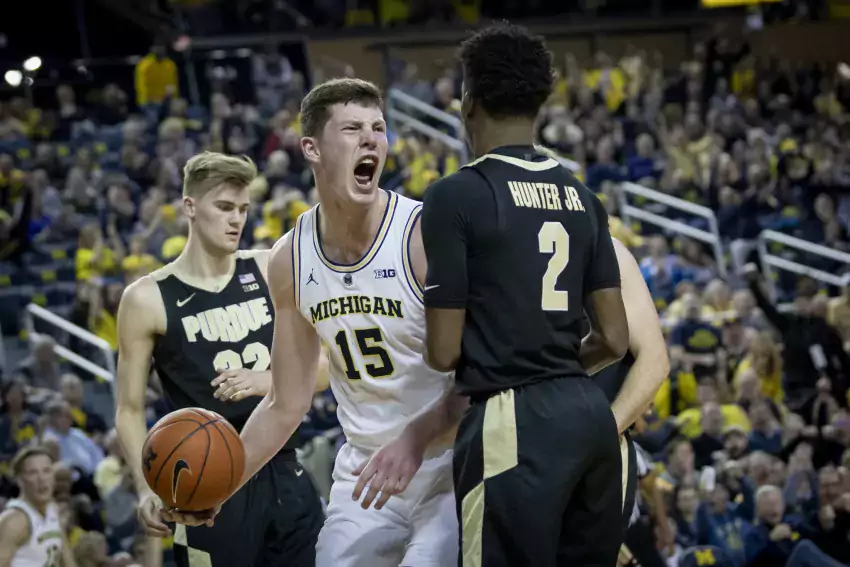
Teske roared afterward, much like he does in the photo that leads this post. That came when he put poor Grady Eifert on a poster:
Attack this week like Jon Teske attacked the rim against Purdue pic.twitter.com/BiA2IbmATb
— Alejandro Zúñiga (@ByAZuniga) December 3, 2018
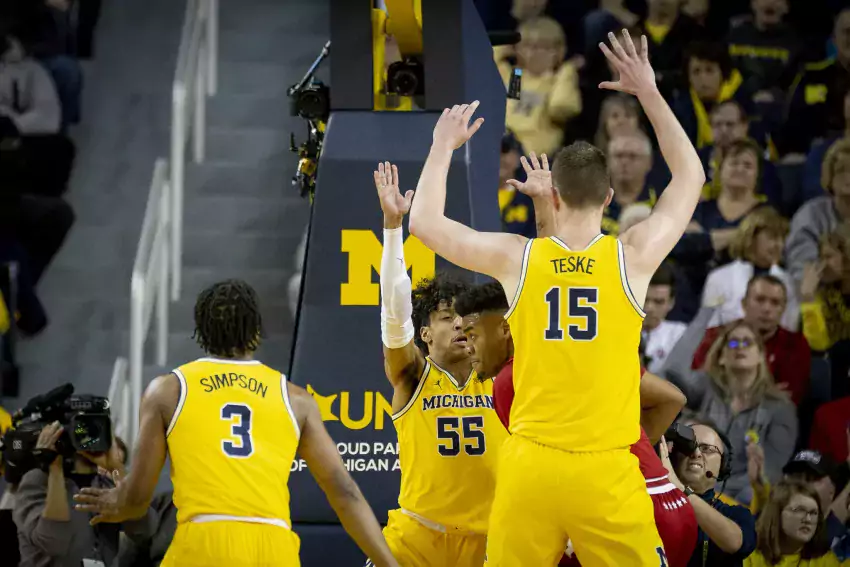
At the top, Simpson is doing his Big Mood walk despite having no involvement in the play. And that's right too. Teske deserves to roar; he deserves all the chest-bumps and weird awkward arm-lock thingies Michigan is doing this year.
He still looks like the nice boy down the street after you increased his pixel count by 50%, and that's why he'll always be Big Sleep to me. Saddi Washington attempted to rebrand Teske as "Big Nasty" last year, but let's keep The Big Sleep around. Big Nasty is taken by Corliss Williamson and generic anyway. Ain't nobody named Big Sleep.
We just have to look at it a different way. The Big Sleep isn't about what Jon Teske is. It's about what he does to your offense, and sometimes your defense. The Big Sleep is a noir movie. The Big Sleep is a wrestling finisher. The Big Sleep is what happens when you tell Cement Ricky you'll have his money in two weeks and don't.
The Big Sleep is what happens when you manage to get past the forest of poking arms around Michigan's perimeter: a giant man in a trenchcoat throws you over his head into the water.
[After THE JUMP: cat and mouse between Beilein and Painter]

The Daily has a book. It is a collection of their coverage from the 2016 season, and it's cheap at just $7.50. Marvel at things Peppers does, grapes that have been removed from existence, and the appallingly excellent skin of the youths who insouciantly bring it to you!
If you're in town you can stop by the Maynard building and avoid shipping costs. There's also something in the draft copy about bringing them a pizza from NYPD so you can see all the things they stole from road games but that's CLEARLY a joke so please don't do that and also don't tell me what it is afterwards. (Operative theory: Michigan State's dignity.)

[Bryan Fuller]
Not a starter, technically. PFF lists the best returning players in the Big Ten. Michigan has a member of the DL land at #3 despite graduating all four starters, and you already know who it is:
Michigan’s defensive line was so loaded in 2016, Hurst was technically not considered a starter. This year, however, he is the clear leader of the unit, as three likely top 100 picks will be moving on to the NFL. In terms of production amongst his returning peers, Hurst has no equal. His 34 total pressures in 173 pass-rush reps last season ranks him first in pass-rush productivity among 2017 defensive tackles, and his 18 run stops on 155 run downs ranks him eighth in run-stop percentage within the same group.
Expect a lot of "where did this guy come from!?" next year as Hurst's increased snap total results in some silly numbers.
Everyone quote tweet tonight. About a dozen people on my timeline quoted this Bruce Feldman tweet to let their followers know it was a good idea:
SOURCE: Former #Michigan head coach Brady Hoke is expected to become the new D-line coach at #Tennessee.
— Bruce Feldman (@BruceFeldmanCFB) February 6, 2017
They are not wrong. Hoke plucked Willie Henry, Ryan Glasgow, and Frank Clark out of obscurity; even the touted recruits he grabbed frequently outperformed their rankings. Chris Wormley(composite #129), Taco Charlton (#132), and Mo Hurst (#258) are all potential first-round NFL draft picks. There were some busts in there, but Hoke recruited seven of the eight guys on Michigan's best-ever defensive line.
I'd take him back in Ann Arbor as a DL coach if that wouldn't be super weird. In this instance, Butch Jones's weird tendency to get the Lloyd Carr band back together is not clinically insane.
Early enrollment is a thing. College football already has an early signing day of sorts:
The 2017 recruiting class seemed to have less late drama than years past, and that could have something to do with the growing number of early enrollees. Among the top 50 prospects in this class, 26 were midyear enrollees, which included 11 of the 15 five-stars. And of the top 150 prospects, 54 enrolled early.
Michigan had a whopping 11 guys enroll early, a program record. The large numbers of Michigan seniors ready to graduate and start prepping for the NFL draft full time created a bunch of openings that freshmen gladly filled.
Haves vs Have Nots: Fight! It's going to be a short fight. Michigan has some analyst spots to fill, as they usually do, and they're going after this gentleman:
The Honolulu Star-Advertiser reported Monday that Hawaii DC Kevin Lempa met with Michigan over the weekend about a "non-coaching" position in Ann Arbor.
Lempa already resigned as the Warriors' DC to take a 'worse' job once before, when he departed the islands to be a DBs coach at Boston College in 2002. He's in his mid-60s so this won't be a play to move up at Michigan if it does indeed happen; it would be about dollars and the opportunity to participate in Championship Football(tm).
FWIW, Don Brown is the connect here. Lempa was on his staffs at Maryland and UConn.
OL exit... MSU OL Thiyo Lukusa has left MSU's program, reportedly to retire. Lukusa played last year as MSU tried to find any combination that would work and was widely expected to compete for and probably win a tackle spot. Not good for the Spartans as they try to pick themselves up after a 3-9 season.
And it might get worse, with rumors flying that a number of other MSU players are off the team. Nothing definitive yet but there is a lot of smoke out there.
...OL entrance? Cal starting left tackle Aaron Cochran plans a grad transfer, and he was definitely a part of a thing that did things:
Cochran was an integral part of an offensive line that paved the way for a nationally ranked offense and numerous school records the past two seasons.
Everyone's nationally ranked, sir.
Anyway, Cochran is enormous at 6'8", 350, and has 16 starts under his belt at a Power 5 team. Cal was third in adjusted sack rate last year so he can't be horrendous. He only pops up once on PFF, but it's an encouraging note: he graded out well in Cal's loss to Washington, the #5 sack rate team last year. He is vaguely draftable per NFL Draft Scout.
Isaiah Hole reports that Michigan is "actively seeking" guys who could help them out but hasn't decided to pursue any particular player yet, including Cochran. If Michigan has the spot it would seem like a no-brainer to add a Pac-12 starter, even an iffy one, at a position of yawning need. Do they have it, though? Right now they're two over their scholarship limit. (Publicly, anyway. It's likely that Michigan knows of a couple departures already.)
Keeping the hype contained. Charles Matthews is profiled by Brendan Quinn, and John Beilein would like to keep expectations reasonable.
Beilein is careful not to preordain Matthews. One of the grand traditions in college basketball is for the redshirt player -- the one no one gets to see -- to be billed as a team's best player. Beilein avoids the pitfall.
...by turning into Fred Jackson:
"He's probably a combination of Hardaway and Glenn Robinson III. That's a good combination to have."
But fast!
Frustration, defined. John Gasaway's Tuesday Truths column from before the MSU game:
| Big Ten | W-L | Pace | PPP | Opp. PPP | EM | |
|---|---|---|---|---|---|---|
| 1 | Wisconsin | 9-1 | 63.2 | 1.08 | 0.93 | 0.15 |
| 2 | Purdue | 8-3 | 70.3 | 1.12 | 0.99 | 0.13 |
| 3 | Maryland | 8-2 | 68.4 | 1.09 | 0.99 | 0.1 |
| 4 | Northwestern | 7-3 | 66.7 | 1.07 | 0.98 | 0.09 |
| 5 | Michigan State | 6-4 | 66.7 | 1.06 | 0.99 | 0.07 |
| 6 | Michigan | 4-6 | 63.3 | 1.14 | 1.13 | 0.01 |
| 7 | Minnesota | 4-6 | 68 | 1 | 1.01 | 0 |
| 8 | Indiana | 5-6 | 67.2 | 1.1 | 1.11 | -0.01 |
| 9 | Iowa | 6-5 | 70.5 | 1.04 | 1.07 | -0.03 |
| 10 | Nebraska | 4-7 | 68.4 | 1.04 | 1.09 | -0.05 |
| 11 | Ohio State | 4-7 | 68.2 | 1.04 | 1.1 | -0.06 |
| 12 | Penn State | 4-7 | 69.9 | 0.95 | 1.01 | -0.06 |
| 13 | Illinois | 3-8 | 66.1 | 1 | 1.1 | -0.1 |
| 14 | Rutgers | 2-9 | 68.8 | 0.85 | 1.02 | -0.17 |
Michigan's offense is as good as anyone in the country in conference play. They have the same points per possession as Villanova, WVU, Kansas, and anyone in the ACC not named North Carolina (1.16). Only the Pac-12 has teams doing better on offense. Even a meh defense gets Michigan into the tournament with ease.
Or you could boot them for Houston, just sayin'. The Big Twelve has voted to dock Baylor a quarter of its annual payout until such time as "proper institutional controls" are in place and vetted by a third party. That's about six million dollars a year and is probably sufficient to get what the Big 12 wants out of them. But you could, I dunno, boot Baylor from your conference for cause and add a school in a much bigger media market? That's both ethical and a financial win.
FWIW, this is a measure of revenge for Art Briles in a mutually-assured-destruction sense. He tried to bilk some money out of Baylor with a lawsuit, causing the Baylor regents to assemble a pile of texts (and submit them to court!) that definitively expose Briles and former AD Ian McCaw as the worst kind of one-dimensional B-movie villain:
When a female student-athlete reported that a football player had brandished a gun at her, the court paperwork said, Briles texted an assistant coach: "what a fool -- she reporting to authorities."
In another case, a masseuse asked the team to discipline a player who reportedly exposed himself and asked for favors during a massage, the document said Briles' first response was, "What kind of discipline... She a stripper?" ...
In one text exchange, after a player was arrested for assault and threatening to kill someone, the paperwork said Briles texted athletic director McCaw that he had just talked to the player, who said Waco police had agreed to "keep it quiet." Briles promised to ask Shillinglaw to check in with a local attorney.
"That would be great if they kept it quiet!" McCaw allegedly replied. He is now the athletic director at Liberty University in Virginia.
Briles had to drop his lawsuit but the revelation of what actually went on was probably a spur for the Big 12's financial penality. In his accidental way Briles actually did some good here. So he's got that going for him.
Etc.: Various croot profiles include Joel Honigford, Cesar Ruiz, PWO and Air Force decommit Sean Fitzgerald, and fellow PWO Jared Davis. Lorenz picks some underrated Michigan recruits. Hugh Freeze is mad that other schools mentioned the obvious thing they should mention about Ole Miss. Vincent Smith profiled by MGoBlue. More mock drafts.
59