Home
we had subs it was crazy

Primary links

  • About
    • $upport (lol)
    • Ethics
    • FAQ
    • Privacy Policy
  • Contact
  • MGoStore
  • MGoBoard
    • MGoBoard FAQ
    • Ticket spreadsheet
    • Michigan bar locator
    • Moderator Action Sticky
  • Useful Stuff
    • Depth Chart By Class
    • Unofficial Two Deep
    • 2013 Offer Board
    • Crude Bug Tracking System
    • Third Down Stats
    • Diaries, Windows Live Writer, And You
    • Michigan Future Schedules
    • User-Curated HOF
    • 2013 Recruiting Board
    • Where To Eat In Ann Arbor
Home

Navigation

  • Forums
  • Recent posts

User login

  • Create new account
  • Request new password

MGoElsewhere

  • @MGoBlog (Brian)
  • @aceanbender
  • @TomVH (Tom)
  • RSS Feed
  • iPhone App
  • Facebook profile
  • MGoKindle Store
  • mgo.licio.us
  • Brian @ TSB [Archive]
  • Brian @ AOL [Archive]
  • Sour Salty Bitter Sweet

Michigan Blogs

  • Big House Blog
  • Burgeoning Wolverine Star
  • Genuinely Sarcastic
  • Go Blue Michigan Wolverine
  • Holdin' The Rope
  • MGoFootball
  • MVictors
  • Maize 'n' Blue Nation
  • Maize 'n' Brew
  • Maize And Go Blue
  • Michigan Hockey Net
  • The Blog That Yost Built
  • The Hoover Street Rag
  • The M Block
  • The M Zone
  • The Wolverine Blog
  • Touch The Banner
  • UMGoBlog
  • UMHoops
  • UMTailgate
  • Wolverine Liberation Army

M On The Net

  • mgovideo
  • MGoBlue.com
  • Mike DeSimone
  • Recruiting Planet
  • The Wolverine
  • Go Blue Wolverine
  • Winged Helmet
  • UMGoBlue.com
  • MaizeRage.org
  • Puckhead
  • The M Den
  • True Blue Fan Forum

Big Ten Blogs

  • Illinois
    • A Lion Eye
    • Hail To The Orange
    • Illinois Baseball Report
    • Illinois Loyalty
  • Indiana
    • Inside The Hall
    • The Crimson Quarry
  • Iowa
    • Black Heart, Gold Pants
    • Fight For Iowa
  • Michigan State
    • The Only Colors
  • Minnesota
    • GopherHole.com
    • The Daily Gopher
    • I'm In Love With A Fringe Bowl Team
    • TNABACG
  • Nebraska
    • Big Red Network
    • Corn Nation
    • Husker Mike's Blasphemy
    • Husker Gameday
  • Northwestern
    • Sippin' On Purple
    • Lake The Posts
  • Notre Dame
    • The House Rock Built
    • One Foot Down
  • Ohio State
    • Eleven Warriors
    • Buckeye Commentary
    • Men of the Scarlet and Gray
    • Our Honor Defend
    • The Buckeye Nine
  • Penn State
    • Slow States
    • Black Shoe Diaries
    • Happy Valley Hardball
    • Penn State Clips
    • Linebacker U
    • Nittany White Out
  • Purdue
    • Boiled Sports
    • Hammer and Rails
  • Wisconsin
    • Bruce Ciskie

Links of Note

  • Baseball
    • Big Ten Hardball
    • College Baseball Today
    • The Baseball Zealot
    • The College Baseball Blog
  • Basketball
    • Ken Pomeroy
    • Basketball Prospectus
    • Midmajority
  • College Hockey
    • Chris Heisenberg
    • College Hockey Stats
    • Inside College Hockey
    • Michigan College Hockey
    • Hockey's Future
    • Sioux Sports
    • USCHO
    • Western College Hockey
    • CCHA
      • LSSU Hockey
      • Bronco Hockey Blog
  • Football
    • Smart Football
    • Every Day Should Be Saturday
    • Doctor Saturday
    • CFB Stats
    • Harold Stassen
    • NCAA D-I Stats Page
    • The Wizard Of Odds
  • General
    • Sports Central
  • Local Interest
    • The Ann Arbor Chronicle
    • Arborwiki
    • Arbor Update
    • Teeter Talk
    • Vacuum
  • Teams Of The D
    • Lions
      • Pride of Detroit
      • Fire Millen
    • Pistons
      • Detroit Bad Boys
      • Need4Sheed
    • Tigers
      • Roar Of The Tigers
      • The Detroit Tigers Weblog
      • The Daily Fungo
    • Red Wings
      • On The Wings
      • Behind The Jersey
      • Winging It In Motown
    • Michigan Sports Forum

Archive

  • May 2013 (55)
  • April 2013 (94)
  • March 2013 (104)
  • February 2013 (81)
  • January 2013 (93)
  • December 2012 (74)
  • November 2012 (142)
  • October 2012 (143)
  • September 2012 (107)
  • August 2012 (103)
  •  
  • 1 of 11
  • ››

Get Yer Tickets

Football Display Case

NFL Watches

Follow your favorite team with localtv-satellite.com: Click Here.

Site Search

Diaries

  • New
  • Popular
  • Hot
  • Does Expansion Actually Lead to More Recruits From a Certain Region?
    maizeonblueaction - 1 day ago
  • Raiding the B1G-er Big Ten: Recruiting Prospects in Maryland and Rutgers Territory
    The Mathlete - 2 days ago
  • A Cynical Take on Why Expansion May be Dead for the Forseeable Future
    maizeonblueaction - 3 days ago
  • LIGHT IT UP, AGAIN. WALLPAPER
    jonvalk - 3 days ago
  • Using Rivals' Star Ratings To Look At Big Ten Football Recruiting: 2002-2013
    LSAClassOf2000 - 4 days ago
  •  
  • 1 of 4
  • ››
more
  • Using Rivals' Star Ratings To Look At Big Ten Football Recruiting: 2002-2013
    LSAClassOf2000 - 938 views
  • More Milford Men Than Michigan Men: Comparing the 11-12 and 12-13 Hockey Teams
    MGoBlueline - 804 views
  • UMich NFL draft history, Part III
    blueheron - 783 views
  • LIGHT IT UP, AGAIN. WALLPAPER
    jonvalk - 751 views
  • A Cynical Take on Why Expansion May be Dead for the Forseeable Future
    maizeonblueaction - 632 views
  •  
  • 1 of 2
  • ››
more
  • Big Ten Recruiting Rankings 4-30-13
    Ace - 81 comments
  • Using Rivals' Star Ratings To Look At Big Ten Football Recruiting: 2002-2013
    LSAClassOf2000 - 19 comments
  • A Cynical Take on Why Expansion May be Dead for the Forseeable Future
    maizeonblueaction - 18 comments
  • LIGHT IT UP, AGAIN. WALLPAPER
    jonvalk - 17 comments
  • Raiding the B1G-er Big Ten: Recruiting Prospects in Maryland and Rutgers Territory
    The Mathlete - 13 comments
  •  
  • 1 of 2
  • ››
more

MGoBoard

  • New
  • Recent
  • Hot
  • OT: The Tigers game is very interesting
    77 replies
  • Michigan wrestlers accused of Molotov cocktail possession suspended indefinitely
    49 replies
  • Who's Your Favorite Michigan QB?
    154 replies
  • Softball Super Regional v. Louisiana-Lafayette, game 1
    53 replies
  • Sam Webb write up on five-star center Elijah Thomas
    12 replies
  • There should be 110,000 Rubber Chickens at the ND Game
    36 replies
  • OT- Miguel Cabrera is good at baseball, visual proof
    35 replies
  • Michigan/Minnesota football - Oct 5 - 330 pm EST
    15 replies
  • Memorial Day Weekend (here for the) posbang thread
    110 replies
  • The Official SIAP Alan Branch Photoshop Thread
    33 replies
  • Which Pay Site Is Best?
    60 replies
  • OT: Star Trek + Dilithium = Esplode…. Esplode clarity
    26 replies
  • OT - ND paid Charlie more than Brian Kelly in 2012
    36 replies
  • Softball SuperRegionals Open Thread
    27 replies
  • OT: ESPN hires Paul Finebaum
    40 replies
  •  
  • 1 of 6
  • ››
  • OT: The Tigers game is very interesting
    76 replies
  • Who's Your Favorite Michigan QB?
    154 replies
  • Scouting Report: Jabrill Peppers
    156 replies
  • Memorial Day Weekend (here for the) posbang thread
    110 replies
  • Michigan wrestlers accused of Molotov cocktail possession suspended indefinitely
    49 replies
  • OT- Miguel Cabrera is good at baseball, visual proof
    35 replies
  • Which Pay Site Is Best?
    60 replies
  • There should be 110,000 Rubber Chickens at the ND Game
    36 replies
  • The Official SIAP Alan Branch Photoshop Thread
    33 replies
  • Softball Super Regional v. Louisiana-Lafayette, game 1
    53 replies
  • Michigan/Minnesota football - Oct 5 - 330 pm EST
    15 replies
  • Sam Webb write up on five-star center Elijah Thomas
    12 replies
  • Who should replace ND in a long-term series?
    145 replies
  • Softball SuperRegionals Open Thread
    27 replies
  • How much do you really hate ohio?
    146 replies
  •  
  • 1 of 6
  • ››
  • OT: Red Wings vs Hawks Game 3 Open Thread
    203 replies
  • OT: Red Wings vs Hawks Game 4 Open Thread
    193 replies
  • Scouting Report: Jabrill Peppers
    156 replies
  • Who's Your Favorite Michigan QB?
    154 replies
  • OT - Official MGoBaby Thread (you got 'em, we want to see 'em)
    151 replies
  • How much do you really hate ohio?
    146 replies
  • Who should replace ND in a long-term series?
    145 replies
  • OT? Graduatin' Season. Who had the Worst Commencement Speaker?
    141 replies
  • Speight and TomVH on Peppers
    116 replies
  • OT: Red Wings @ Hawks Game 2 Open Thread
    114 replies
  • Prayers for Moore, Oklahoma
    112 replies
  • Memorial Day Weekend (here for the) posbang thread
    110 replies
  • 5 star 2013 DT may not be enrolling at Notre Dame
    93 replies
  • OT: NBA Draft Lottery
    78 replies
  • ESPN 30 for 30 on the Bad Boys
    77 replies
  •  
  • 1 of 6
  • ››

mgo.licio.us

  • Burke says Michigan can be 'just as good' next year with McGary, Robinson III leading

    yes plz

    0 comments
  • SEC coaches with tiny faces

    I don't think they changed Les at all actually

    1 comments
  • This college baseball team is the best at postgame interviews

    national champs baby

    1 comments
  • Rounding up the latest in NCAA absurdities.

    Patrick Hruby is doing God's work.

    0 comments
  • Cornell wrestler tops Michigan's Trey Burke for Sports Illustrated award | The Detroit News | detroitnews.com

    first comment: "EVERY ATHLETE HAS ASPIRATIONS OF WINNING AND WE HAVE OUR FAVORITES BUT IT IS ALWAYS A PLEASURE TO OTHER STUDENTS ACHIEVE THEIR GOALS, TOO!"

    0 comments
  • Burke hearing he'll go two through six in NBA draft

    stupid Pistons and their refusal to tank properly

    0 comments
  • 2013 NHL Draft Prospect: Andrew Copp

    rundown of Michigan's riser

    0 comments
  • Michigan's key returnee: Glenn Robinson

    needs moar usage

    0 comments
  • Former Arkansas QB Brandon Mitchell transferring to NC State

    so much for that

    0 comments
  • The B1G List: Ranking the State Fossils of the Big Ten

    This list is completely arbitrary and not a genuine analysis of the relative merits of state fossils.

    0 comments
  • Trey Burke turns to inner circle to prepare for NBA draft

    will be michigan's highest pick in a while

    2 comments
  • B1G assistant coach salaries on the rise

    money has to go somewhere

    0 comments
  • Tim Hardaway Jr. is motivated by his critics and doubters, and supremely confident in his ability

    I am only motivated by people who have no opinion about me.

    0 comments
  • Big Ten football procrastinates on parity-based scheduling, and nothing ever changes

    the just released schedules were a flat-out statement that the B10 doesn't believe SOS will matter in playoff selection

    1 comments
  • Michigan's Glenn Robinson III, Mitch McGary ranked inside top 20 on ESPN's 2014 draft board

    but I thought that draft was supposed to be incredibly loaded?

    1 comments
  •  
  • 1 of 2
  • ››
more

football hmmm

Michigan Museday Matches Nickels and Dimes

By Seth — August 15th, 2012 at 9:44 AM — 33 comments
Filed under:
  • desmond morgan
  • football hmmm
  • jake ryan
  • museday
  • safeties
  • spread is dead
  • spread n shred
  • spread offense
  • thomas gordon

Personnel

Background image by mgouser hillhaus

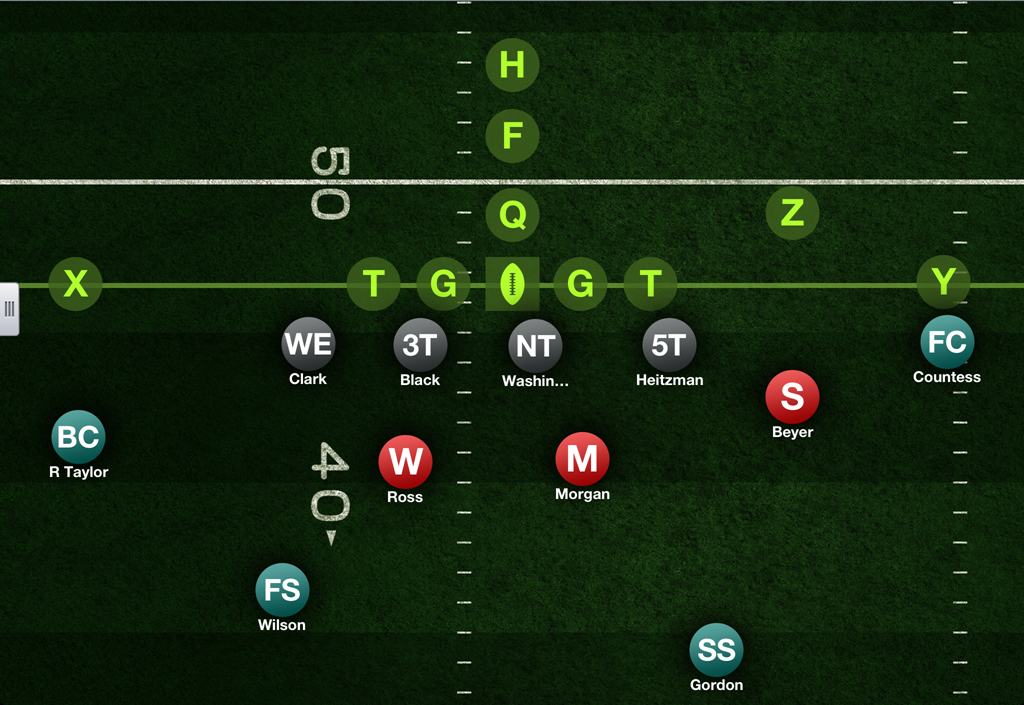
A thing I noticed this offseason while going over the depth and usage of various Michigan defenders is that Mattison used a lot more nickel than we gave him credit for. One thing Ace noted was that we're (finally) recruiting more cornerbacks. We shrugged a bit while losing two more CBs to playing time transferitis this fall, but I don't think we should be shrugging so much.

A little background (skip this if you already know personnel terminology and usage): Defensive coaches tend to match their personnel to the types of players on the field for the offense, NOT the formation. In general the number of backs and tight ends will be matched by linebackers, and the more that come out for receivers the more DBs the defense will send out. Three wide receivers generally means five defensive backs (i.e. nickel), two wide receivers equals four DBs (e.g. 4-3 or 3-4), etc.

The classic personnel shift is on 3rd and long, when the steady rock-pounders make way for the seven-yards-or-bust fellas. But it happens so often despite the situation that it's more accurate to see the game of matching personnel as another strategic aspect of the master's football game.

The offensive personnel is usually expressed in three digits meaning # of RBs, # of tight ends, and # of receivers, respectively. So 113 means 1 RB, 1 TE, and three WRs. Sometimes they'll call that same "eleven" personnel, referring to the first two digits. Examples below; click embiggerates.

Not different:

Personnel113-shotgunPersonnel113-iform

Different:

Personnel212-iformPersonnel221-iform5-3

How the matching up occurs is up to the coach. You could, for example, play a run-first OLB whenever a fullback is in, and sub him for a more rangy linebacker when the the fullback runs off the field for a tight end who's a known receiving threat. This happens all the time, but it's hard to track the defenses' reactions since we can't tell one linebacker in a formation from another in UFR. We do have data from which we can determine how many receivers were out there at any given time, and it's clear from these data that the more receivers the more defensive backs.

From the UFR defensive database, Michigan in 2011 was no exception:matchingpersonnel

  Avg. Personnel
WRs in Game DL LBs DBs
Four 3.8 2.4 4.7
Three 3.8 2.5 4.7
Two 4.0 3.0 4.0
One 4.1 3.3 3.6
None 4.7 3.3 3.0
Average 3.9 2.7 4.4

The last row is important because it shows Michigan left its base 4-3 Under set for an extra defensive back far more often than otherwise, usually at the expense of a linebacker. We didn't go to a nickel every time three receivers stepped on the field, in fact there were 22 plays charted where Mattison put his 4-3 personnel against four-wide (mostly against Northwestern and Purdue). But the charts not only say that Michigan was forced out of its base 4-3 set often; it says we played more Nickel downs than 4-3.6411555271_43a84798f0_o

  Receivers in Formation
Def. Form 4 3 2 1 0 Total
Nickel 121 155 14 1 x 291
4-3 22 34 195 29 x 280
Okie 20 32 2 x x 54
4-4 1 x 6 11 1 19
4-6 x x 10 5 x 15
3-3-5 5 7 1 x x 13
5-3 x x 1 2 1 4
Goal line x 1 x 2 1 4
3-4 1 1 x 1 x 3
6-2 x x 1 1 x 2
Dime-30 1 x x x x 1
Dime-40 x 1 x x x 1
Total 171 231 230 52 3 687

If I remove 4th quarters and all plays that occurred when Michigan was up by more than one score, the 4-3 just barely edges the Nickel, 147 to 140. This isn't opponents trying to play catch-up. It's two things: the personnel that Mattison inherited, and the spread offense forcing Michigan to adapt to it.

--------------------------------------------

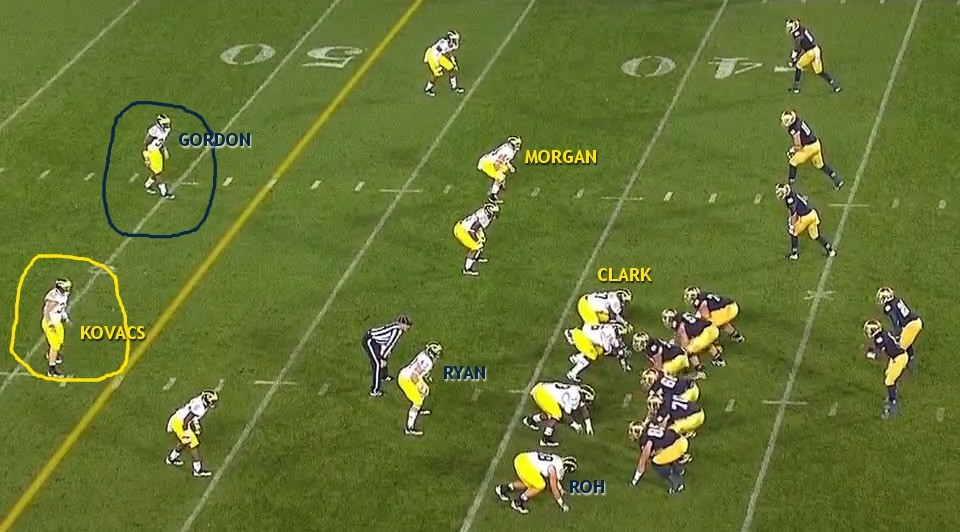
Why all the nickel and diming? The first part is a story about outside linebacker. Early in the 2011 season Michigan played Brandon Herron and Brandin Hawthorne at WILL, while at SAM we lost Cam Gordon to injury and his backup was a redshirt freshman. That freshman, Jake Ryan, was earning his way toward more playing time, but in the meantime we still had Carvin Johnson taking snaps at free safety while Thomas Gordon was in at the nickel role. Watch what happened at about mid-season:

TACKLESBYGAME

That is Gordon moving to free safety and splitting time with Woolfolk, while the freshmen linebackers had their usages increase. Greater faith in Jake and Des explains some of the variance, however the real story is matching personnel:

Opponent Receivers DBs Difference 4-3 Nickel Okie Other
Western Michigan 3.02 4.68 1.67 15.79% 59.65% 15.79% 8.77%
Notre Dame 3.05 4.49 1.44 25.00% 51.25% 12.50% 11.25%
Eastern Michigan 2.20 3.98 1.78 57.78% 17.78% 4.44% 20.00%
San Diego State 2.51 4.38 1.88 43.21% 44.44% 6.17% 6.17%
Minnesota 2.72 4.36 1.64 50.00% 41.67% 2.78% 5.56%
Northwestern 3.75 4.82 1.07 14.75% 80.33% 0.00% 4.92%
Michigan State 2.36 4.25 1.90 55.93% 32.20% 1.69% 10.17%
Purdue 3.07 4.30 1.24 60.87% 32.61% 0.00% 6.52%
Iowa 2.02 4.04 2.02 64.81% 16.67% 5.56% 12.96%
Illinois 2.83 4.57 1.74 25.71% 52.86% 14.29% 7.14%
Nebraska 2.83 4.28 1.45 37.50% 35.00% 15.00% 12.50%
Ohio State 2.48 4.19 1.71 58.62% 24.14% 12.07% 5.17%
Total 2.75 4.38 1.63 40.76% 42.36% 7.86% 9.02%

I pointed out the two extremes on the schedule with boldation: Northwestern used about twice as many receivers in their formations as Iowa did, but there was a limit to how many defensive backs Michigan would counter with. The nickel served as well for 4 WR as for 3, yet accounted for 4 in 5 plays. However when the opposition went to 2 WR (Iowa), Mattison could spend a majority of the game in the 4-3.

--------------------------------------------

When Michigan's on offense. Nothing is out of the ordinary yet, but when we turn the tables and show how defenses have reacted to Michigan's personnel it gets interesting:

Season Avg. Receivers in Formation Avg. DBs in Formation Difference
2008 3.13 4.36 1.2
2009 2.84 4.46 1.6
2010 3.07 3.93 0.9
2011 2.62 4.2 1.6
Total 2.91 4.22 1.3

This is not including anything when Michigan was more than a score down, but the season averages counting everything say about the same thing. I went through the plays and even a few youtubes and yes, in 2010 they played one-high against us despite spreading the field to pass as much as Purdue. Michigan went bigger in 2011, and got more defensive backs, which is counterintuitive except for one factor: opponents in 2010 really really really feared the running game, and tempted Michigan to pass.

treecatching

Okie dokie. | Greg Shamus via ESPN

One more table to break this down by Michigan's opponents last year, 4th quarters and two-plus-score leads excised:

Opponent WRs in formation DBs in formation Difference
Western Michigan 2.41 3.97 1.6
Notre Dame 3.10 4.60 1.5
Eastern Michigan 2.71 4.11 1.4
San Diego State 2.44 4.89 2.4
Minnesota 2.31 3.77 1.5
Northwestern 2.55 3.89 1.3
Michigan State 2.54 4.00 1.5
Purdue 2.53 4.13 1.6
Iowa 2.67 4.08 1.4
Illinois 2.78 4.04 1.3
Nebraska 2.67 4.43 1.8
Ohio State 2.79 4.21 1.4
Total 2.62 4.12 1.5

Nothing really jumps out except perhaps more spread in close games, and SD State's apparent paucity of linebackers (weird—didn't they just have that guy who recruits lots of linebackers there?) Actually that's Charlie Strong's 3-3-5, and the GERG numbers from 2010 are similar due to the same effect.

--------------------------------------------

What it means for this year. Alabama and Air Force aren't going to be spread it out—their challenges are elsewhere. However the Big Ten schedule is spread-heavy, with Ohio State joining the ranks of the many-receivered. Due to recent attrition, Michigan goes into 2012 with just six scholarship cornerbacks for three positions that will be filled half the time. It's a good thing the coaching staff has four guys coming in at corner to replace the one expected departure. These days, in order to keep up with the Joneses, that nickelback position has to be considered as much of a starter as, well, a third receiver.

  • 33 comments

Michigan Muse(urs)day Has a Wicked Fastball

By Seth — April 5th, 2012 at 2:28 PM — 3 comments
Filed under:
  • al borges denard fusion cuisine
  • al borges evil genius
  • al borges hates bubble screens
  • football hmmm
  • MANBALL
  • MANBALL is +EV
  • museday
  • offense

aom-booktom_brady_photos1Denard_Fitz_Offense-thumb-590x391-95878JustinVerlander357FEB24004_Detroit_Tigers_Spring_Training 

MANBALL: BEATING the opponent with POWER running and repetitive CONTACT and MANLY CAPITALIZED WORDS.

West Coast: A symphony of route design and timing that puts defenses into a progression of impossible choices

Option: Isolate an unblocked defender so that he's forced into a Catch 22 decision.

Justin Verlander: A metaphor.

After reading Parts I, II and III of this series you might think a college offense must only be one of these things. That is a very effective thought, as the best offenses in college football according to people who can extricate offense from defense, special teams, winning, fairy dust, and these days seem to center around doing one of these things very well.

But doing one thing well and building around that isn't the only way to build an offense. In fact if you only do your one thing well and can't execute other things, the other team will adjust quickly and now you won't do your one thing well anymore. These were the points made in the previous articles, the first (Doctor Rocklove) to explain the terminology, the second (Rock, Paper, Scissors) to describe constraint theory and demonstrate a Rock/Paper/Scissors for four different philosophies. The third (Pulls Bazooka!) got into the concept of vanilla defense. This last asks the question: what's Michigan's rock?

The Verlander Effect: Doing Multiple Things Well is Good

I'd like to first hone in on how "Rock" is used in this context, since it's not just another cell in an equal triangle matrix.

In honor of Opening Day today I'll use a baseball metaphor. Pitchers, like offenses, usually build a strategy out of a maximizing the effectiveness of one thing they are exceptional at. A 95+ mph 4-seam (ie straight-up) fastball is a common "rock" pitch that will, to a typical batter looking for any kind of pitch, give the most trouble. To keep hitters from sitting on the fastball, the pitchers use slow-speed secondary pitches, for example a curveball and/or changeup. This is the constraint theory at play. But when you break down the pitch selection of a typical Fastball-Curveball-Changeup starting pitcher, you'll notice quickly that the fastball is between 40% and 50% of his pitches. Football offenses function on the same principle: throw the fastball, and mix in curveballs and changeups to keep the hitters/defense from overreacting to, and thus killing the effectiveness of your heater.

Now to relate this to Michigan's offense. You see, not everyone has the same suite of pitches. Among Tiger starters Doug Fister is the normal fastball-curve-changeup guy, but Max Scherzer and Rick Porcello both use a 2-seam fastball, ie a breaking fastball, as "rock." This pitch will dive downwards and (righty on righty) inwards. The downward motion gets a hitter aiming for the meat of the baseball to hit the top of the ball instead, the spin absorbs some of the power of the stroke, and the result is a lightly hit ground ball. To keep hitters from simply adjusting their aim, the 2-seamer's constraints are a 4-seamer (leading to a pop-up), and a slider, which has a lateral motion opposite that of a 2-seamer.

This brings us to Justin Verlander, the best pitcher in (and MVP of) the American League last year. Justin's "rock" is a killer 4-seam fastball – it has lots of lateral movement and lots of velocity and is a total bitch to hit. In a season between half and two thirds of his pitches will be the fastball. However any MLB hitter who is looking for any fastball will be able to hit it, just as Northwestern defenders can stop a Wisconsin rushing attack if they're looking for it or a I-AA team can...let's not go there. Justin also has a devastating curveball and changeup, both of which will F you up if you're looking for his fastball. Verlander's curveball is like Cam Newton's arm: the constraint is good enough in its own right that you can't beat it unless you're overreacting to it, in which case you're now going to be eaten alive by the fastball and changeup.

In 2010 and 2011, Verlander leapt from being a great young pitcher to undeniably elite. What happened is he developed a 2-seamer game. The two-seamer and the slider arrived in 2010 and now account for about 15% of Justin's pitches.

This is all strategy; the other 90% is execution.

What Does Michigan Do Very Well?

The offense of 2011 at its apex was versus Ohio State. Since the Sugar Bowl strategy became "dear God stay away from the middle" on account of Molk playing gimpy, last year's Game is also the best representative we have so far (other than practice video zoomed into Toussaint's nostril hairs) of the 2012 offense. So let's re-live that game from the perspective of formation, personnel, philosophy, and RPS to get a feel for the current Borgesian ideal.

Remember, personnel is the number of RBs and number of TEs, so 22 is two of each. Subtract the total RBs and TEs from 5 to know the number of receivers. I defined "Value" on this scale: 1: Fail. 2: Got some yards, not what it was supposed to. 3: Did what it was drawn up to do. 4: Did better than it was drawn up to do. 5: Broke open for big yardage/score.

Ln Dn Ds Formation Per-son-nel Play Philosophy RPS Value Yards
M26 1 10 Shotgun 11 QB sweep MANBALL Rock 3 5
M31 2 5 Shotgun 12 Zone read belly Option Rock 1 0
M31 3 5 Shotgun 10 Slant West Coast Rock 1 Inc
O47 1 10 Split Backs 21 Flare screen West Coast Scissors 4 6
O41 2 4 Shotgun 20 Inverted veer keeper Option Rock 5 41
M48 1 10 Denard Jet 12 Jet sweep MANBALL Rock 3 5
O47 2 5 Ace 11 Throwback screen MANBALL Scissors 2 2
O45 3 3 Shotgun 11 QB power MANBALL Rock 2 2
O43 4 1 I-form 22 FB dive MANBALL Rock 4 3
O40 1 10 Denard Jet 12 Counter pitch MANBALL Rock 2 3
O37 2 7 Shotgun 12 Rollout hitch MANBALL Paper 4 8
O29 1 10 Shotgun 20 Inside zone Option Rock 2 3
O26 2 7 Shotgun 21 Post MANBALL Paper 5 26
M7 1 10 Shotgun 11 Zone read dive Option Rock 2 2
M9 2 8 Shotgun 11 Inverted veer keeper Option Rock 1 2
M11 3 6 Shotgun 11 Rollout Sack MANBALL Paper 1 -4
M20 1 10 Shotgun 10 Zone read dive Option Rock 2 3
M23 2 7 Shotgun 20 PA scramble Option Paper 2 5
M28 3 2 Shotgun 22 QB power MANBALL Rock 3 3
M20 1 10 Shotgun 11 Zone read keeper Option Rock 1 1
M22 2 9 Shotgun 11 PA TE flat Option Paper 3 7
M29 3 2 Shotgun 10 Scramble West Coast Rock 4 9
M38 1 10 Shotgun 11 Sprint counter MANBALL Rock 5 46
O16 1 10 Shotgun 11 Inverted veer give Option Rock 2 2
O14 2 8 Ace 12 Waggle TE flat MANBALL Paper 2 3
O11 3 5 Shotgun 10 Drag West Coast Rock 3 5
O6 1 G Shotgun 12 Zone read dive Option Rock 1 0
O6 2 G Shotgun 20 Inverted veer keeper Option Rock 5 6
M20 1 10 Shotgun 11 Inverted veer give Option Rock 4 8
M28 2 2 Shotgun 11 QB power MANBALL Rock 2 3
M31 1 10 Ace 11 Throwback screen MANBALL Scissors 4 8
M39 2 2 Shotgun 20 Inverted veer give Option Rock 3 4
M43 1 10 Shotgun 20 Triple option dive Option Rock 3 4
M47 2 6 Shotgun 12 Triple option keeper Option Rock 3 5
O48 3 1 Shotgun 11 QB power MANBALL Rock 3 3
O45 1 10 Shotgun 21 PA TE seam Option Paper 5 26
O19 1 10 Shotgun 11 QB sweep MANBALL Rock 4 6
O13 2 4 Shotgun 12 Triple option pitch Option Rock 1 -7
O20 3 11 Shotgun 10 Dig West Coast Rock 5 20
M9 1 10 Shotgun 11 Sprint counter MANBALL Rock 1 1
M10 2 9 Shotgun 11 QB draw West Coast Scissors 4 10
M20 1 10 Shotgun 20 Inverted veer keeper Option Rock 5 22
M42 1 10 Shotgun 20 Triple option dive Option Rock 2 3
M45 2 7 Shotgun 11 PA rollout out MANBALL Paper 3 4
M49 3 3 Shotgun 10 Corner West Coast Rock 1 Inc
M25 1 10 Shotgun 11 QB sweep MANBALL Rock 2 3
M28 2 7 I-form 21 Waggle deep out MANBALL Paper 5 20
M48 1 10 Shotgun 20 Zone stretch Option Rock 5 11
O41 1 10 Shotgun 11 QB draw MANBALL Scissors 4 10
O31 2 In I-form 21 Power off tackle MANBALL Rock 3 5 + 13 Pen
M13 1 10 Shotgun 11 Zone read keeper Option Rock 2 3
M10 2 7 Shotgun 11 Inverted veer keeper Option Rock 3 6
M4 3 1 Goal Line 23 Waggle TE corner MANBALL Paper 3 4
M20 1 10 I-form 21 Sweep MANBALL Rock 2 2
M22 2 8 Shotgun 20 Rollout corner MANBALL Paper 5 28
50 1 10 Shotgun 11 Zone read dive Option Rock 1 -1
M49 2 11 Shotgun 10 QB draw West Coast Scissors 5 16
O37 1 10 I-form 21 Power off tackle MANBALL Rock 5 20
O17 1 10 I-form 21 Power off tackle MANBALL Rock 2 2
O15 2 8 Shotgun 11 QB power MANBALL Rock 4 11
O4 1 G Shotgun 21 QB power MANBALL Rock 1 -1
O5 2 G Goal Line 23 Power off tackle MANBALL Rock 3 5
O1 3 G Goal Line 23 Bootleg MANBALL Paper 1 1 (pen -25!)
O25 3 G Shotgun 10 Throwaway West Coast Rock 1 Inc

Non-bullets with charts:

Counting "Denard Jet" as another Ace formation, here's the breakdown:

Philosophy Shotgun Ace I-form Split Backs Goal Line Total
MANBALL 17 5 6 - 3 31
Option 24 - - - - 24
West Coast 8 - - 1 - 9
Total 49 5 6 1 3 64

And the breakdown by RPS %:

Philosophy Rock Paper Scissors Total
MANBALL 61.3% 29.0% 9.7% 48.4%
Option 87.5% 12.5% 0.0%* 37.5%
West Coast 66.7% 0.0% 33.3% 14.1%
Grand Total 71.9% 18.8% 9.4% -

As you can see the RPS rolls look more like a Verlander pitch-type tracker than a triangle matrix of equal things. You can also see Borges working in his West Coast game like a 2-seamer/slider tandem. If there was a base play in there it's probably the zone read from a Shotgun 1-back, 1-TE formation, with the blocking switched up (read: "veer"). Borges threw a lot of fastballs, but it worked:

Philosophy Rock Paper Scissors Total
MANBALL 2.8 3.2 3.3 3.0
Option 2.6 3.3 - * 2.7
West Coast 2.8 – 4.3 3.3
Total 2.7 3.3 3.8 2.9

Remember 3.0 on my value scale means the offense was getting that 3rd down conversion, that 5 yards on 1st down, or setting up that 3rd and short every time. Manball accounted for about 72% of plays, and its effectiveness was strong, including many plays that broke big. The corollary of rock's effectiveness was that the constraints all performed better. This offense was working. About the only complaint here is that the Option game was totally missing a constraint. There was one play where Michigan actually faked this constraint—you know what that constraint is—and it was wiiiiide open, but then the play went rock and got stuffed. This is a minor complaint.

----------------------------------------------

* Y U NO BUBBLE SCREENS?

----------------------------------------------

What the hell was this offense?

ManballisPlusEV

It was Fastball-Curveball, with some West Coast sprinkled in. Even Rich Rodriguez's Pat White teams would sprinkle in that much pass-first philosophy, because that's another type of changeup you can throw. What we see here though is that the Option-from-Shotgun philosophy and MANBALL-from-mostly-shotgun philosophies are working in tandem. If you recognize this, it's really not all that different than Michigan's offense in 2010. If you have Denard, you run POWER with him, or you use him in a zone read option.

So after all that you're saying Al Borges is running the same offense Rich Rodriguez ran?

Wait, you were the subheads a second ago; when did you become a bolded alter-ego?

Answer the question!

Well no because it was just 75% shotgun versus like 85%, but other than that, yeah, kind of. But it's not Rich Rod's offense (the Zone Read) from West Virginia; it's what RR did when he got Denard. And I might point out that this was against Ohio State, so while I'm using it as a stand-in for the 2012 offense, that's not quite right because Borges has said and shown in other games that he's not going to have Denard run this often. This was Ohio State; this was balls to the wall.

The lesson of the 2011 offense is that Borges believes in all of this stuff, and despite earlier reticence, is happy to take the best of different philosophies and best use his personnel. And he can identify what that is.

The other thing is how he uses things other than the normal constraint plays as his changeups. Michigan is pitching with a plus-fastball and plus-curveball out of the same "motion," in this case formation. The personnel change on virtually every play, and the changeups are rare and (sometimes) devastatingly effective.

As a 2011 strategy it was frustrating during Iowa to see Michigan come out in an I-form on 1st and 10 in the 1st quarter, and then to hear Borges in the press conference treat questions about that as if we were asking about I-form on 2nd and 2 in the 4th quarter when Michigan's in clock-kill mode. This he learned, as he learned the best way to use Denard is to keep the threat of his legs involved in everything.

So why all the "Power" in the press conferences?

We learned this isn't actually philosophic zeal so much as the fact that one of the key benefits of running power for coaches is getting to say the word "Power" in press conferences. One of the nice things about Power is using the rhetoric, and until the massive incoming linemen and rocket-armed QB and pounding tailbacks and stable of tight ends and tall receivers are on hand to make a Wisconsin offense a reality, these coaches will be happy to take the best of all philosophies and run with them.

Next time in this series (last time?), I'll tackle why recruiting for the Wisconsin offense is perhaps a good idea for the future.

  • 3 comments

Michigan Museday Pulls Bazooka

By Seth — March 13th, 2012 at 8:02 AM — 9 comments
Filed under:
  • constraint theory
  • cover two zone
  • football hmmm
  • MANBALL is +EV
  • museday
  • offense

paper1

Shouldn't Spock be in this?

Hi. Me. Back. So before that much-appreciated vacation, I used this space to talk about constraint theory of offense and provide a rock-paper-scissors matrix for offensive/defensive play calling in various offenses. Today I'm on to Part III, the one where I tell you that Rock-Paper-Scissors is only a fraction of the football head game, because the actual decision trees are far too complicated for even a coach to play all of the interactions, let alone teach them. Moreover, unlike in RPS, or super-advanced-nuclear-capable-canid RPS, there are levels to things: scissors cuts paper better than it cuts (but still cuts) woven kevlar.

Rock-Paper-Scissors is a game you learn to play on the bus ride to school in 2nd grade or thereabouts. It is a very simple, 2-dimensional, triangular matrix:

RPS

…meaning every point interacts with every other. It's one dimension past a coin flip but you still only need to remember three interactions (yellow lines). Based on your personal capacity for testing the limits of social institutions, you either very quickly or eventually tried to insert an additional dimension to the triangular matrix, and realized that you were exponentially increasing the amount of interactions you had to remember.

RPS2RPS3

Your 2nd grade mind didn't draw this; it just exploded the same way it might if you interlaced Grbac to Howard, Wangler to Carter and Robinson to Roundtree into the same video. Then it came up with a brilliant way to add a point without adding dimensions:

RPS4

Bazooka!!! Bazooka blows up rock. Bazooka turns scissors into mangled slag. Bazooka leaves only scant streaks of carbon where once was paper. This idea is not totally silly, since defensive coordinators call bazooka like all. the. time.

Bazooka = Vanilla

Just as the offense wants to get really good at one basic thing and then do that thing all the time, many defenses are deploying the same concept. It's a bit harder for them because they have to react to various offenses on the schedule and various plays, but the concept's the same: the defense wants to stay in a scheme that is basically sound, and will mix in blitzes and different coverages as constraints, so that they can keep running their well-practiced, mostly sound blanket defense. Bazooka is a jack of all trades, solid against the run, solid against the pass, solid against tomfoolery, and vulnerable only to great offensive play and their own physical/mental limitations.

43tampa2

Defenses are a bit more varied than offenses but the most popular vanilla D these days, as I mentioned in the earlier discussions, is a Cover-2 zone (above-left) against run-first teams, or the Tampa 2 against pass-ier teams (above-right).

The difference between those two is in the MLB's coverage duties—in a Tampa he has the deep middle, in a regular Cover 2 he has the short middle and can be more involved in the run game. Everybody, including the cornerbacks, are hovering around close enough to gang-attack running plays like a pincer; and soft spots in the zone (everyone has them) are relatively small and difficult for non-accurate quarterbacks.

If these guys are all reacting correctly and aggressively to the run, if the cover guys are fast enough to close their zones, and the four rushers can generate pressure with rock-paper-spockregularity, this defense can bazooka anybody's rock, paper, scissors, candle, Vulcan, or whatever. Of course that is way easier said than done—remember offenses are recruiting, training, practicing, and designed for attacking this scheme.

Offensive rock is made to beat defensive bazooka. I want you to look at the above and imagine various offenses succeeding against them. ISO running forces the linebackers to read run, read the hole, and get there in time to take out a lead blocker and lead runner who by design are getting there ASAP. West Coast passing lives in those soft spots under and between the coverage. Air Raids attempt to warp the zones into providing bigger holes by flooding and stretching them. Option running makes a balanced coverage into an effective numbers advantage for the offense at the point of attack. Vanilla defense is made to stop whatever's thrown their way, and offenses gain success by making Mr. Jack-of-All die a consistent bleeding death.

To see vanilla defense in action throw a dart at any recording of Iowa in the last 12 years; their M.O. is to stick to this maniacally. The converse in-conference would be Michigan State. On the way home from Europe this weekend I randomly sat next to MSU LB Chris Norman. Other than "Wisconsin's offense was way tougher than any of the SEC teams," and "lol Michigan's uniforms last year," Norman happily admitted "YAARRGGH SPARTY SMASH!!" is the coaches' favorite blitz, and that they'll run it or something like it more than any other play. Some teams like paper.

So there are exceptions but the exceptions can be beat with your properly executed scissors. The point remains that all matrices aside, much about football comes down to defeating your opponent's bazooka, or vanilla thing, or "rock" defense with your rock. If you recognize this particular bit of wisdom from DeBordian philosophy, well yes in this DeBord is absolutely right. But if you don't properly mix in your constraints, and you always run rock to the same spot/guy out of the same formation, and you shuffle your fullba…uh let's not go there.

Next time (last one? I think it is but I keep stretching these): What's Our Rock?

  • 9 comments

Michigan Museday in Rock, Paper, Scissors

By Seth — February 28th, 2012 at 9:19 AM — 15 comments
Filed under:
  • constraint theory
  • football hmmm
  • MANBALL
  • museday
  • offense
  • rock paper scissors
  • west coast offense

rock-bull-dwayne-the-rock-johnson-775398_1178_1319Toilet-Paperedward aux mains d'argent

This is a follow up to to Doctor Rocklove a few weeks ago, where I identified the influence of offensive sets on philosophies. If you're not familiar with offensive theory you should go back and read that. If you're a football coach you are welcome to pinch the bridge of your nose and shake your head, for this is only going to cover about 20 percent of what you know to be the basics of offensive football.

The point today is to look at some of the base plays of various offenses, and a few of the constraint plays that they use to counter, and what defenses do to counter that. In doing so I hope to find stumble upon a better explanation of Borgesian offensive theory than the "grab bag" this space has previously suggested.

That Thing You Do

You've probably read enough college football boilerplate by now to have heard a coach talk about "what we'd like to do." This does not have to mean one play, but it often means one concept—very much like a play—which the team will be able to execute to perfection against the defense they want to see. That play is usually going to be low-risk, and if executed flawlessly against the vanilla defense it's built to beat, it will gain a consistent 5 to 7 yards. the-art-of-manlinessIt can be run out of many formations, and you will practice it a thousand million times until you are sure it will work every time unless the opposition "cheats" to beat it.

For Vince Lombardi it was the sweep. For Wisconsin (and virtually every high school in our division in the late-'90s) it was the ISO. It could be the Triple-Option (Bo), or the Zone Read (Rodriguez), or Hitch-n-Out (Walsh) or Levels (Peyton Manning's favorite), or 62 mesh (Captain Leachbeard). With passing offenses, which is Borges's thing, it's important to note that the core concept itself can often be a package of plays which work off of each other, none particularly favored; for running the same concept will vary where on the line it will attack.

You can go crazy for your core concept. You can practice it incessantly. You can recruit players whose skills best fit what they're supposed to do on that play. You can even focus physical training on developing muscles that are used on that play. The better you are at that play—and this is a sliding scale—the more the defense has to move someone or do something to "adjust" to you. But this is a zero-sum game, so if you're moving a defender to stop the base play, he's no longer doing the thing he was doing before. He is making something else way easier than it should be. He'll do this anyway, until you make him pay.

Constraint Theory of Offense and RPS

What you choose as your core play or concept will determine much about the other things your offense does, because now you add plays to punish defenses for adjusting to your base play. That's what coaches mean by "constraint"—you are constraining the level to which the defense can react to your bread and  butter. What you are essentially doing is creating an environment in which you get to run your core play, which you've practiced more than any other play, exactly how you drew it up as much as you can.

Mike Martin forces a pitchCertain concepts are almost always constraints because they won't work against vanilla defenses. Delayed handoffs work because the defensive line is closing on the quarterback as if it's a pass play. Halfback screens work well against blitzes but if a linebacker is in man on the running back, a vanilla defensive concept, you're screwed.

Defensive wins in rock, paper, scissors are rare and lucky guesses; usually a D's successes come from outstanding execution of a vanilla defense, for example if the nose tackle shoots past a playside block and forces a pitch on a speed option (as if that could happen).

Defenses have constraints too but theirs are limited by the offense's greatest advantage: whoever has the ball chooses the play (the D's advantage is so much more can go wrong with offensive execution). Defensive constraints translated to boilerplate sound like "we took away the run and made Denard beat us through the air." What they mean is the defense was cheating against the offense's base play all game but leaving themselves more open to the constraint plays, betting on poorer execution by the offense.

Dantonio last year sent two blitzing linebackers up the middle on many occasions, taking away Michigan's bread 'n butter play "Denard-'n-stuff." This forced Michigan into our constraint, which was targeting open receivers in short zones, but then Dantonio took this away by having safeties replace the blitzing LBs. This opened up another constraint by making deep coverage completely up to the cornerbacks, but then a trash tornado covered that constraint for them.

What the constraint theory does for playcalling is create a kind of matrix of offensive adjustments to defensive adjustments and adjustments to those adjustments. For a typical varsity high school team that matrix is probably 20 plays, and for college football it's more complex, and in the NFL the adjustments are so myriad and subtle I'd have an easier time teaching EMI/RMI shielding (it sounds hard).

Because the shades of gray in such a big decision matrix make for convoluted understanding, I've tried to (over-)condense the basic constraints of four basic offenses. There is way, way more but these are a few of the constraint packages that Michigan used last year.

Manball

aom-bookgeorge-halas-16180157606_e0a358684b_z

Offensive Concept: I'm bigger, faster and stronger than you are, so I'm gonna hit you so hard your momma cries, then evoke masculine metaphors.

Defensive Concept: Control the point of contact, win 1st down, never let the train leave the station.

  Offense Defense
Rock Man-on-man blocking, backs hit 2nd level at full speed running vertically. Repeated success quickly tires defenders, especially if the backs are regularly hitting defensive backs, and sets up soul-crushing play-action. Read and react. Have LBs who can react quickly to the right hole (5-2, 4-3 under, 3-4), or b) have superior DL beat their blocks while the LBs maintain their gaps (4-3). Zone behind that so CBs can pincer.
Paper Prey on the reacting linebackers by running play action, then rolling the pocket away from the point of attack and passing deep. Blitz their favorite gaps. The point is to control where the point of contact occurs, so the sooner that happens, the sooner one of them will take out the lead blocker, and the sooner the ballcarrier is tackled.
Scissors Screens, draws, and quick, short passes to curl and out routes to take advantage of corners' fears of something deep. Back off into safe coverage--these days it's cover 2 man, meaning the cornerbacks are in man on WRs with safety help over the top. This takes the CBs out of run support but any pass deep is into double-coverage.

Timed Passing (West Coast)

Timing_is_everything12Walsh_Bill1_49erstom_brady_photos1

Offensive Concept: A symphony of route design and timing that puts defenses into a progression of impossible choices.

Defensive Concept: Throw off your timing, suffocate your routes, kill your conductor.

  Offense Defense
Rock Quick routes by receivers and RBs that make a zone defender commit to one guy, then hit the other guy before another defender can come up. Cover-2, and faster, smarter zone defenders who pass off receivers seamlessly, so that the O has to check down to nothing, throw into a super-tight window, or just runs out of time before the pass rush gets home.
Paper Run the ball with power, delayed handoffs and screens. Once the defense is thoughtlessly stepping backwards when the QB is, they're no longer able to react to something as basic as a RB and his convoy pointed downhill. Zone blitz, i.e. drop DL into coverage while random LBs and safeties blitz or squat in short zones. Reads and blocking are much more difficult, and small windows become no windows.
Scissors Throw "hot" into the pressure, with pre-arranged hot (post-snap) reads that both the QB and his receivers make. Levels/Robber. Drop back in a 3-deep zone while rushing 5 (often the SLB/nickel). Robber reacts to runs/screens or replaces guy who blitzed for instant pick/scared QB.

Read Passing (Air Raid, Pro)

09-14-07MikeLeachmaxhall1

Offensive Concept: Spread, mesh, read, and gun, so on any given play, at any spot on the field, we can put it where you ain't.

Defensive Concept: Anywhere you can get, I can get faster

  Offense Defense
Rock Spread to pass. The O-line is spread to basically neutralize line play (DL will break through eventually but seldom right away). Receivers run "mesh" routes against each other, then cut off their routes when they've recognized the D in order to find soft spots in the zone. Cover-3 zone, trusting your LBs to intelligently route receivers and react and trusting the QB and WRs can't connect on all of their 7-yard passes and that soft spots are small.
Dynamite with a cut-able wick Curls, and/or bubble screen whenever the defense is obviously backing off. Dana Holgorsen has altered this to delayed handoffs and screens by using two RBs and putting one in motion to simulate the spread. 3-5-3. The Air Raid threatens the whole field to open up the easy passes off of two crossing routes, so forget pass rushing and clog up the middle.
Scissors (This is just mean) Four Verts: suddenly the deep receiver is no longer just a quick glance to keep you honest but a high-low with the seam. Press man coverage/blitz up the middle.

Option (Triple-Option, Zone Read)

Options40031_1Denard_Fitz_Offense-thumb-590x391-95878

Offensive Concept: Reverse the traditional 7-on-6 "numbers" advantage of the defense in the running game (i.e. their front 7 versus 5 OL and a running back) by having the quarterback participate, and "blocking" an edge defender by optioning off of him instead of wasting a body.

Defensive Concept: The cat has more patience than the mouse.

  Offense Defense
Rock Isolate an unblocked front-7 defender against the QB and another accessible option he can go to once the defender commits. Change up the edge attack so the QB is reading the wrong guy or walking into a trap. Scrape exchange, slant the DL, etc.
Paper Fake the option and then send a quick seam over the heads of the oncoming defenders. Cheat extra defenders (8 or 9 in the box) into the area where the option will occur so nobody gets isolated and/or blitz into one of the options (e.g. CB blitz or MLB blitz into RB's hole) so unblocked guy can focus on one option.
Scissors Option 3. This is the FB dive in a triple-option and the bubble screen in the spread 'n shred, and is a constraint called by alignment. Line up "clean" with safeties still in coverage, and if they option do what you can to delay the decision and await the cavalry.

Next time in this series: vanilla defenses, and the best offense for Michigan this year and beyond.

  • 15 comments

Michigan Museday in Doctor Rocklove

By Seth — February 14th, 2012 at 5:53 AM — 29 comments
Filed under:
  • al borges denard fusion cuisine
  • al borges evil genius
  • football hmmm
  • MANBALL
  • MANBALL is +EV
  • museday
  • offense

Or How I Learned to Stop Worrying and Love the I

aom-book1777154-4_barrel_shotgun_1_largeTiming_is_everything12Options

Things of offense: Manliness, shotgun, impeccable timing, and options

Over the last few seasons we've talked a lot in this space about how shotgun formations and the spread are awesome, while anything else will steal your children. This is a myth—all offenses that score points are equal—but you could almost be forgiven for thinking that we are spread zealots when we have a tag called "i am a spread zealot no foolies." Most of the time we were saying "this is what Michigan should run right now," but to say most of the authors here haven't been partial to Oregonian offenses is an insult to your bias sensors.

Part of this is because I haven't always used the most correct terminology, or used sets and formation and personnel and philosophies as interchangeable when they're not. What we haven't said very much is talk about other offensive philosophies and why they are awesome too. What I'd like to do then is rectify some of that.

HUUUGE thank you to Tyler Sellhorn and Steve Sharik for looking over this stuff, then saying "omigod this is only like 10% of what offense is." Everything below that is correct came from them, but as you read I ask you only think of them as exasperated professors watching their theories butchered by a student presentation.

I. What's the Point of Offense?

Scoring is the point. How you get there is what we're talking about, and that's strategy. Offensive strategy comes down to a fairly simple concept: find a thing that you can beat a base defense with most of the time, then build in things around it to force the defense to defend you with a base defense. Anything can be adjusted to, but adjustments are usually unsound and thus make some other aspect easier than it should be. Where coaches disagree is on what that thing is, and whether to get so good at that as to be nigh unbeatable at it, or to get good at other things that beat base defenses too. What follows is a layman's oversimplification of offensive formations, and how they relate to offensive philosophies by a layman who needs to oversimplify it to get it.

* That link is to Chris Brown's "Why Every Team Should Apply the Constraint Theory of Offense" and you should read that.

-----------------------------------

II. Terminology

When I started trying to make formations and philosophies into the same thing, two coaches I asked about it said don't do that because personnel groups matter more. A formation is two things: personnel (how many RBs and TEs vs. receivers are there) and set (how they line up). Common backfield sets are the words you're probably most familiar with: a. I-Form, b. Split-backs, c. Ace, and d. Shotgun.

a.I-form b.PRoset

c.ACE d.SHOTGUN

But these words are only part of the set nomenclature. "I-Form" means the RB, FB, and HB are more or less in a line (though the FB is often shifted one way or another). "Split-Backs" refers to where the RBs are lined up, whereas "Shotgun" just means where the quarterback is lined up. What you know as "Ace" is actually referring to personnel, i.e. there is just 1 RB in the backfield. In the above examples both (c.) and (d.) could be called "Ace."

"Pro Set" is a specific alignment of the wide receivers, where one side has a receiver (the "flanker") plus a tight end, and the other side has just one receiver, the "split end."

The part defensive coaches are most concerned about when they're matching is not the set but the personnel. Football coaches express personnel in numeric terms you may have heard them yell at their wards but never understood: Twelve! Twenty! Twenty-One!, i.e. 12, 20, 21. These numbers, like "43" for a 4-3 defensive alignment, are combo digits where the first refers to the number of running backs out there, and the second to how many tight ends. So "12" means there's one running back and two TEs, "21" is two RBs and a TE, "11" is one RB and one TE. A third digit in the representation is the receiver count, e.g. 104 personnel means 1 RB, 0TE, 4 WRs.

So the four examples above are a.) I-form 21 Pro, b.) Split-backs 21 Pro, c.) Ace 11, and d.) Shotgun 11.

-----------------------------------

III. Why Set Matters

20081122_Nick_Sheridan_hands_to_Brandon_Minor_against_Ohio_StateDenard_Fitz_Offense-thumb-590x391-95878

DeSimone c/o DetNews | Melanie Maxwell

There are tradeoffs to how you line up your backfield, especially in the running game. A running back who starts the play behind the quarterback (a., b., or c.) will get the handoff a few yards behind the line of scrimmage with a running start in the direction you want the ball to go, but if the QB's getting a shotgun snap that handoff occurs six feet behind the line of scrimmage, and if the RB is moving it's not forward. This is a considerable disadvantage—one second after the snap a ball carrier about to hit his hole at full speed is far preferable to one at a dead stop far behind the line of scrimmage.

"Spread" has virtually lost its meaning but it's basically the opposite of bunching, the idea being to trade off some of the "I can put lots of guys at any point of attack on the line really really fast" for a measure "I can make your defenders pull apart to open up more space for my athletes to beat yours in space." I couldn't find a coach to back me up on this but I see horizontal spreading as a sliding scale between how much of the line of scrimmage in the box can you attack quickly with lots of guys (less spread) or how much of the line of scrimmage outside of the tackles can you attack quickly with one guy in space (more spread). Again, this is a tradeoff between things that are (specific talents nonwithstanding) equal.

Three of the four formations above are made to threaten this quick-strike downhill runner. Having the QB under center gives the RB in an Ace formation that head start. With multiple backs you threaten such quick attacks at multiple gaps in the line (think of two chess bishops next to each other), though when you go to 20-something personnel the defense will likely match.

I-form gets the added bonus of a fullback hitting that same hole even faster, either as a lead blocker or the main attraction. This is the key to such favorite I-form plays as SLAM! and WHAM! and BUHBUHBLAM!!! So long as the O-line can do its job the speed and power with which such an attack hits a base defense can make it good for 3 or 4 yards consistently. I've just described part of the base premise of Manball philosophy.

-----------------------------------

IV. Philosophies

george-halas-1Walsh_Bill1_49ers40031_1

There are plenty more than this, but the four concepts that seem to cover most offenses  you need to know are:

  • Manball: My bigger- and stronger- and faster-than-you-are running back and his lead blocker are going to attack any spot between the tackles so fast your defenders won't get there until we're already in your backfield. Requires: Talent across the board. An OL who can't block 1-on-1 can screw up the play; an RB who loses all momentum at the moment of impact is giving up an extra YPP.
  • Timed Passing: aka "West Coast:" A symphony of route design and timing that puts defenses into a progression of impossible choices, living and exploiting those precious seconds when your zone defender can't be in two places at once. Requires: Quick-thinking, –seeing quarterback with strong arm and laser accuracy, WRs with great hands for catching under duress, pass-pro OLs.
  • Mesh/Read Passing: Spread, mesh, read, and gun, so on any given play, at any spot on the field, we can put it where you ain't by having QBs and receivers read your coverage and go right to the holes. Requires: Smart QB and receivers who can quickly read a defense, receivers with speed to open up those holes, incessant drilling so that QB and WRs are "in sync" or "on the same page."
  • Option: Isolate an unblocked defender so that he's forced into a Catch 22; when he makes his decision, take the option he didn't. Requires: QB with running back skills, quicker OL, WRs who can sustain blocks.

All of these are unbeatable strategies if executed properly against a base defense. And it's important to note that none are restricted to any one formation. What was so cool about the Zone Read, which uses an option philosophy, is that it does so from the same formations NFL offenses normally use for their Timed/Read passing games, preserving all of those passing advantages for the constraint plays. At Michigan Rich Rodriguez ran a ton of QB Iso out of a shotgun spread, sending a lead blocker (at times the RB, an H-back, or a pulling guard) into the intended gap and having Denard Robinson (and Feagin before him), act as his own I-back. It's also key to remember that most offenses use many concepts, in fact most NFL offenses today, though they call themselves West Coast, all use concepts that are very Air Raid.

However the formations do have some relationship to the above philosophies. To way oversimplify, here's a matrix of base effectiveness for each common formation and the four above philosophies ("1" being "Most Effective, and "4" being "Least Effective"). Also I'm comparing the formations to each other; West Coast still works quite well out of the I-form I'll have you know.

Shotgun Spread (11, 12) I-Form (21, 20, 22, 23) Split Back (20, 21, 22) Ace (12, 13)
MANBALL 4. Can work as a changeup (e.g. the delay) against defenses keying on ZR or pass, or with a great rushing QB. 1. Multiple RBs and blockers quickly hit many points of attack with forward momentum. 2. Two RBs mean either can get the handoff and get outside the tackles quickly, but any lead-blocking plays are slow to develop. 3. Single RB hits the hole with momentum, but no lead blocker. Power is mostly a check against passing.
Timed Passing (West Coast) 3. RB can stays to help with protection and QB should have time to survey, room to step up into the pocket. But because it's a pass-heavy set the defense will be keying on it, meaning less time to throw. 4. Relies a lot on play-action, rollouts, and the running game being good enough to make opponents cheat on it. Works if D must respect PA. 2. RBs and OL are already set in pocket formation. Great formation for a good Pro-style QB/WR combo to let routes develop. Usually frees a TE or RB in the flat as an outlet. Lack of spread hurts. 1. Horiz. spreading helps, drop-back is timed with routes. PA, threat of screens, end-arounds, and pre-snap motion force D to play it honest.
Mesh/Read Passing 1. QB is immediately in position to see and throw, receivers are spread horiz and vert. However lack of running threat lets D tee off with 9-techs, etc. Most NFL offenses today are this. 4. RBs are mostly limited to flat routes that you can high-low and TE is only inside receiver, but D overplaying run should get WRs good space for curls and slants. 3. Two receiver options are RBs starting far behind the line so meshing routes is difficult. Threat of run establishes pass options. 2. Receivers can be arranged to spread horizontally or bunched to flood a zone, RB acts as center threat.
Option 3. Spread 'n Shred. It gives up ground and is slower to develop. Options btw dive and QB off-tackle; Option 3 is a pre-snap read (bubble screen). Speed option gives up the dive for Options 2 or 3. 2. Nebraska under Osborne. The triple-option is often run from this set since Option 1 (the FB dive) can happen super-quick. 1. The triple-option ("Houston Veer") was born from this set. The playside RB is the dive, and you can option off of multiple front 7 players. 4. One of your "backs" is a receiver so the way to run Triple-O is to put that guy in motion (think Denard Jet), which basically means you're converting to an I-form.

No the formations are not created equal. Some are better at running, others passing. But the thing to remember here is the rule of constraints: if you can do something well from a formation that doesn't do it well, the things that formation does do well are now available to you. Oregon's offense works so well because running so effectively from the spread means defenses have to cheat against the run against an essentially passing 6180157606_e0a358684b_zformation. Meanwhile MANBALL offenses are best if filled with great passing pieces, e.g. Henne and Braylon/Avant, because if the safeties are backpedaling away from a 21 I-formation, well yipee.

When Brian complains about DeBord it's often because his playcalling was so predictable. The crime here wasn't anything to do with Manball as a Philosophy, but in not using the pass as a constraint, and in telegraphing which side the play was going—more often than not behind Long/Kraus because the other side was Mitchell/ Ciulla/ Schilling/ Ortman/ McAvoy/ Riley/ Whatever—by shifting the fullback to that side. Defenses would do the unsound thing, and there would be zero constraint. Conversely, when I was making yards-per-attempt cases from the UFRs earlier this year it again wasn't anything wrong with Manball the Philosophy, but because the offensive personnel's strengths were the wrong strengths for that philosophy. By 2015 I'm guessing that will have reversed.

Next Museday: a grossly oversimplified matrix of Rock, Paper, Scissors for each philosophy, and the RPS counters by defenses for each, then a long discussion of which philosophy I think Borges really believes in.

  • 29 comments
Powered by Pressflow, an open source content management system
Theme provided by Roopletheme; sidebars adapted from Chris Murphy.