david foster wallace

1/8/2024 – Michigan 34, Washington 13 – 15-0, 9-0 Big Ten, Big Ten Champs, Rose Bowl Champs, National Champs
The opponent was almost as different as it could possibly be, but the game held to almost the same script. Michigan dominates early, then their offense goes in a hole for about a half while the defense valiantly attempts to bar the door. Thanks to a couple boggling misses from a harried Michael Penix, they had. Michigan led by seven instead of trailed by seven when the offense entered Win The Game mode, again. JJ McCarthy fired a high hard one at Colston Loveland, who caught it and ran past an erroneously airborne safety in an echo of Roman Wilson at the Rose Bowl. Emboldened by newfound field position, Sherrone Moore called some play action that got Michigan in the red zone.
First and goal from the fifteen, eight minutes left in the national championship game. The guy two seats to my left says "take us home, Blake." Michigan runs duo up the middle for three yards. Second and seven, seven minutes left in the national championship game. The guy two seats to my left says "take us home, Blake."
Michigan lines up in an unbalanced set they'd used on the previous play and earlier in the game, a tight bunch to the field—all TEs, naturally—with a flanker outside of it. They got a chunk duo off of it earlier and three yards on the last play, but this one is counter. Blake steps left as Keegan and Barner pull the other way. The MLB is not fooled. He does not false step, instead reading the pulls and taking a scrape angle deeper than Karsen Barnhart, releasing free from guard, has any hope of chasing. Trente Jones has authoritatively turned in the playside end; Barner kicks out the force guy. Now we are two on two.
This is how Michigan gets home: the playside Washington end charges inside. He wants to spill Corum outside into that middle linebacker. All year, Michigan has handled this with aplomb, sealing that guy inside and letting fate dictate what happens at the point of attack. This has not worked as well as it did last year, when Blake Corum would juke any fool willing to occupy a phonebooth with him into the ground. It still works pretty well.
But here is a thing that Trevor Keegan does. Keegan could be forgiven if he's heard nothing but "Zinter, Zinter, Zinter" in this season after both guys came back to chase a ring. Last year Donovan Edwards's lightning bolt finishers went between Zinter and Olu Oluwatimi; this year it's Zinter getting first round hype and Keegan rounding out the draft eligibles. I don't think Trevor Keegan gives a good goddamn about any of this, except maybe for an itch in the back of his mind. I mention it out of professional obligation. I have been yelling at PFF about this man. He owns that 77 just as much as Jake Long now.
Anyway. Here is a thing that Trevor Keegan does. He engages the DE, shoving him down the line, and in the same motion realizes that guy is done. He's overcommitted. He will never get back to Corum even if left. So Keegan leaves. Physics being what it is, this is an act of optimism. He's never getting to that linebacker, and indeed he does not. Keegan never touches him.
It's still enough. The LB has to extend a little further outside—a step, maybe—to clear Keegan. He remains in flow mode an extra beat, unable to get square as he rounds the blocker. Corum cuts back, and then cuts again as the linebacker makes contact. The step; the bend; the flow: all of this means that there is a man trying to tackle Blake Corum by wrapping him up around the shoulders.
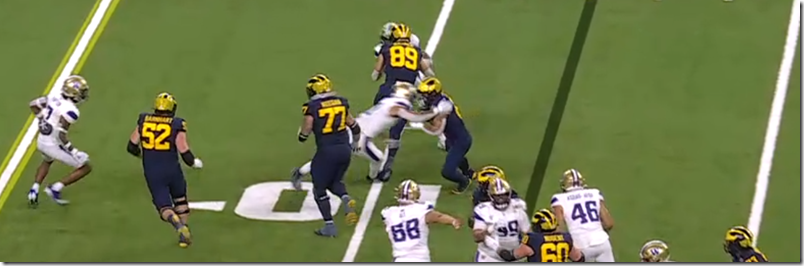
To describe this act as "futile" doesn't capture it. Bail out your boat with a colander. Watch the first season of a quirky sci-fi Netflix drama. Attempt to get to a destination flying Spirit Airlines. These are all as likely to get you to a satisfactory conclusion as tackling Blake Fucking Corum by the shoulder pads. Especially when you're not even square to the guy. Corum shakes like he's Ryan Day watching Lou Holtz say something true and the linebacker falls off; Keegan and Barnhart put the last guy in the center of the Earth. Ballgame.
Almost, anyway. Close enough when you have approximately two of the best defenses in America on one team.
-----------------------------------------------------------------
I still read physical books. I also have a disease wherein if I start a book I have to finish it, even if I loathe it. ("Of course you do," sighs every single person who's ever encountered this blog.) Sometimes when I finish one it is a great relief to have that trial in the rear-view mirror. I slam the book back onto the shelf, where it will sit for the end of time, remembered but never encountered again.
Sometimes the end of a book is a tragedy because it gave something to me and now it is over. There is no more of it. When this happens I close the book and hold it in my hands, turning it back and forth, looking at the back cover and front, reading the silly blurbs on it for the first time if it happens to have them. I think about what just happened, and while I know I cannot ever have the experience of encountering this for the first time again I know that it will go back on the shelf, too, and I can revisit it when I want to get a shadow of the feeling I had the first time.
I've mentioned this before: once that happened immediately, when I was frustrated by Infinite Jest's sudden, indeterminate stop and shifting timelines. Remembering something from the beginning of the book that I could connect with something towards the end, I flipped back to it, and after a while I realized that David Foster Wallace had pulled one over on the ol' Brian Cook. I mentally issued DFW the Robert Deniro finger wag meme. I did not actually get stuck in a loop of reading Infinite Jest, getting mad at it, and reading it again, like I was someone who had encountered The Entertainment in real life.
I thought about it, though.
-------------------------------------------------------------------
Afterwards, I waited. I wanted to see the last I could see of those who had just finished their Michigan careers. The next time Blake Corum takes a snap he will not be wearing a winged helmet and there will be something subtly wrong with the universe, so I watched him walk through the tunnel 20 minutes after the game. Donovan Edwards, Mike Barrett, an assemblage of walk-ons who are doing their part by convincing OSU fans that Michigan has 44 seniors and will go 3-9 next year. Every one a champion.
Sainristil was the last one. He came over to the section by the tunnel where the players' families were camped, and his dad held his legs and lifted him so he could talk to someone there. Then he came down, took pictures, and gave an impromptu interview that I imagine was the most polished post-championship interview in the history of the genre.
A stadium worker came down to kick us out. I did not move. She then came down to kick me out, specifically, because I was the last one in the section, and mercifully this was the moment that Sainristil had discharged all his on-field obligations and could stride down the tunnel to the locker room, also a champion. The last champion.
Now we close the book, and turn it back and forth in our hands. The shelf can wait a little while longer.
[After THE JUMP: Awards! And an apology that the bric-a-brac is coming tomorrow!]


9/30/2023 – Michigan 45, Nebraska 7 – 5-0, 2-0 Big Ten
This column is about being grateful but first a digression into obscure lexicography, as the readership demands. Despite an Atlantic article that accidentally implies that the noun "fantods" was a neologism sprouted from David Foster Wallace's mother, Merriam Webster asserts that Charles Fredrick Briggs deployed in 1839; indeed, it actually found its way in to Huckleberry Finn:
"They was all nice pictures, I reckon, but I didn't somehow seem to take to them, because … they always give me the fantods."
I think it is probable that DFW's mother is the originator of the phrase "howling fantods," which does feel like a temple erected on top of a previous religion's foundation. Fantods are one thing. When they howl, wow. Buddy. I mean. It's not good.
I was put in this frame of mind in the midst of Michigan's comprehensive dismantling of Nebraska because whilst I was enjoying myself, many other sports fans were not. I was particularly affected by two morose persons in particular. One was Robert Rosenthal, who goes by @alioneye on Twitter and is very likely the world's most dedicated Illinois fan. Illinois is coming off a promising season, and as directed by the laws of Illinois football that means they must immediately descend into the Earth's mantle. Ryan Walters, until recently the Illinois defensive coordinator, provided that via means of a 44-19 hamblasting at the hands of Purdue. Here is a place I have been:
Found it: https://t.co/7g5yifZnba
— Robert Rosenthal (@ALionEye) September 30, 2023
I have been in the Place Of Cheese, except it was more like, you know, alcohol. At some point in the Rodriguez era I responded to news of Troy Woolfolk's injury with a burst of tweets that resulted in this exchange…
@mgoblog you are a grown man drinking tea at 9pm - things are looking VERY down
— TigerCub33 (@Tigercub33) August 18, 2010
…and me hurriedly explaining that yes I was drinking tea but, like Fred Jackson, I was also drinking several other things that may or may not kill me and that I was not entirely certain which outcome I was hoping for. After the JT Was (Probably Not) Short game I poured a double of Lagavulin 16 and wandered around in the wooded area behind my home for 45 minutes before returning to reality. Did it help? Absolutely. Enough? No.
-------------------------
Depressed sports fan number two was Roger Bennett of Men In Blazers, who is apparently a fan of both Everton and the Chicago Bears. If you responded to this information with a sort of low, keening, sympathetic howl you know more about the EPL and NFL than I do but I saw this from Roger this weekend and thought "I literally wrote this except it was a 600-word column":
Sports fandom meant to be a joy. A diversion. An alternate universe rife with wonder. Not the teams I support. Peddlers only of misery, self-loathing, and pain. A stark reminder only of the truth: Life has no meaning and we are all going to Die pic.twitter.com/XJIjfDw76U
— roger bennett (@rogbennett) October 1, 2023
I first ran across Bennett during the 2014 World Cup, when Men In Blazers was a sort of late-night World Cup recap show on ESPN, and loved their general exuberance about things. To see Bennett brought so low by the things he loves is a grim reminder that two years ago I was declaring Michigan football the least fun program in the whole of sports. And… I mean… it kind of was.
Now that we are not beset by howling fantods about sports we should take a minute to appreciate that this team is not only good but also very fun. After JJ McCarthy scrambled for a 20-yard touchdown, FOX's mics picked him up saying "thank you so much boys" to his offensive line after demanding pretend corn. After Corum walked in later he pretended to salt the OL's corn. Jim Harbaugh reached unprecedented levels of football dad in the locker room after the game:
Jim Harbaugh: “It just came to me that we ought to sing ‘For He’s a Jolly Good Fellow’ to Kenneth Grant for that amazing play that he made. … First time I’ve ever asked a team to sing, ‘For He’s A Jolly Good Fellow.’ It just came over us. The guys liked it. I think it’s a…
— Alejandro Zúñiga (@ByAZuniga) October 1, 2023
The levels of dad Harbaugh is reaching are potentially dangerous, but if there's a fanbase in the country who can adapt and survive it's this one:
This is why @CoachJim4UM is the perfect coach for Michigan, and Michigan is the perfect place for Coach Harbaugh:
— Jordan Acker (@JordanAckerMI) October 2, 2023
Since @ByAZuniga posted this, I've received 2 emails about it, both from Michigan fans explaining the origin of the song at a French battle in the early 1700s. https://t.co/9RnthAEe9z
I don't know where this season is going to end up but I'm delighted that I get to spend some time with these guys every Saturday.
AWARDS
Known Friends and Trusted Agents Of The Week
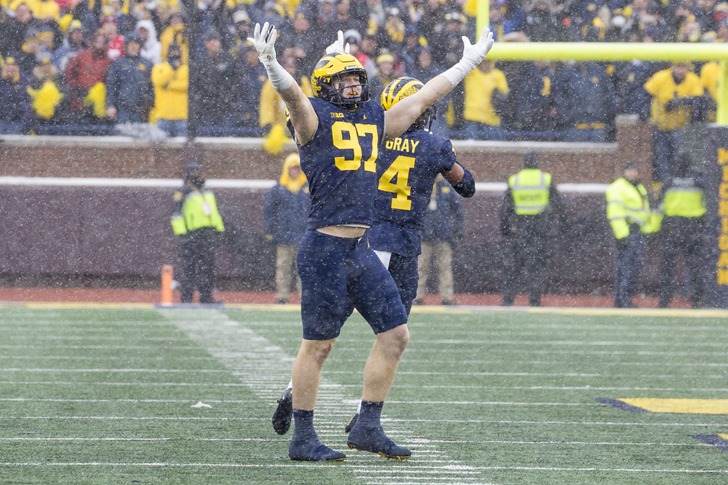
box score shmocks score [Barron]
![-2535ac8789d1b499[1]](https://mgoblog.com/sites/mgoblog.com/files/images/537fc4d56c20_9177/-2535ac8789d1b4991f1c37dee-a502-44d9-94ed-bee425f87474.jpg)
#1 Kris Jenkins. Notched a total of two tackles; don't care. On review of the game he was never successfully blocked. Never. I'm sure Seth will find a couple of counter-examples but Jenkins was a primary reason Nebraska's somewhat vaunted ground game went exactly nowhere.
#2 Braiden McGregor. Very hard to pick out another defensive player for the usual reasons—no snaps, everyone does like one thing—but McGregor did three things in this game: he forced the interception with a batted pass that went sky-high, he shoved a tight end into Haarberg on Nebraska's failed fourth and one, and he (like many others) showed Tyler Corcoran his own intestines en route to a sack.
#3 Roman Wilson. You make that catch, you get to be a Known Friend and Trusted Agent.
Honorable mention: JJ McCarthy averaged nearly ten yards an attempt, scored a scramble TD, ate imaginary corn, thanked his linemen to a national television audience, and kissed his girl with twenty minutes left in the game. Only sixteen attempts, though? AJ Barner and Max Bredeson continue to mash faces. Derrick Moore had a strip-sack, a batted pass, and another hurry. Blake Corum weaved through dudes.
KFaTAotW Standings.
(points: #1: 8, #2: 5, #3: 3, HMs one each. Ties result in somewhat arbitrary assignments.)
22: JJ McCarthy (#1 ECU, #1 UNLV, #2 Rutgers, HM Nebraska), Kris Jenkins (HM ECU, T2 UNLV, #1 BGSU, HM Rutgers, #1 Nebraska)
11: Mike Sainristil (T3 ECU, HM BGSU, #1 Rutgers)
9: Roman Wilson (T2 ECU, HM UNLV, HM BGSU, #3 Nebraska), Blake Corum (HM ECU, HM UNLV, #2 BGSU, HM Rutgers, HM Neb)
7: Braiden McGregor(T3 UNLV, #2 Nebraska)
6: Kenneth Grant (T3 ECU, T2 UNLV), Cornelius Johnson (T2 ECU, HM UNLV, HM BGSU)
5: Mason Graham (HM ECU, T2 UNLV), Junior Colson (#3 BGSU, T3 Rutgers)
4: Ernest Hausmann (T3 ECU, T3 Rutgers)
3: Mike Barrett (HM UNLV, T3 Rutgers)
2: Josh Wallace (T3 ECU), Derrick Moore (T3 UNLV), Jaylen Harrell (HM UNLV, HM BGSU), AJ Barner (HM BGSU, HM Neb), Max Bredeson (HM Rutgers, HM Neb)
1: Tommy Doman (HM ECU), Donovan Edwards (HM ECU), Tyler Morris (HM UNLV), Semaj Morgan (HM Rutgers), Colston Loveland (HM Rutgers), Quinten Johnson (HM Rutgers), Derrick Moore (HM Neb)
Who's Got It Better Than Us(?) Of The Week
Roman Wilson provides his version of the Prothro.
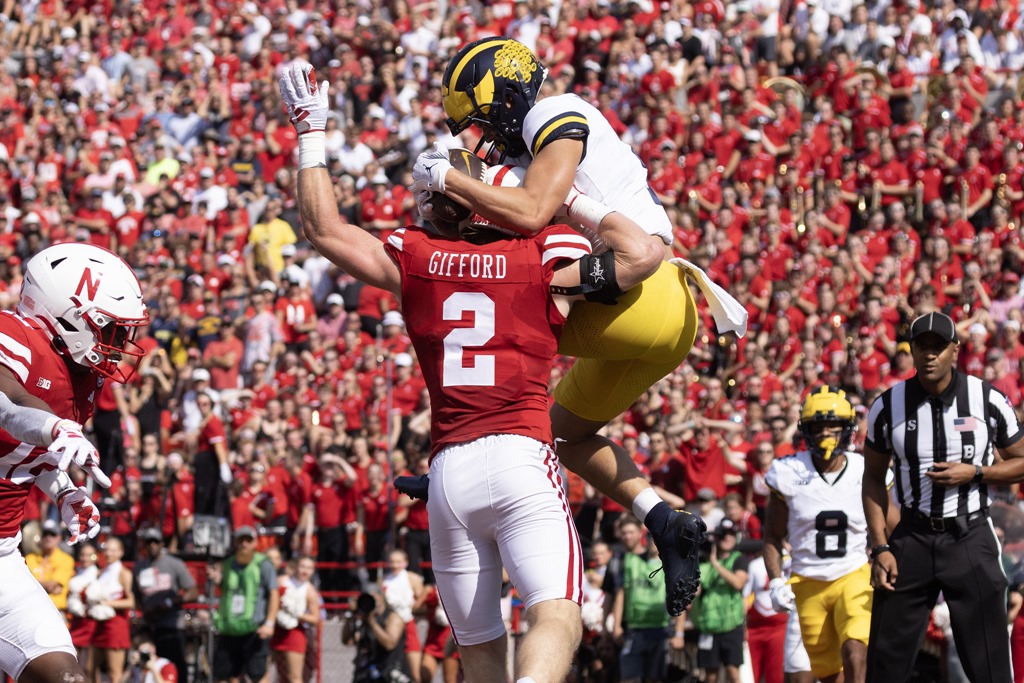
[Barron]
Honorable mention: Kenneth Grant intercepts Nebraska's second play from scrimmage thanks to a McGregor bat; McCarthy rolls away from pressure and fires in a thirty-yard laser for another Wilson TD; Michigan coaches succumb to the clamoring of the internet and agree to call a flea flicker every game.
 MARCUS HALL EPIC DOUBLE BIRD OF THE WEEK.
Uh… Tyler Morris muffed a punt, which he then returned for 30 yards?
Honorable mention: A couple of long completions on slants are irritating.
Sponsor Note. If you're in the market for high-quality cannabis at reasonable prices and want to feel like you're in a spaceship while shopping, Information Entropy is the place.

They're open until 8 now and provide free delivery. They're also family-owned by locals; Drew is a Michigan alum. Also: 10% off if you mention MGoBlog. I suggest mentioning MGoBlog by sidling up to someone there and whispering it at almost sub-vocal levels. Let's make it weird. This is a good way to keep a sponsor.
POY/COY. Congratulations to Naz Hillmon, the Big Ten's women's basketball player of the year. Hillmon averaged 25 and 11 while shooting 65% from the floor. That'll do. Congratulations are also in order for Juwan Howard, the Sporting News MBB coach of the year.
Yes I will link a retrospective of Trey Burke stealing the ball from Keith Appling. This is a thing I will do:
“As soon as we turned the ball over, I started thinking of ways to get the ball back, like, ‘we’ve gotta get the ball back, or they’re gonna hold for the last shot,’ ” Burke told the Daily in a phone interview this week. “My mind automatically went to getting the steal.”
Matched up against Keith Appling, the Spartans’ star guard, Burke knew what to look for. Appling dribbled the ball up past half-court and turned his head towards Michigan State coach Tom Izzo. As Appling asked for a play call, his right hand was exposed. Despite the Spartans being in the double-bonus, Burke went for the steal.
“I had gotten it on a few other guards that year, but Keith Appling usually wouldn’t leave the ball there,” Burke said. “He usually would spin with the ball in the right hand, with his outside hand, so you can’t get it.”
It's Duncan Robinson content Tuesday. First, a preview of his interview with one half of Men In Blazers cites one DFW:
Inspired by the words of David Foster Wallace, Duncan Robinson explains to Rog how he acts as a "conscious participant" in his own life, on and off the court.
— Men in Blazers (@MenInBlazers) March 8, 2021
The @MiamiHEAT player joins us this WEDNESDAY. @D_Bo20 is proper @ManCityUS. Airs 3:30 pm ET on NBCSN @NBCSportsSoccer. pic.twitter.com/BEFhsaZLoq
I was initially surprised by this and then created a mental list of athletes most likely to cite David Foster Wallace. "Guy who went to Williams" for a year topped it.
Second, how Robinson went from the G-League to an NBA record-setter:
https://www.youtube.com/watch?v=0tOjr9OJxQI
He also tops the most unlikely pro star list.
[After THE JUMP: in which the common sense of the hockey committee is relied upon]
168