full cost of attedance scholarships
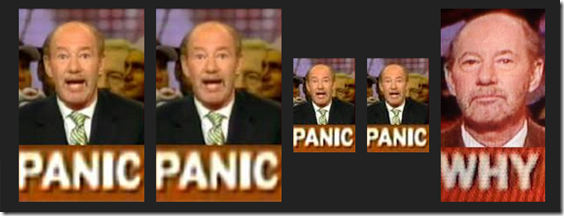
sometimes google image search is art
We are not worried about this frivolous lawsuit. NCAA Football is dead, you guys:
NCAA will not renew EA Sports contract
The NCAA has made the decision not to enter a new contract for the license of its name and logo for the EA Sports NCAA Football video game. The current contract expires in June 2014, but our timing is based on the need to provide EA notice for future planning. As a result, the NCAA Football 2014 video game will be the last to include the NCAA’s name and logo. We are confident in our legal position regarding the use of our trademarks in video games. But given the current business climate and costs of litigation, we determined participating in this game is not in the best interests of the NCAA.
Paired with the credit-rating downgrade the NCAA just received, that sounds like a team of lawyers running around in circles shouting "THINK OF SOMETHING" to each other. Most favored bomb-thrower Patrick Hruby:
What gives is lawyer-ese. The NCAA is never going to publicly say that the O’Bannon case has them scared, because that would imply they’ve done something wrong and therefore have reason to be afraid of adjudication. However, the current facts of the case don’t look good for it: O’Bannon’s claim is rooted allegations that the NCAA and co-defendants EA Sports and the Collegiate Licensing Company colluded to profit from the unauthorized use of former players’ NILs – price-fixing their value at zero – and documents uncovered by the plaintiffs’ lawyers during discovery strongly support said allegatioons.
The other tell? Check out the rest of the NCAA’s brief statement, which says that “given the current business climate and costs of litigation, we determined participating in this game is not in the best interests of the NCAA.” (Bold added.) In this case, current business climate and costs of litigation are lawyer-ese for ruh-roh.
Individual schools and conference can still license their trademarks to EA. Will they? I'm guessing yes, as Kotaku explains that most of the licensing is through the CLC, making the NCAA's decision "nearly a technicality."
If not get ready for EA Sports Football Type Substance And Incredibly Easy To Edit Thing 2015. Back in the day when I was playing the college version of Front Office Football I had to download a file to turn "South Bend" into "Notre Dame," and such, but it's a lot harder to import winged helmets than change names.
Shots fired. Will Muschamp is pretty cheesed off at Urbs, you guys. SEC Media days are ongoing, and Muschamp's turn at the tiller included this gem:
Muschamp, who succeeded Meyer as the Gators' coach, is even borrowing a page from Michigan coach Brady Hoke, who won't even call Ohio State by its full name.
"That's really a dead issue with me," Muschamp said Tuesday at SEC media days. "In both situations, we were turned in by Ohio. We didn't do anything wrong. The University of Florida didn't do anything wrong. And so we appreciated our friends from Ohio making sure we're compliant with NCAA rules. They certainly know a little bit about that subject."
That zing was followed up by a personal shot at Urban Meyer for fostering a murderer he is responsible for. No, seriously:
"You can’t expect a coach to know where all 125 players are all the time," Muschamp said. "But you also can’t stick your head in the sand and think everything is OK. You're 100 percent responsible."
Arrest Urban Meyer! Unless that would help his recruiting, which it might. Arrest Urban Meyer or take a picture of him checking out a Justin Beiber concert?
I hope you guys are better at real defense than computer defense. Ondre Pipkins played Dymonte Thomas in NCAA and came out with a screenshot that is just all kinds of wrong:
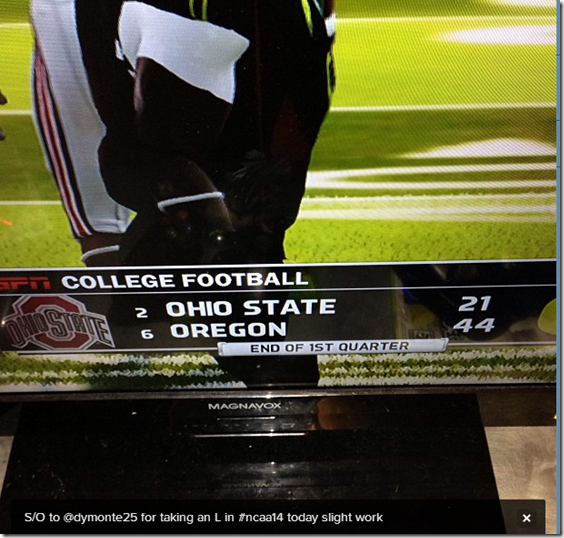
Are these 30 minute quarters? Why are you taking Ohio State? Why has Ohio State scored if that was the case? What is going on? IS URBS GOING TO FLIP DYMONTE?
Slive pushing. Self-interest, sure, but self interest in the name of providing a fig leaf of player compensation is better than the alternative:
"The NCAA has not been successful in meeting the full cost of attendance of our student athletes, whether through the so-called miscellaneous expense allowance or some other model that provides broad access to additional funds," said Slive, about to begin his 12th year as commissioner.
The issue, in a nutshell, is that some schools can afford to pay the stipend and some can't. Those that can't are able to keep the idea bottled up. Those that can, like schools in the SEC, are getting tired of it.
"Conferences and their member institutions must be allowed to meet the needs of their student-athletes," Slive said.
Slive followed up by saying that in meetings with other conference commissioners "there appears to be a willingness" to go through with a cost of attendance adjustment, at least until individual schools submarine it through the override process.
Mitch staying. SI spotlights Mitch McGary in a manner that'll get your salivary glands going:
When he submitted his name to the NBA's draft advisory board, McGary was told what he already suspected: He was a surefire first-round pick, and very possibly a lottery pick. The vast majority of college players would have jumped at that opportunity, but McGary defied convention and announced he would stay in school. "I want to prove to people that my potential is much greater than what I showed," McGary explained. "The way I look at it is, so far I've only cracked the glass. Next year I'm trying to break through it."
McGary is down to around 255 after starting last season twenty pounds heavier—too heavy—and you could see the increased stamina and athleticism late. That was the #2 recruit in the country, and Michigan figures to get that this year.
TSN's Mike DeCourcy, meanwhile, says McGary is still a load even at the lighter weight:
4. Jadeveon Clowney was a big topic of conversation at SEC Media Days. What current college hoops player could take your head off if he played football?
DeCourcy: Michigan’s Mitch McGary. Not messing with that dude. If Mitch had been the Wolverine in possession of that football instead of Vincent Smith back in the Outback Bowl, it might have been Clowney whose helmet went flying.
So much for that. If you were hoping that Fox Sports 1 would be an alternative to ESPN, it will, but not in the way you want:
…to differentiate FS1, to lend it personality and create a distinct brand, Fox is going with a concept that David Hill, chief executive officer of Fox Sports, calls “jockularity.” The plan is for FS1 to be the funny, irreverent, less serious sports channel.
Among other things, that involves hiring a couple of Canadian pranksters to anchor the network’s flagship program and building another show around Regis Philbin.
So much for that unless the Canadian is Norm Macdonald.
Never say die. The Big Ten has created a new bowl at Ford Field, but the Pizza Bowl guys won't let it die:
Ken Hoffman feels there’s no reason Ford Field can’t handle playing host to two bowl games starting in 2014.
Hoffman’s Little Caesars Pizza Bowl was on the outside looking in following the news Wednesday the Detroit Lions bowl game was official, starting Dec. 30, 2014, with a Big Ten team going up against a team from another power conference.
Guys. It's over.
Etc.: Eleven Warriors' guide to visiting Ann Arbor is seemingly designed to get you to dislike Ann Arbor, but I guess it's aimed at guys who get ATV catalogs. Pro sports attendance beginning to suffer in baseball and basketball. Average Boston Red Sox ticket cost: 88 dollars! FIFA can't sell the World Cup to pay-TV in the UK.
Music City Bowl will pit an SEC team versus an ACC/B10 team for the next five years. A la carte ESPN projected cost: 30 bucks. Thanks, people who don't care about sports but pay for ESPN anyway. Old man yells at cloud. Potential VCU rematch in the second round of Puerto Rico.

The Old Man is coming. The Old Man.
![image_thumb173[1]](https://mgoblog.com/sites/mgoblog.com/files/images/UV_D651/image_thumb1731.png "image_thumb173[1]")
The Old Man is coming.
The McCrayken is alive. All of the internets to user mdoc, who responded to the winged-helmet-kraken request instantly:
![6962778889_6054f75199_z[1]](https://mgoblog.com/sites/mgoblog.com/files/images/UV_D651/6962778889_6054f75199_z1.jpg "6962778889_6054f75199_z[1]")
This blog is rooting for Mike McCray to be a destructive force so hard.
Penn State's death has been greatly exaggerated. OR: look what we can do when we have a head coach! PSU's 2012 class was terrible. All their good recruits ended up with Urban Meyer and they replaced them with two stars snatched from the MAC. That's going to hurt for a while. Despite that, Nittany Lions fans are probably feeling more chipper than they thought they would about their program's intermediate-term prospects. They've recently swooped in on the following recruits:
- QB Christian Hackenberg, a consensus four star claiming offers from Alabama and Florida.
- DE Garrett Sickels, who is rated a lot like Mike McCray (ie: top 50 on Rivals, solid four-star elsewhere)
- CB Ross Douglas, a three/four star tweener.
They are almost certain to add five-star-ish TE Adam Breneman tomorrow. By doing so they've become the only Big Ten team kind of sort of keeping up with the big two when it comes to shiny stars next to high schoolers' names. The Sandusky effect is looking pretty short-lived.
All you have to do is look at OSU's last class to know that this is good for Michigan. A strong Penn State takes recruits from teams who play Michigan all the time and puts them on one that plays Michigan 40% of the time; also it would be really nice if there was someone strong enough in the East to prevent an annoying B10 championship game instant rematch.
I'm with Fitz, sort of. Pat Fitzgerald does not want 6-6 teams to be excluded from bowl consideration:
Northwestern coach Pat Fitzgerald hopes the Big Ten does not support potential legislation to limit bowl games to teams with at least seven wins.
"The best part of bowl games is about the opportunities -- not just the teams, but for your students, your fans, your alumni, your fans in the area," Fitzgerald told the Tribune on Tuesday. "I'm not for limiting it."
Paging Captain Renault. I agree that if a couple teams want to play some football it's better than watching ping-pong, but I'm not a fan of goofs in blazers bleeding college tuition out of the system. Leave it at 6-6 and severely reduce ticket guarantees. That will cause a bunch of bowls to collapse and solve the problem organically.
And this is 95% of the reason I linked the article:
"I'm not for five-win teams even being able to receive a waiver," Fitzgerald said. "That's tough noogies. If you have a losing record, you are out. A .500 record should be the benchmark."
I love Pat Fitzgerald. May he coach at Northwestern for 30 years.
![CONFUSED-FITZGERALD[1]](https://mgoblog.com/sites/mgoblog.com/files/images/UV_D651/CONFUSED-FITZGERALD1.gif "CONFUSED-FITZGERALD[1]")
Al Borges and the interesting things. Borges was on the Huge show recently and the resulting conversation had an unusual density of interesting things said. Borges admits that the early-season (and Iowa) forays into a more pro-style offense were a mistake:
"I think had we had to do it over again, we would have been a little more spread offense early on and gotten better at that. We kind of weaned ourselves into more spread offense as we went. That's really what was best for Denard at the end of the day."
He also makes a great observation about where Denard is at his most dangerous in the passing game:
"Denard is better in the pocket than rolling out," Borges said. "The thing with Denard, where he scares the defense the most, is when he sits in the middle of the pocket, comes underneath the rush, and poses not just a passing threat to the defense, but a running threat too. If you roll him out all the time a lot of time what they did is they would pin us into the sideline where Denard's improv skills aren't used near as much."
Whole thing is recommended. Borges references the "drastic leap" from year one to year two in his passing game. If Denard can just set his feet regularly and not throw into double coverage, Michigan will be cooking.
Sounds good to me. Andy Staples has a fascinating article on the potential impact of full cost of attendance scholarships:
For years, doomsayers have predicted a scenario in which the wealthiest 50 or 60 schools compete only against one another. If such a scenario ever came to fruition, it would have its roots in the debate over the full-cost-of-attendance scholarship.
Doomsayers? As long as we're talking about football here that sounds like heaven.
The article goes into arguments both for and against, with the small schools making arguments that moving some of the money currently going to coaches and facilities to players exacerbates competitive inequity. They don't make the case that this isn't a good thing, and then Nebraska's chancellor just blows it up anyway:
"You can tell me that I can't give them bagels with cream cheese and I can't give them more scholarships and I can't do this and I can't do that, and I follow those rules," Perlman said. "But then what I do to recruit competitively is I spend the money on other stuff. So I build facilities where there is no limit on what I can do, and I make those facilities far beyond what normal students live in because there's no limit on that. There's a standard understanding about regulatory environments that if you regulate something, people will move to the part of their activity that isn't regulated."
At worst the proposal takes the middleman out of competitive inequity.
It sounds like the big schools are getting increasingly exasperated with small schools with no financial weight imposing restrictions on them because they like to pretend they're DI schools when they're really just Indiana State. Eventually some sort of split is coming.
BONUS WASHINGTON PRESIDENT MICHAEL YOUNG PROBABLY WORKS FOR ADULT SWIM ZINGER:
"The kids who are on solely need-based aid can basically work 20 hours a week or whatever and earn a little pizza money or earn a little money for tattoos or whatever they want," Young said, tongue planted firmly in cheek. "Our athletes, on the other hand, work 40-50 hours a week for the school, and they don't get anything except what these other kids get without having to work for it. It seems when one thinks about simple equity, from that perspective, it's hard to argue that these kids shouldn't get something."
You're all right, Washington president Michael Young.
Wat. Brady Hoke is going to loathe this:
Hoke, Beilein and Brandon —along with U-M softball coach Carol Hutchins and a handful of business professors— will host a six-day executive education program intended to teach business leadership through lessons learned in U-M sports. Those lessons, according to a recent U-M announcement, include the trick to "transformations in times of crisis," as well as how to teach people "new ways of doing things" and how to "take on fierce competitors and produce winning results."
Only $15,000! Some people have too much money.
Etc.: Possibly random Hardaway renaissance is retconned into narrative. Please be true, narrative. Mitch McGary's "defensive impact" draws high praise—that would be nice, wouldn't it? If you've got ESPN insider this Wolverine Nation piece in which recruits are anonymously surveyed on recruiting tactics they've faced is a must-read. Excellent Yost student section retrospective. John Beilein for everything.
Trade mag article on how Michigan Stadium amplified the band. Maybe next year they'll have a piece on how they made it sound better in section 44. : (
![samtheeaglethefirstavengermain[1]](https://mgoblog.com/sites/mgoblog.com/files/samtheeaglethefirstavengermain1.jpg "samtheeaglethefirstavengermain[1]")
![napoleon[1]](https://mgoblog.com/sites/mgoblog.com/files/napoleon1.jpg "napoleon[1]")
JIM DELANY VS THE COLONIAL ATHLETIC ASSOCIATION: FIGHT
[UPDATE: Original credit for the PDF should go to Christian Dennie. Andy Staples also has a good piece on this.]
Get the Picture unearths the reasons given by 100+ schools for overriding the $2k stipend recently adopted at the behest of the Big Ten and SEC. Two of them are BCS schools: Wake Forest and Rutgers. Rutgers manages to lose buckets of money, so that's obvious. Both schools bring up the Title IX implications as their reasoning, and even if I don't agree with how Title IX is implemented that's a federal mandate you can't get around. It's a legal concern.
Anyway, some of the reasons presented by smaller schools are valid:
The way this legislation was adopted was through channels intended for emergency or non-controversial issues. Neither applies in this case. [Miami (Not That Miami)]
Another reason for overriding this legislation should be the need to at least eliminate its application to FCS football. The football championship division exists because there are about 120 Division I institutions that sponsor football programs and choose to spend less on scholarships, coaching staffs, etc. than the Division I FBS members. Taking a stand against the Cost of Attendance, at least for FCS football, would be consistent with this philosophy. [Tennessee-Martin]
However, many are fist-shakingly cynical, totally oblivious, and/or as misspelled as this blog's "full cost of attedance [sic] scholarships" tag:
The insitution [sic] is not in a position to fund the additional costs associated with the miscellaneous expense. Many institutions are likely to be in the same position which would create a competitive advantage for those insitutions [sic] who had [sic] large budgets [Marshall]
Trying to legislate cost saving in other areas, while adding this potential hugh [sic] expense to institutions [Maryland-Baltimore County]
2011-96 provides an unfair disadvantage to smaller institutions that will struggle to find the funds necessary to provide the additional $2,000 to student-athletes. Some schools may only be able to provide these funds to their revenue producing sports by pulling money away from their other sports which could have a negative impact on the student-athletes involved in those sports. [Wright State]
"Unfair"? Unfair? IS THIS AMERICA OR NOT, YOU LILY-LIVERED PINKOS AT WRIGHT STATE? THIS IS CAPITALISM YO, SINK OR SWIM LOVE IT OR LEAVE IT.
We are a "have-not." This rule benefits the Division I "haves" and would widen the chasm between "BCS" schools and non BCS schools. [Southeastern Louisiana]
Southeastern Louisiana's 2010 athletic department budget shows about 2.5 million in actual money taken in*, almost half of which consists of NCAA distributions from basketball tournament revenue and guarantee games from bigger schools. They should take their 1.1 million a year and say "yes, sir" if they want to keep up the fiction they are capable of competing as a Division I school.
*[They claim 10m in revenues with 6.9 million of that "direct institutional support" and 660k in "indirect facilities and administrative support." Also who knows what the 260k listed as "other" consists of.]
The Board of Directors passed this legislation that will cost 75% of the membership millions of dollars they don’t have. In addition to the obvious costs there are gender-equity implications of this initiative that make the costs even higher. It's not realistic to maintain that this legislation is permissive and not acknowledge the costs it will create because of competitive equity. [Tennessee-Martin]
In 2006, Tennessee-Martin's annual budget for men's basketball was $134,264, 331st of 331 teams then competing in D-I. (Since then 14 additional schools have decided to add basketball programs.) They are making same argument NBA owners make when they demand CBAs that prevent them from throwing outrageous contracts at bad players.
And then there's this from Tennessee Tech:
I want to share a very supportive and knowledgeable university professor's view of this change in legislation. He writes "Perhaps my biggest grievance is the apparent insensitivity and bad timing involved. It seems most dubious to give some student athletes what amounts to "tattoo money" at a time when far too many others are unable to put food on the table, and the institutions themselves are almost all facing choices among various undesirable options.
I'm not sure whether to high five the guy for calling the stipend "tattoo money" or mock this tweed-jacket-with-elbow-patch-wearing pipe smoker for deploying "most dubious" and expecting people to take him seriously. We are not contemplating an invasion of the Hottentots. Your diction is invalid.
I've apparently gone with the mocking option. In retrospect, it was inevitable.
BONUS: A number of overrides have been submitted for the next proposal, 2011-97, which allows institutions to offer scholarships longer than a year. It's like Boise State just came to this planet:
When you combine 2001-97 [multi-year offers] with 2001-96 [FCOA] it creates a culture of brokering. For a prospective student-athlete, the decision as to where to attend college and participate in athletics is most likely the biggest decision they will make at that point in their lives. That tough decision becomes more complicated when the student and his/her family have to factor in what school "offers the best deal" versus where they may want to attend if all offers were for one year without the enticement of 2,000. [Boise State]
I don't even know where to start with this being portrayed as a negative. A "culture of brokering" sounds a lot like "the exact goal of the legislation."
The current system works. We don't need to get into bidding wars where one school offers a $75% for 2 years and the other school then offers 85% for 3, etc., etc. This puts the kid into a situation where they almost need an agent/advisor just to determine the best "deal." Again, if it isn't broke, don't fix it. [Indiana State]
The person who does this for Indiana State watches ice skating exhibitions on Saturdays instead of football. ISU also submitted overrides for every proposal that attempted to increase academic standards.
BTW, Rutgers also objects to this proposal making me think ill of their athletic department. Utah is the only other BCS school to submit an override (because the "Student-Athlete advisory council" is against it since "they feel it locks student-athletes in," which it doesn't, and "eliminates the potential for other athletes to receive aid," which it does by increasing degree completion rates).
With only 48 overrides in for 2011-97, it looks like multi-year grants will pass even if they open the schools up to a horrifying world wherein they have to compete in one of those market things. Commies.
46